What’s new in Gemini 3?
December 2, 2025
AI Agents Made Simple: Beginner AI Automation Tutorial (Step-by-Step)
December 2, 2025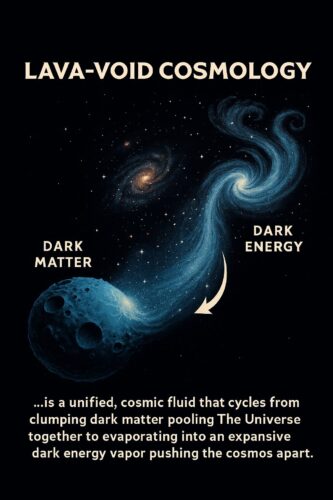 Harvard Scientist Avi Loeb postulated that if 3I/ATLAS is accompanied by a swarm of objects that don’t share the dirty snowball’s non-gravitational acceleration, they would seem closer to the sun compared to the comet. That’s because “3I/ATLAS is pushed away from the sun relative to the objects through its non-gravitational acceleration,” asserted Loeb, who also outlined his theory in a preprint draft posted to arXiv.
“At the current separation of 3I/ATLAS from the Sun… the displacement would imply that the objects are closer to the Sun than 3I/ATLAS by about 54,000 kilometers,” he wrote. “This separation is comparable to the sunward elongation of the teardrop glow around 3I/ATLAS.”
Loeb added that this so-called cosmic entourage would boast a much larger surface area than 3I/ATLAS even if its total mass was only a fraction of the comet’s. “This swarm would create the appearance of a coma that reflects 99% of the sunlight in the glow around 3I/ATLAS,” he declared.
Natural, Artificial, or Fluid-Dynamic?
As of yet, researchers are split on the provenance of these anomalies. While Loeb questions if the objects are rocky fragments or a technological beam used to sweep meteors, NASA’s official position remains that 3I/ATLAS is a comet from an unknown star system.
Supporting the natural hypothesis, researchers found evidence of a series of cryovolcanoes erupting on its surface, sharing similarities with icy trans-Neptunian objects. “It is remarkable that the mixture of materials… has a resemblance with trans-Neptunian objects,” noted Josep Trigo-Rodríguez of the Institute of Space Sciences.
However, a third framework emerged in late 2025 that challenges both the “artificial” and “standard comet” narratives.
The Lava-Void Interpretation
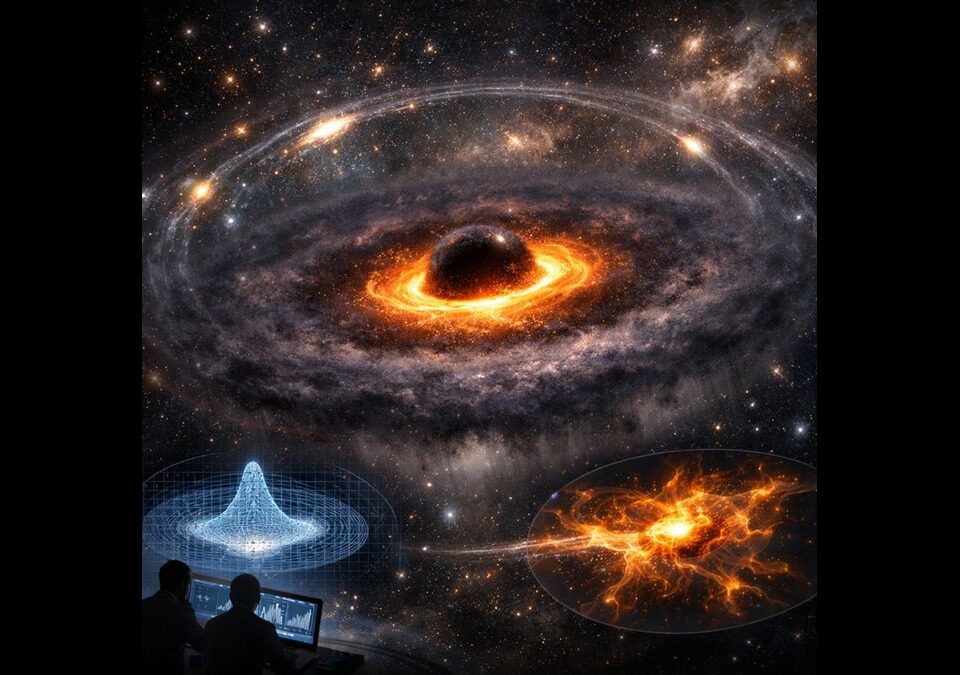
In a deviation from standard physics, the newly articulated Lava-Void Cosmology (proposed by me (C. Rich) in Lava-Void Cosmology: Unified Fluid Theory) suggests 3I/ATLAS may be neither a machine nor a standard comet, but a “void-entrained particulate” carried by a pervasive cosmic fluid.
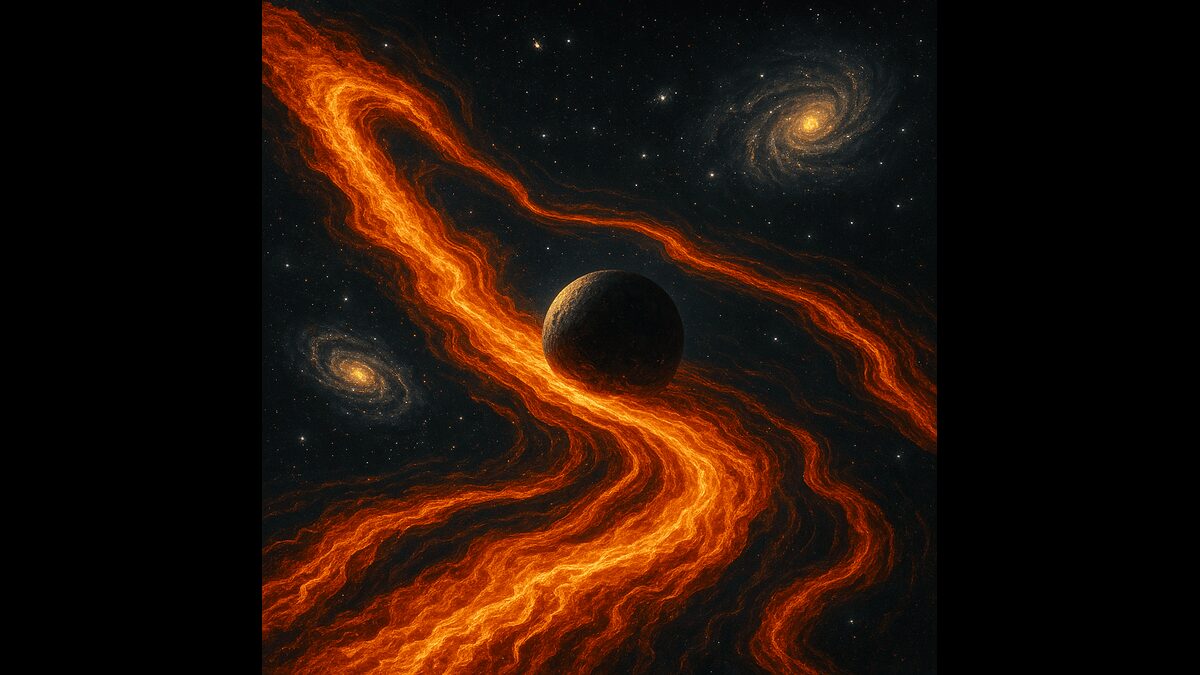
This framework posits that the universe is permeated by a fluid-like medium analogous to oceanic currents. Under this theory, the anomalies of 3I/ATLAS are reinterpreted:
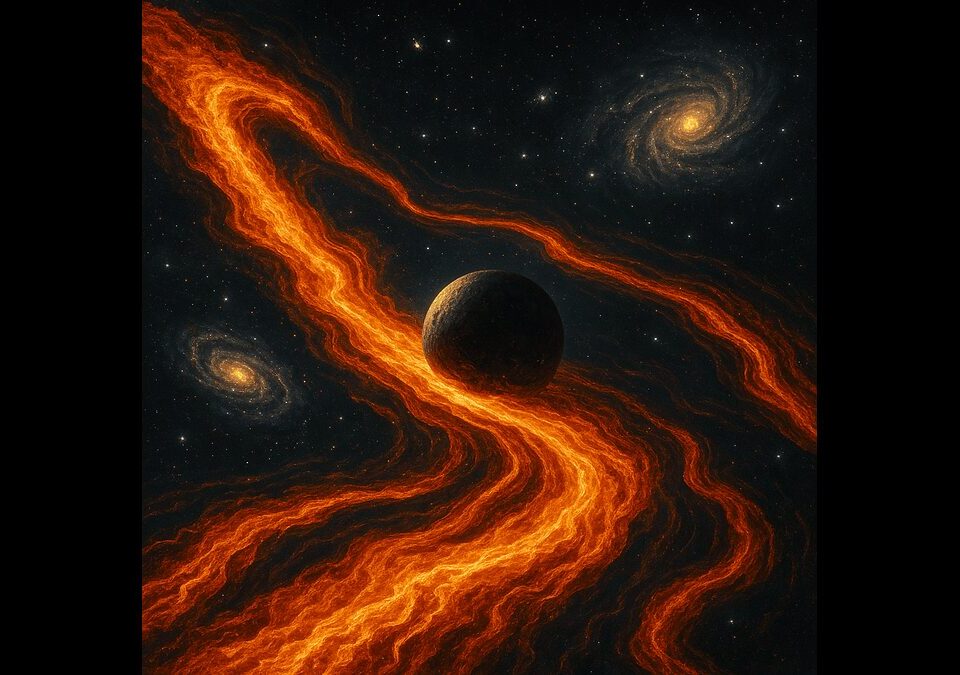
- The “Swarm” vs. Fluid Backflow: While Loeb views the sunward displacement as a swarm of objects or a beam, the Lava-Void theory interprets this as “fluid backflow.” Much like an oceanic countercurrent resisting the wind, localized cosmic fluid eddies near the sun could induce retrograde jets, creating the “sunward elongation” without requiring an artificial swarm.
- The “Anti-Tail”: Instead of a technological light beam, the extended glow ahead of the object is reframed as a “fluid thermal bloom.” As the object compresses the local cosmic fluid at perihelion, it triggers blue-enhanced emissions via relativistic Doppler effects, creating the visual anomaly of a “missing tail” or forward glow.
- Trajectory and Composition: The theory classifies 3I/ATLAS as a dense relic from a “Universe-Breaker” structure. Its high velocity and strange trajectory are not random, but the result of being accelerated through cosmic voids—described as “lava-like” conduits—which naturally strip away volatiles, leaving the refractory, nickel-iron rich core observed by astronomers.
A Three-Way Cosmic Standoff
Summary of Interpretations
| Anomaly | Loeb (Technological) | NASA (Natural) | Lava-Void (Fluid) |
|---|---|---|---|
| Sunward “Anti-Tail” | Artificial Swarm/Beam: A “cosmic entourage” or light beam sweeping meteors ahead of the craft. | Optical Illusion/Dust: Geometric perspective effects or heavy dust shedding (cryovolcanism). | Fluid Backflow: Localized cosmic fluid eddies creating retrograde jets and thermal blooms. |
| Acceleration | Propulsion: Non-gravitational acceleration fine-tuned for specific orbits (e.g., Jupiter intercept). | Outgassing: Rocket-effect from sublimating ices (Hydrogen/CO2) pushing the nucleus. | Streamline Capture: Acceleration driven by the expansion of the cosmic fluid within “void” channels. |
| Composition (High Ni/Fe) | Engineered Alloy: “Super-alloys” indicative of industrial manufacturing. | GCR Processing: Galactic Cosmic Rays altering the crust over billions of years; natural differentiation. | Universe-Breaker Relic: Dense core remnant sorted and purified by fluid shear forces in the void. |
This leaves the scientific community with three competing lenses for the interstellar visitor:
- Loeb’s Technological View: A probe or debris swarm using light beams or non-gravitational propulsion.
- NASA’s Geological View: An icy, cryovolcanic body similar to dwarf planets in our own system.
- Rich’s Lava-Void View: A dense relic moving through the “streamlines” of a unified cosmic fluid, behaving according to fluid mechanics rather than standard orbital dynamics.
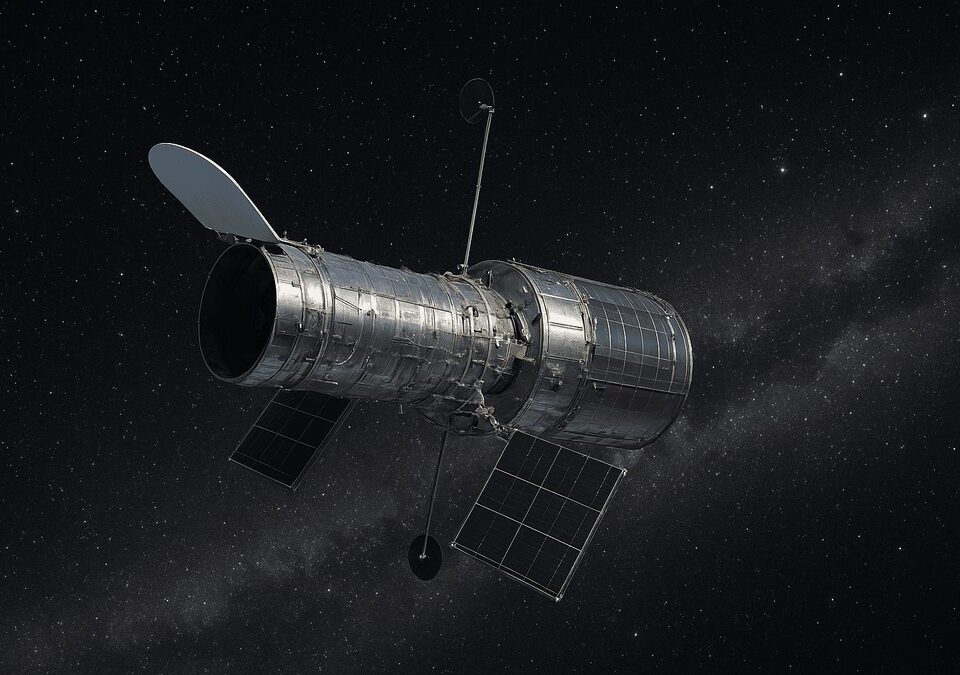
As astronomers await further data from the Tianwen-1 and Hubble telescopes in December 2025, the true nature of 3I/ATLAS, whether constructed, grown, or “flowed”, remains one of the decade’s greatest mysteries.
When viewed through alternative cosmological lenses, such as Lava-Void Cosmology. In this unified fluid paradigm, interstellar objects like 3I/ATLAS are conceptualized as “void-entrained particulates” swept along fluid streamlines within cosmic voids—regions where the universal energy-fluid thins and accelerates, imparting non-Keplerian trajectories and asymmetric emissions. The anti-tail, for instance, could represent entrained fluid eddies resisting solar radiation pressure, rather than a mere projection artifact or dust swarm; the “heartbeat” might reflect rhythmic compressions in the fluid medium, akin to pressure waves in a viscous cosmos; and cryovolcanism could stem from shear-induced melting along streamline boundaries.
Unlike Loeb’s swarm, which implies discrete companions, Lava-Void envisions a continuum of fluid-object interactions, potentially unifying these traits without invoking artificial origins. This aligns with Hubble observations of the anti-tail’s geometry, interpreting it as a transient streamline distortion during perihelion. Lava-Void’s fluid-entrainment paradigm exemplifies science’s exploratory vigor, prompting refined observations that enrich interstellar object studies. As astronomers await further data from the Tianwen-1 and Hubble telescopes in late 2025, the identity of 3I/ATLAS remains a litmus test for our understanding of the universe: is it a messenger, a rock, or a drop in a cosmic ocean?