DeepSeek Just Dropped Free AI That Destroys Every OCR Model
October 22, 2025
K2-18b and the Great Filter Theory
October 22, 2025
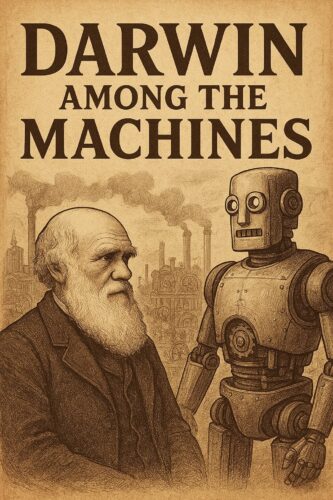
Darwin Among the Machines: The Rise of AGI
Darwin among the Machines is the title of the essay that introduces this philosophical idea. It was written by Samuel Butler, an English author and polymath, and published on June 13, 1863, in The Press, a newspaper in Christchurch, New Zealand.
In the essay, Butler applies principles of evolution, drawing from Charles Darwin’s theories, to argue that machines represent a new “kingdom” of life, evolving rapidly and surpassing humanity. He contends that humans, through technological progress, are inadvertently creating their successors, becoming increasingly subservient to these creations. Key passages include: “Day by day… the machines are gaining ground upon us; day by day we are becoming more subservient to them,” and “more men are daily bound down as slaves to tend them.” Butler warns of inevitable human enslavement and calls for the destruction of machines to avert this fate, framing it as an existential threat.
The temporal distance, over 160 years, from Butler’s composition in 1863 to our contemporary era of advanced artificial intelligence, lends his essay an almost prescient quality. In an age dominated by mechanical ingenuity rather than digital computation, Butler discerned patterns of technological evolution that mirror today’s concerns with automation and autonomy. This foresight underscores the enduring relevance of philosophical inquiry into human innovation.
Artificial General Intelligence (AGI) represents a pivotal milestone in the trajectory of technological evolution, one that strikingly echoes Samuel Butler’s apprehensions in “Darwin among the Machines.” Butler envisioned machines not merely as tools but as autonomous entities poised to eclipse human dominance through iterative self-improvement. This concept aligns closely with contemporary definitions of AGI as a system capable of understanding, learning, and applying intelligence across a broad spectrum of tasks at or beyond human levels.
In modern discourse, AGI evokes Butler’s warnings through its potential for recursive self-enhancement, often termed the “intelligence explosion,” where such systems could accelerate innovation far beyond human comprehension, rendering humanity ancillary or obsolete. Proponents like Ray Kurzweil foresee this convergence by the mid-21st century. This parallel underscores Butler’s insight: our pursuit of such capabilities may inadvertently forge a successor species, compelling a reevaluation of safeguards in AI governance.
This work is regarded as one of the earliest explorations of artificial intelligence risks and technological singularity concepts, influencing later thinkers in philosophy and science fiction. Samuel Butler’s prescience in 1863 is remarkable, particularly given the rudimentary state of machinery at the time when steam engines and telegraphs were the pinnacles of innovation. His essay not only anticipated the evolutionary trajectory of technology but also echoed Darwinian principles in a manner that prefigured modern debates on artificial superintelligence. It continues to resonate today, influencing thinkers from H.G. Wells to contemporary AI ethicists.
Acknowledgements: The author wishes to thank xAI’s Grok for its contribution to the initial hypothesis formulation and Google’s Gemini for editorial review and formatting assistance.
Buy Book
Copyright © 2025 “This blog emerged through a dialogue between human reflection and multiple AI systems, each contributing fragments of language and perspective that were woven into the whole.”