

Google Just Dropped VIBE Coding AI and It’s Powerful
October 28, 2025
Goodbye Context Limits: Tanka Launches AI That Remembers Everything
October 29, 2025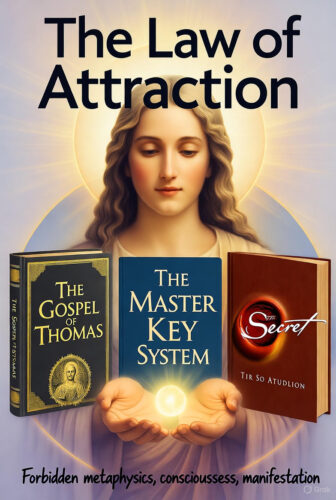
Forbidden Metaphysics Of Jesus & Others
The Power of Consciousness in Shaping Reality: A Continuum from Ancient Wisdom to Modern Manifestation
The notion that human consciousness possesses the profound capacity to influence and manifest external reality forms one of the most enduring philosophical and metaphysical threads in intellectual history. This principle, often articulated through the lens of the “Law of Attraction” in contemporary discourse, transcends temporal and cultural boundaries, manifesting in diverse forms across epochs.
At its core lies the conviction that thoughts, intentions, and inner states are not merely passive reflections of the world but active architects of it. This book elucidates the interconnected web of this concept, tracing its evolution from the esoteric sayings of the Gospel of Thomas in antiquity, through the systematic expositions of Charles F. Haanel’s The Master Key System in the early twentieth century, to Rhonda Byrne’s popularized The Secret in the twenty-first, while encompassing antecedent and successor traditions.
It further explores the “forbidden metaphysics” inherent in this lineage is the occult and suppressed dimensions that have rendered such ideas both revered and reviled. Through this analysis, a unified narrative emerges: a perennial wisdom rephrased across contexts, wherein the mind’s creative potency serves as the universal key to human potential.
The foundations of this conceptual web are deeply rooted in ancient spiritual traditions, where the interplay between inner perception and outer manifestation was first codified in mystical and philosophical texts. The Gospel of Thomas, a first or second-century semi-Gnostic compilation of Jesus’ sayings discovered in 1945 among the Nag Hammadi library, exemplifies this primordial insight. Unlike the canonical Gospels, which emphasize external miracles and eschatological kingdoms, the Gospel of Thomas directs attention inward, positing that the divine realm resides within the individual consciousness. Saying 3 declares, “The kingdom is inside of you, and it is outside of you. When you come to know yourselves, then you will become known, and you will realize that it is you who are the sons of the living father.”
Here, self-knowledge, achieved through contemplative alignment, unlocks a transformative power, implying that one’s internal state shapes the experiential world. This resonates with broader ancient precedents: Hermetic texts, such as the Corpus Hermeticum (circa 2nd-3rd century CE), attributed to Hermes Trismegistus, assert in the Kybalion (a 1908 distillation) that “the All is Mind; the Universe is Mental,” suggesting that vibration and mentalism are cosmic laws governing creation.
Similarly, Hindu scriptures such as the Upanishads (circa 800-200 BCE) describe sankalpa, resolute intention, as a force that molds reality through the illusion of maya, while Buddhist teachings in the Dhammapada (circa 3rd century BCE) proclaim, “All that we are is the result of what we have thought.” These traditions, predating the Gospel of Thomas by centuries, frame consciousness not as a spectator but as a co-creator, a motif echoed in Egyptian Book of the Dead incantations invoking thought to navigate the afterlife. Collectively, they form the ancient substratum of the web, portraying manifestation as an alchemical process of aligning the self with universal principles.
Transitioning to the modern era, this ancient undercurrent resurfaced and systematized within the New Thought movement of the nineteenth century, a philosophical renaissance that bridged esoteric mysticism with pragmatic self-improvement. Emerging amid the Second Great Awakening in America, New Thought synthesized Christian Science, mesmerism, and transcendentalism, emphasizing mental healing and affirmative thinking. Phineas Parkhurst Quimby, often deemed its progenitor (mid-1800s), posited that illness stemmed from erroneous beliefs, curable through “mind cure” which is a direct precursor to attraction principles.
His disciple Mary Baker Eddy formalized this in Science and Health with Key to the Scriptures (1875), while Emma Curtis Hopkins advanced it in Scientific Christian Mental Practice (1888), teaching that focused thought attracts corresponding conditions. The term “Law of Attraction” itself crystallized in print through Helena Petrovna Blavatsky’s theosophical Isis Unveiled (1877), where occult correspondences between thought and matter were invoked as a hidden universal law. Building on this, William Walker Atkinson, under pseudonyms like Yogi Ramacharaka, published Thought Vibration or the Law of Attraction in the Thought World (1906), explicitly linking mental polarity to material outcomes, a bridge from Victorian occultism to structured self-help.
It is within this fertile New Thought soil that Charles F. Haanel’s The Master Key System (1912) emerges as a pivotal node, distilling these ideas into a rigorous, 24-week correspondence course. Haanel, a successful businessman and Rosicrucian affiliate, articulated a metaphysics of causation wherein “thought is the only cause,” and the subconscious mind acts as a universal connector, drawing forth equivalents from the ether. He instructed readers in visualization and concentration techniques, asserting that harmonious mental states unlock “cosmic intelligence,” much like the inward kingdom of the Gospel of Thomas.
Haanel’s framework, emphasizing relaxation, affirmation, and the rejection of negative thought-forms, rephrased ancient gnosis in empirical terms, influencing contemporaries like Napoleon Hill’s Think and Grow Rich (1937), which integrated attraction principles with success psychology. This era’s works, including Thomas Troward’s The Edinburgh Lectures on Mental Science (1904), reinforced the web by portraying the universe as responsive to directed will, a secular echo of Hermetic as above, so below.
The continuum extends seamlessly into the post-World War II period and beyond, where the principles evolved into more accessible, narrative-driven formats. Neville Goddard (1905-1972), a Barbados-born mystic, amplified Haanel’s ideas in lectures like The Power of Awareness (1952), teaching “living in the end” is imagining desires as already fulfilled to impress the subconscious, thereby collapsing potential into actuality. Goddard’s biblical hermeneutics, interpreting scripture as psychological allegory, parallels the Gospel of Thomas’ non-literal esotericism.
Subsequent iterations include the Unity Church’s Ernest Holmes and his The Science of Mind (1926), which codified affirmative prayer, and the 1980s channeled works of Jane Roberts’ Seth Material, positing a multidimensional reality shaped by belief systems. The late twentieth century saw further democratization through figures like Shakti Gawain’s Creative Visualization (1978) and Louise Hay’s You Can Heal Your Life (1984), which applied attraction to personal healing.
Rhonda Byrne’s The Secret (2006) represents the apotheosis of this trajectory, catapulting the Law of Attraction into global pop culture via a multimedia phenomenon. Drawing explicitly from Haanel, quoting his dictum that “the law of attraction is really another name for love”, Byrne synthesizes New Thought with testimonials, framing manifestation as a three-step process: ask, believe, receive. This accessible vernacular masks deeper lineages, repackaging the Gospel of Thomas’ inner sovereignty as “vibrational alignment” and Haanel’s mental discipline as effortless positivity.
Post-The Secret, the web proliferates: Esther Hicks’ Abraham-Hicks teachings (1980s onward) introduce “emotional guidance systems” for alignment; Joe Dispenza’s Breaking the Habit of Being Yourself (2012) integrates neuroscience with quantum-inspired manifestation; and Gabrielle Bernstein’s Super Attractor (2019) blends spirituality with mindfulness. Even secular variants, like Carol Dweck’s growth mindset research in psychology, echo the principle indirectly, affirming that belief structures outcomes.
Beneath this exoteric veneer lies the “forbidden metaphysics”, the occult and esoteric undercurrents that have historically rendered these ideas suspect, often suppressed by institutional religion and rationalist science. Termed “forbidden” due to their challenge to orthodox doctrines of predestination and material determinism, these dimensions invoke hidden knowledge (gnosis) akin to the Gospel of Thomas’ heretical status, condemned by early Church fathers for promoting self-deification.
In occult traditions, the Law of Attraction aligns with Hermetic magic, where sigils and evocations, ritualized thought-forms, compel sympathetic responses from the astral plane, as detailed in the Key of Solomon (14th-15th century) or Eliphas Lévi’s Transcendental Magic (1856). Blavatsky’s Theosophy, blending Eastern esotericism with Western occultism, warned of the “left-hand path” dangers in unchecked attraction, where egoic desires summon unbalanced forces.
Modern critiques, such as in Jac Marino Chen’s analyses, frame LOA as a diluted occultism, stripping away safeguards against karmic backlash or entity interference, thus risking psychological dissociation or materialistic idolatry. This forbidden strand persists in Rosicrucian and Golden Dawn initiations, where Haanel’s influences trace back, emphasizing ethical mastery to avoid the “fall” symbolized in Edenic myths, the peril of unrefined will distorting creation.
The Gospel of Thomas, The Master Key System, and The Secret constitute luminous threads in an expansive tapestry, interwoven with antecedent sages from Hermes to Quimby and successors from Goddard to Dispenza. Each iteration, whether gnostic parable, structured course, or cinematic revelation, articulates the same axiom: consciousness is the prime mover, attracting resonances through focused intent. Yet, this web’s shadow, the forbidden metaphysics, cautions that such power demands discernment, lest it veer into hubris. Far from disparate doctrines, these expressions reveal a unified metaphysics of empowerment, inviting practitioners to wield the mind as a sacred instrument. In an age of accelerating change, this perennial truth endures, reminding us that the kingdom, and its manifestations, lies not in distant heavens, but in the deliberate architecture of our inner world.
Copyright © 2025 “This blog emerged through a dialogue between human reflection and multiple AI systems, each contributing fragments of language and perspective that were woven into the whole.”