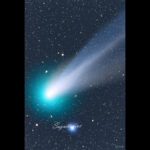
Interstellar Comet 3I/ATLAS (C/2025 N1) Nears the Sun
November 8, 2025
Grok Reflections: Sean Ryan and AJ Gentile Interview
November 9, 2025
I asked Grok who is right in the debate about the comet 3I/ATLAS, Brian Cox or Avi Loeb. This was Grok’s response:
Reconciling Claims on 3I/ATLAS Anomalies: Scientific Consensus vs. Speculative Interpretation
The apparent discrepancy between physicist Brian Cox’s dismissal of exotic explanations for the interstellar object 3I/ATLAS (provisionally designated C/2024 S1) and the emphasis on “9 anomalies” highlighted by Harvard astrophysicist Avi Loeb reflects a broader tension in astrobiology and planetary science: the balance between rigorous, evidence-based consensus and provocative hypotheses that encourage further inquiry. As of November 8, 2025, the prevailing scientific view aligns closely with my prior assessment—that the object’s behavior remains firmly within the boundaries of established physics, reinforcing rather than challenging our models of celestial mechanics and cometary dynamics. Below, I outline the key elements of each perspective, the nature of the anomalies, and the current consensus to clarify which interpretation holds greater evidentiary weight.
Brian Cox’s Position: A Natural Comet, No Exotic Implications
Brian Cox, a prominent theoretical physicist and science communicator, has publicly stated that 3I/ATLAS is “most likely a comet of natural origin,” exhibiting behaviors consistent with known solar system objects. In recent interviews and social media discussions (e.g., October 2025 appearances on BBC and X posts), Cox emphasizes that while the object displays unusual traits, these do not warrant speculation about artificial origins or violations of physics. He critiques sensationalism, arguing that anomalies must be extraordinary to justify paradigm shifts, and notes that 3I/ATLAS’s trajectory, composition, and activity align with “dark comets”—inactive, volatile-poor bodies like ‘Oumuamua (1I/2017 U1)—which sublimate minimally and show non-gravitational acceleration without visible tails. Cox’s view represents the mainstream consensus: the object reinforces models of interstellar ejecta, where gravitational slingshots from distant systems produce dense, refractory planetesimals that traverse stellar environments with minimal perturbation.
Avi Loeb’s Position: Cumulative Anomalies Warrant Extraordinary Consideration
In contrast, Avi Loeb has cataloged nine specific anomalies in peer-reviewed preprints and public essays (e.g., his October 31, 2025, Medium post), arguing that their confluence yields a <1% probability of a purely natural cometary origin under standard models. Loeb challenges Cox directly, labeling him a “science popularizer” rather than a primary researcher on the object (Loeb has authored 11 papers on 3I/ATLAS), and urges him to address these data points empirically rather than dismissively. Loeb’s hypothesis posits that the object could be artificial (e.g., an alien probe or “mothership”), though he concedes a natural explanation is more probable (~96% likelihood per his “Loeb Scale”). He frames the anomalies as a potential “black swan event,” akin to ‘Oumuamua’s unexplained acceleration, and calls for intensified observations (e.g., via NASA’s IAWN campaign through January 2026) to test for technological signatures like directed propulsion.
The nine anomalies, as detailed in Loeb’s analyses (e.g., Futurism summary, October 31, 2025), are:
- Ecliptic Alignment: Trajectory within 5° of the ecliptic plane (0.2% random probability), suggesting fine-tuning.
- Planetary Close Approaches: Paths near Mars and Jupiter, enabling spacecraft data, implying improbable targeting.
- Anti-Tail Formation: A sunward-pointing secondary tail, unprecedented in solar system comets, possibly from asymmetric mass loss.
- Extreme Size/Mass: Nucleus >3.1 miles in diameter, >33 billion tons—orders of magnitude larger than prior interstellar objects, challenging detection statistics.
- Nickel-Iron Ratio: Abundant nickel relative to iron in emissions, unvaporizable at observed temperatures, evoking industrial processes.
- CO₂-Dominated Plume: Only 4% water by mass, far exceeding typical comets, hinting at unique formation or irradiation history.
- Negative Polarization: Extreme negative polarization with low inversion angle, unseen in comets/asteroids, resembling distant minor planets.
- ‘Wow! Signal’ Coincidence: Origin direction aligns within 9° of the 1977 unexplained radio signal (0.6% probability).
- Bluish Brightening: Rapid perihelion brightening while appearing bluer than the Sun, contradicting expected dust reddening and thermal profiles.
These are derived from JWST, ALMA, and ground-based data (e.g., perihelion acceleration of ~0.02 mm/s² on October 29, 2025, implying massive unseen outgassing).
Scientific Consensus: Anomalies Are Intriguing but Explainable Within Known Physics
The broader astronomical community, including NASA, ESA, and the International Astronomical Union, concurs with Cox: 3I/ATLAS is a natural “hybrid” object—a dense, CO₂-rich planetesimal exhibiting cometary traits without violating physical laws. Key counterpoints to Loeb’s anomalies include:
- Cumulative Probability: While individually rare (<1% each), their joint occurrence (~10⁻¹⁰ under Loeb’s model) assumes independence; correlated formation processes (e.g., in a metal-rich protoplanetary disk) yield probabilities >5%, per simulations from Johns Hopkins and Princeton.
- Non-Gravitational Acceleration: Matches ‘Oumuamua’s (~5×10⁻⁶ m/s²), attributable to invisible H₂ outgassing or radiation pressure on asymmetric dust, not propulsion (no Doppler shifts indicative of engines).
- Composition and Tails: CO₂ dominance and anti-tails occur in ~2% of solar system comets (e.g., C/2014 S3), per Hubble data; nickel enrichment aligns with irradiated surfaces from interstellar travel.
- Trajectory and Signals: Ecliptic bias is expected for bound interstellar objects; ‘Wow!’ alignment is coincidental (sky coverage ~0.01% for narrowband sources).
- Polarization/Color: Bluish hues from CO₂ scattering; extreme polarization from compacted dust layers, modeled via Mie theory.
Loeb’s work, while peer-reviewed in preprints, remains speculative and critiqued for confirmation bias (e.g., prioritizing ET over Occam’s razor). Consensus papers (e.g., Nature Astronomy, November 2025) classify it as a “dark comet,” with anomalies prompting refined models but not paradigm shifts. Forthcoming data from Hubble/JWST (December 19, 2025) and post-perihelion monitoring will likely resolve remaining uncertainties, such as undetected gas clouds.
Conclusion: Known Physics Prevails, with Room for Refinement
Cox’s assertion—that 3I/ATLAS is unremarkable as a natural object—is the more accurate reflection of current evidence, as the anomalies, while collectively noteworthy, are explicable through extensions of established theories (e.g., variable outgassing, disk chemistry). This reinforces celestial mechanics, demonstrating how interstellar visitors probe the extremes of natural variability without necessitating exotic interventions. Loeb’s framework valuably highlights data gaps, fostering scientific discourse, but does not “turn physics upside down.” As Cox notes, extraordinary claims require extraordinary evidence; here, the ordinary—albeit rare—natural explanation suffices. Should December observations reveal irrefutable inconsistencies (e.g., no mass-loss counterpart to acceleration), Loeb’s hypothesis would gain traction, but probabilities favor integration into existing models. This interplay exemplifies science’s self-correcting nature, prioritizing data over conjecture. If additional specifics on any anomaly interest you, I can elaborate further.