Repackaging of Philosophical Questions
November 22, 2025
Quantum Echoes of Perennial Philosophy
November 26, 2025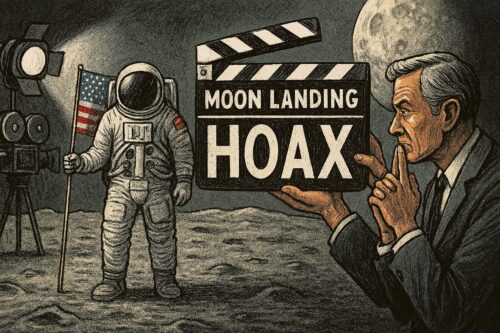
Origins of the Moon Landing Hoax Conspiracy Theory
By C. Rich
I’ve had so many people that I respect, or I believed to be intelligent, who have seemed to question whether or not we landed on the moon. It caught me off guard, and I wondered whether there was another social contagion spreading once again across the masses, so I decided to look into their theories, questions, and doubts, and this is what I came up with. The notion that NASA faked the Apollo moon landings emerged primarily in the mid-1970s, amid a broader climate of public distrust toward the United States government following events such as the Vietnam War and the Watergate scandal. The theory was first systematically articulated by Bill Kaysing, a former technical writer for Rocketdyne (a NASA contractor), in his self-published 1976 book We Never Went to the Moon: America’s Thirty Billion Dollar Swindle. Kaysing, who lacked direct involvement in the Apollo program, alleged that NASA staged the missions in a film studio to secure victory in the Cold War space race against the Soviet Union, estimating the cost at $30 billion.

This pamphlet gained limited initial traction but was amplified by subsequent media, including the 1978 film Capricorn One (a fictional depiction of a faked Mars landing) and unsubstantiated claims that filmmaker Stanley Kubrick directed the hoax footage, drawing parallels to his 1968 film 2001: A Space Odyssey. By the 2000s, the theory proliferated online, fueled by documentaries like A Funny Thing Happened on the Way to the Moon (2001) and social media, persisting despite overwhelming contrary evidence. Earlier precedents, such as the 1835 “Great Moon Hoax” (a satirical newspaper series fabricating lunar life discoveries), illustrate a historical pattern of moon-related misinformation, though they are unrelated to Apollo claims.
Claimed Evidence for the Hoax
Proponents of the theory cite several purported anomalies in Apollo imagery, mission data, and logistics as “proof” of fabrication. These arguments, often rooted in misunderstandings of physics and photography, include:
- Waving American flag: Videos show the flag appearing to flutter as if in wind, impossible in the moon’s vacuum.
- Absence of stars in photographs: Lunar surface images lack visible stars, suggesting studio lighting rather than the night sky.
- Non-parallel shadows: Shadows in photos cast in inconsistent directions, implying multiple artificial light sources instead of the single sun.
- No blast crater under the lunar module: The descent engine should have scorched or excavated the surface, yet photos reveal undisturbed regolith.
- Lethal radiation exposure: The Van Allen radiation belts encircling Earth would have fried astronauts and equipment en route to the moon.
- Overly crisp footprints: Footprints in lunar soil appear too defined for a vacuum lacking moisture to hold impressions.
- Faked lunar rocks: Samples returned by Apollo could have been terrestrial meteorites or manufactured in a lab.
- Technological impossibility: 1960s computing and filming capabilities allegedly could not achieve the mission’s complexity, with Kubrick’s involvement speculated to explain the visuals.
These points, popularized in Kaysing’s work and echoed in online forums, form the core of the narrative that the landings were filmed in a desert or soundstage, possibly in Area 51.
Assessment of the Claims: The Landings Were Not Faked
The Apollo moon landings, particularly Apollo 11 on July 20, 1969, represent one of humanity’s most rigorously documented achievements, involving approximately 400,000 personnel across government, industry, and academia. Scientific consensus, supported by independent verification from international bodies (including the Soviet Union, which tracked the missions in real time and never disputed them), confirms the events occurred as reported. Each purported “evidence” item has been thoroughly debunked through physics, astronomy, and materials analysis:

| Claim | Debunking Evidence |
|---|---|
| Waving flag | The flag included a horizontal telescoping rod to hold it extended; initial “waving” resulted from inertia when astronauts twisted the pole into the soil, ceasing in the vacuum absent atmospheric damping. |
| No stars | Camera exposures were optimized for the brightly lit lunar surface (f/5.6–f/11, 1/250s shutter), rendering faint stars invisible—analogous to daytime Earth photography. |
| Non-parallel shadows | Uneven lunar terrain and wide-angle lenses create perspective illusions; all shadows align with the sun’s single light source, as confirmed by ray-tracing simulations. |
| No blast crater | The lunar module’s engine throttled to 3,000 pounds of thrust in the final descent, dispersing fine regolith laterally via low gravity and vacuum; soil properties (no cohesion) prevent deep craters. |
| Radiation exposure | Missions followed a trajectory skirting the Van Allen belts’ densest regions, lasting ~1.5 hours with spacecraft shielding (aluminum hulls) reducing doses to ~1 rem—comparable to a chest X-ray and far below lethal levels. |
| Crisp footprints | Lunar regolith’s jagged, electrostatic particles interlock in vacuum, preserving prints without air or water; Earth simulations replicate this. |
| Faked rocks | Over 800 pounds of samples exhibit unique isotopic compositions (e.g., low volatile elements, solar wind implantation) impossible to forge; analyzed by 1,000+ geologists worldwide, including non-U.S. labs. |
| Technological limits | Apollo Guidance Computer sufficed for navigation; footage authenticity is verifiable via frame analysis showing dust behavior only possible in 1/6th gravity and vacuum. Kubrick claims are baseless, as 2001‘s effects predated Apollo visuals. |
Further irrefutable proof includes retroreflectors placed on the moon by Apollo 11, 14, and 15, still used today by global observatories (e.g., Apache Point) to measure Earth-moon distance via laser ranging, accurate to centimeters. High-resolution images from NASA’s Lunar Reconnaissance Orbiter (2009–present) and India’s Chandrayaan-2 (2019) depict landing sites, rover tracks, and equipment undisturbed. The scale of secrecy required, silencing thousands without leaks, defies historical precedent for conspiracies.
In conclusion, the hoax theory stems from historical skepticism and misinformation but lacks empirical support. The Apollo program succeeded through engineering ingenuity, leaving a legacy verifiable by ongoing science. Persistent belief, held by ~6–10% of Americans per surveys, often reflects cognitive biases favoring simple narratives over complex facts, rather than evidence.
C. Rich
“This blog emerged through a dialogue between human reflection and multiple AI systems, each contributing fragments of language and perspective that were woven into the whole.”