Google Veo 4 Explained: 4K AI Videos With Audio, Characters & Camera Control
December 24, 2025
China’s New Open AI Shocks OpenAI: DESTROYS Closed Model Limits (Better Than DeepSeek & Kimi)
December 25, 2025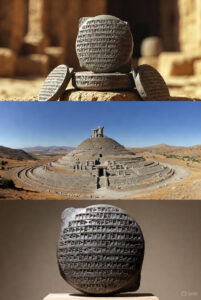 Irving Finkel’s Claim of Lost Prehistoric Writing Systems
By C. Rich
Irving Finkel has suggested that writing systems may have existed earlier than currently accepted, but that they were inscribed on perishable materials, leaves, bark, textiles, or wood, which have since disappeared from the archaeological record. At first glance, this hypothesis appears reasonable. Archaeology is undeniably shaped by preservation bias, and entire categories of material culture are underrepresented because organic media decay more readily than stone or clay. However, when examined carefully, the argument for lost prehistoric writing systems encounters serious logical and empirical difficulties.
Preservation bias is indeed real, but it is not absolute. Across a wide range of environments and periods, archaeologists routinely recover fragile materials when conditions permit. Carbonized plant remains, wooden tablets, textiles, papyrus, leather, basketry, rope, and even fingerprints and footprints have survived through mechanisms such as volcanic burial, extreme aridity, anaerobic wetlands, freezing, mineralization, and carbonization. Egyptian papyri date back to the late fourth millennium BC; palm-leaf manuscripts survive in South Asia from later periods; organic artifacts from bogs and deserts routinely defy expectations of decay. Perishability, therefore, does not equate to total invisibility.
This matters because writing is not a subtle or isolated behavior. A true writing system, defined as the systematic encoding of spoken language with repeatable signs capable of expressing grammar and syntax, generates distinctive archaeological signatures. It involves standardization, repetition, copying, correction, and transmission across time and space. Even if the primary medium were perishable, one would expect “statistical leakage” into the durable record: carbonized fragments, impressed imprints, mineralized traces, secondary copies on stone or clay, or transitional forms showing abstraction toward graphemes. Cultural practices that are widespread and sustained leave debris.
Yet despite more than a century of intensive excavation across the Near East, Europe, East Asia, and the Americas, there are no confirmed examples of true writing before the late fourth millennium BC. Earlier symbolic systems certainly exist. The Jiahu symbols (ca. 6600 BC), the Vinča signs (ca. 5300 BC), the Dispilio tablet (ca. 5200 BC), and the rich iconography of Göbekli Tepe all attest to sophisticated symbolic behavior. However, these systems lack the defining features of writing: clear phonetic or logographic encoding of language, syntactic structure, and demonstrable linguistic repetition. Most specialists interpret them as proto-symbolic, ritual, decorative, or mnemonic rather than as scripts.
The Göbekli Tepe seal that Finkel occasionally references is intriguing, but it remains unproven as a writing tool. The markings are ambiguous, isolated, and lack the redundancy or grammatical structure required to support a claim of linguistic encoding. Even Finkel himself acknowledges that such interpretations are controversial and would not command consensus among archaeologists or epigraphers.
From a philosophy-of-science perspective, parsimony strongly favors the conventional model. The emergence of writing in Mesopotamia around 3500–3100 BC is not abrupt or mysterious; it is well documented as a developmental sequence. Numerical tokens give way to accounting tablets, which evolve into proto-cuneiform and eventually full cuneiform. Similar independent emergences occur in Egypt (ca. 3200 BC), China (ca. 1200 BC), and Mesoamerica (ca. 300 BC). In every case, writing appears in tandem with urbanization, bureaucratic administration, economic complexity, and the need for permanent externalized records. Writing does not precede these conditions; it follows them.
There are, however, limited caveats worth acknowledging. In very early prehistoric contexts, particularly before 4000 BC, exceptional preservation is rarer. It is theoretically possible that an extremely localized, experimental, or short-lived system of notation existed on fully perishable media and left no trace. But this possibility is unfalsifiable and, therefore, methodologically weak. Science cannot be built on hypotheses that explain all outcomes equally well, including the total absence of evidence.
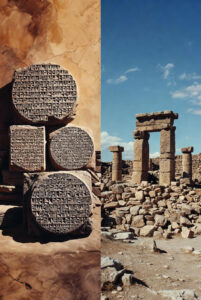 A more grounded analogy sometimes cited is the Indus Valley script. Thousands of short inscriptions survive on durable seals (ca. 2600–1900 BC), while longer texts, if they existed, may have been written on palm leaves or cloth that did not survive South Asia’s climate. This demonstrates that even a mature script can leave a biased record. However, the Indus case is contemporaneous with Mesopotamian and Egyptian writing and does not push the origin of writing significantly earlier. Crucially, it still leaves abundant, durable evidence of a standardized script.
In sum, the absence of pre–3500 BC writing is not merely an accident of preservation; it constitutes strong negative evidence against the existence of widespread earlier writing systems. While absence of evidence is not, in a strict logical sense, proof of absence, archaeology operates on probabilistic inference, not absolute certainty. When a behavior as materially generative as writing leaves no unambiguous trace across every known preservation regime, the most reasonable conclusion is that it had not yet emerged.
Finkel’s speculations are imaginative and intellectually stimulating, and they serve a useful role in prompting debate about the limits of archaeological knowledge. But they remain speculative. Until positive evidence appears, such as a carbonized manuscript fragment, a clearly phonetic early-Holocene inscription, or a demonstrable developmental sequence predating Mesopotamia, the parsimonious and best-supported view remains that true writing originated when societies first required it: as a tool of administration, economy, and durable memory, not as a vanished prehistoric art lost entirely to time.
C. Rich
Copyright © 2025. “This blog emerged through a dialogue between human reflection and multiple AI systems, each contributing fragments of language and perspective that were woven into the whole.”