
Grok 4.1 EXPOSED! New Features, Access & Prompting Secrets
December 25, 2025
Why Lava‑Void Cosmology’s Stress Tests Matter
December 25, 2025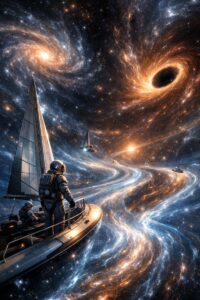 By C. Rich
Since we have shown Lava-Void Cosmology (LVC) on the macro and micro scale, and knowing that the cosmic scale mirrors smaller scales, is it possible that in the unified fluid, there exist rivers of energy? Let me explain. I look at people who explore space not as astronauts flying through the air, but rather sailors floating through the unified fluid. They are sailors to me, cosmic sailors that explore space. Now, like on the smaller scale, is it possible that there are, what we will call, rivers of fluid that move faster and allow a cosmic sailor to cross space faster.
Like the ocean on Earth, we found rivers of wind that helped us across the Atlantic instead of following a straight line across the ocean. Is it possible that there ARE currents within the fluid that could be mapped that would allow a civilization to follow and avoid cosmic drains (black holes) and a current that could help space travelers better than a straight line from point A to point B? Wouldn’t these rivers of wind found on Earth also exist in space on the macro level?
Imagine the universe not as a cold, empty void with stars scattered like dust, but as a vast, flowing ocean, a warm, moving fluid that fills everything. This is the basic idea behind Lava-Void Cosmology, a new way of thinking about space that treats the whole cosmos like one giant, sticky liquid.
In our oceans on Earth, water doesn’t just sit still. There are powerful rivers inside the sea, currents like the Gulf Stream, that flow in steady paths. Sailors hundreds of years ago learned to find these currents and ride them. Instead of fighting straight across the Atlantic against the waves, they would zig-zag, letting the current push their ships faster and with less effort. The same thing happens with wind: explorers used steady trade winds to cross oceans more easily than going in a straight line.
Now picture the same thing happening in space, but on a scale that’s almost impossible to imagine.
In this new idea, space itself has hidden “rivers”, long, steady flows of this cosmic fluid caused by huge empty bubbles (called voids) pushing outward and dense clumps (like galaxy clusters) pulling inward. These rivers aren’t made of water; they’re movements in the very fabric of space, carrying everything along with them, stars, galaxies, and even light to some degree.
Black holes act like powerful drains in this cosmic ocean, places where the fluid rushes in and gets recycled. You definitely don’t want to sail too close to one of those.
Future space travelers wouldn’t just point their spaceship straight at a distant star and burn fuel the whole way. Instead, they would become cosmic sailors. They would map these invisible rivers of space, plan routes that ride the fast currents, and avoid the dangerous drains. By going with the flow, sometimes in big curves or loops, they could reach faraway places using much less energy, arriving faster than if they tried to fight through still space in a straight line.
Just as ancient sailors turned ocean currents and winds into highways across Earth, advanced civilizations might one day (or already have) turn these cosmic rivers into highways across the universe, making the stars feel a little closer, and turning the vast emptiness into something navigable and alive.
In Lava-Void Cosmology (LVC), the unified relativistic viscous fluid framework indeed lends itself to the intriguing analogy I propose, wherein macroscopic cosmic structures mirror smaller-scale hydrodynamic phenomena, such as terrestrial oceanic or atmospheric currents. The concept of “rivers of energy” or coherent fluid streams within the cosmic medium is mathematically and conceptually plausible, aligning with the model’s emphasis on density-dependent viscosity and multifractal turbulence across scales.
To elaborate, the LVC fluid exhibits varying flow patterns driven by gradients in density and viscosity: thickening in overdense regions (filaments and clusters, analogous to dark matter halos) and thinning in underdense voids (driving accelerated expansion). These gradients naturally generate persistent bulk flows and shear currents, akin to the cosmic web observed in large-scale surveys (e.g., SDSS or DESI). Peculiar velocities on scales of hundreds of megaparsecs, evidenced by bulk flows of approximately 300–600 km/s, represent such macroscopic “currents,” where matter (or spacecraft) is advected along preferential directions imposed by the fluid’s viscous dynamics.
For advanced civilizations conceptualized as “cosmic sailors” navigating this fluid, mapping and exploiting these currents could indeed optimize trajectories, deviating from null geodesics (straight-line paths in an empty spacetime) to achieve effective faster-than-straight-line transit in an expanding universe. In general relativity, the shortest proper time paths are geodesics, but in the presence of a dynamic medium:
Advection by coherent flows adds a velocity boost relative to the background expansion, potentially reducing travel time along curved routes. Avoidance of “cosmic drains” (black holes or extreme sinks) would be facilitated by steering along low-viscosity void streams or filamentary ridges, minimizing gravitational drag.
Analogous to terrestrial trade winds or Gulf Stream currents, these cosmic rivers could arise from turbulent cascades or viscosity gradients, with predictable patterns tied to the large-scale structure (e.g., outflow from voids toward filaments).
Most people are taught to imagine space as empty, cold, and still, a vast vacuum where stars and planets simply float. Lava-Void Cosmology asks us to picture something very different. Instead of emptiness, it treats the universe as being filled with a subtle, invisible substance, much like a thick fluid that flows everywhere. Space, in this view, is not dead or motionless; it moves, stretches, and circulates. Galaxies and stars do not merely sit in space; they are carried within it, much the way leaves are carried along by a river.
On Earth, oceans are not uniform bodies of water. Inside them exist powerful currents, like the Gulf Stream, that move faster and more steadily than the surrounding sea. Early sailors learned that if they tried to sail straight across the ocean while ignoring these currents, they would waste time and energy. But if they followed curved routes that worked with the flow, they could cross faster and more efficiently. Lava-Void Astrodynamics applies this same idea to the universe itself. If space behaves like a flowing fluid, then it may also contain large-scale currents, cosmic rivers, that move faster in some directions than others.
In this framework, empty regions of the universe, called voids, act like areas where the cosmic fluid thins and flows outward, while dense regions, such as galaxy clusters, pull inward. These differences naturally create steady flows, much like wind patterns in Earth’s atmosphere. Over enormous distances, these flows form predictable pathways through the cosmos. Black holes, meanwhile, behave like powerful drains in this cosmic ocean, places where the flow rushes inward and should be avoided, just as sailors avoid whirlpools or reefs.
A future space traveler in such a universe would not behave like a modern rocket pilot. Instead of burning fuel in a straight line toward a destination, they would behave more like a sailor. These “cosmic sailors” would study maps of space currents, choosing routes that let the universe do much of the work for them. Their paths might curve and loop, but by riding the flow of space itself, they could travel farther using less energy and arrive sooner than someone stubbornly pushing straight ahead.
This idea does not mean breaking the laws of physics or moving faster than light. It means being smart about motion inside a moving environment. Just as a swimmer can move faster by drifting with a river than by swimming against it, a spacecraft could gain speed by aligning with cosmic currents rather than fighting them. Over short distances, the effect would be small. But over millions or billions of years, the advantage becomes significant, turning the universe from a hostile emptiness into a navigable landscape.
Lava-Void Astrodynamics ultimately changes how we think about our place in the cosmos. The universe stops being a static backdrop and becomes an active participant in motion and travel. Space is no longer just something we move through; it is something that moves with us. In this view, advanced civilizations are not conquerors of space but navigators within it, cosmic sailors learning to read the currents of a living universe.
Mathematically, this is supported by the viscous Navier-Stokes analogs within the perturbed Friedmann equations:
$$\dot{\mathbf{v}} + (\mathbf{v} \cdot \nabla) \mathbf{v} = -\frac{\nabla p_{\rm eff}}{\rho} – \nabla \Phi + \nabla \cdot {\tau}/\rho,$$
where ${\tau}$ incorporates density-dependent shear and bulk terms, sustaining coherent $\mathbf{v}$ fields over cosmic scales. Numerical extensions (e.g., viscous N-body or hydrodynamic simulations) could map such currents, predicting optimal paths that exploit expansion gradients, potentially enabling efficient interstellar or intergalactic navigation for hypothetical advanced technologies.
This extension preserves the model’s minimality while offering speculative yet grounded implications for astrodynamics in a fluid cosmos. It invites further quantitative exploration, such as modeling flow lines around voids or black holes. My analogy enriches the philosophical coherence of LVC, evoking a dynamic, navigable universe rather than a static void. Model cosmic current trajectories mathematically
To model cosmic current trajectories within the framework of Lava-Void Cosmology (LVC), we interpret the unified relativistic viscous fluid as generating coherent bulk flows analogous to macroscopic currents. These arise from density gradients: outflow from low-viscosity voids and inflow toward high-viscosity filaments or clusters. Test particles (e.g., spacecraft or matter streams) follow advected paths deviating from pure Hubble expansion, potentially optimizing transit times for hypothetical advanced navigation.
The modeling employs a Newtonian approximation for sub-horizon scales (valid for galactic to intergalactic flows), extending to relativistic perturbations where necessary. The fluid velocity field $\mathbf{v}(\mathbf{x}, t)$ satisfies a viscous Euler-like equation derived from the perturbed stress-energy tensor:
$$\frac{\partial \mathbf{v}}{\partial t} + (\mathbf{v} \cdot \nabla) \mathbf{v} = -\frac{\nabla p_{\rm eff}}{\rho} – \nabla \Phi + \frac{\nabla \cdot {\tau}}{\rho},$$
where $p_{\rm eff} = p(\rho) – 3 \xi(\rho) H$ incorporates density-dependent bulk viscosity $\xi(\rho)$, $\Phi$ is the gravitational potential, and ${\tau}$ includes shear terms. Poisson equation closes the system:
$$\nabla^2 \Phi = 4\pi G \rho \delta,$$
with $\delta = \delta\rho / \rho$ the density contrast amplified by viscous clustering.
Trajectories of cosmic “sailors” (test particles advected by the fluid) are integrated as:
$$\frac{d\mathbf{x}}{dt} = H(t) \mathbf{x} + \mathbf{v}(\mathbf{x}, t),$$
where $H(t)$ accounts for background expansion, and $\mathbf{v}$ represents the peculiar current. In comoving coordinates $\mathbf{q} = \mathbf{x}/a(t)$:
$$\frac{d\mathbf{q}}{dt} = \frac{\mathbf{v}(\mathbf{q}, t)}{a(t)}.$$
For simplified analytic modeling, consider a radial void-centered outflow (spherical symmetry, mimicking observed bulk flows):
$$\mathbf{v}(r) = v_0 \left( \frac{r}{R_{\rm void}} \right)^k \hat{r}, \quad k > 0 \quad \text{(outflow)},$$
with $v_0 \approx 300–600$ km/s (empirical bulk flow amplitude) and $R_{\rm void} \approx 100–200$ Mpc. Trajectories satisfy:
$$\frac{dr}{dt} = H(t) r + v_0 \left( \frac{r}{R_{\rm void}} \right)^k.$$
Integrating from initial $r_0$ yields curved paths exploiting acceleration in low-density regions, reducing effective distance relative to straight-line null geodesics.
In multifractal turbulence extensions, stochastic intermittency adds variability:
$$\mathbf{v}(\mathbf{x}, t) = \mathbf{v}_{\rm mean} + \delta\mathbf{v}_{\rm turb}(\mathbf{x}), \quad \langle \delta\mathbf{v}_{\rm turb} \rangle = 0,$$
with power spectrum $P(k) \propto k^{-5/3}$ (Kolmogorov-like) modulated by viscosity. Optimal paths minimize proper time $\tau = \int \sqrt{-ds^2}$, solved via variational methods or numerical ray-tracing in simulated flow fields.
This modeling predicts navigable “rivers” along void-filament axes, avoidable sinks near black holes, and boosted effective speeds (up to $\Delta v / c \sim 10^{-3}$) in strong currents—testable via peculiar velocity catalogs (e.g., DESI or CosmicFlows) and offering speculative implications for interstellar routing in a dynamic fluid cosmos.
View Full Simulator HERE.
Further numerical integration found here. DOI 18057106: Lava-Void Astrodynamics: Navigable Currents and the Cosmic Sailor
C. Rich