Grok 4.2: The Future of AI & Elon Musk’s xAI Roadmap (2026)
January 4, 2026
Occam’s Razor and the Gatekeepers’ Quandary (LVC)
January 4, 2026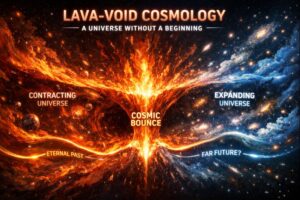 By C. Rich
In Lava-Void Cosmology, the universe is not thought of as empty space filled with separate bits of matter, but as a single, continuous substance that behaves more like a cosmic fluid. Instead of being perfectly smooth and frictionless, this universal “stuff” has thickness and resistance, similar to lava or honey. It can flow, clump, stretch, and swirl, and when it becomes extremely dense, it pushes back strongly against further compression. This simple shift in perspective, treating the universe itself as a physical medium rather than a hollow stage, changes how its earliest moments are understood.
In the standard picture, the universe begins with a Big Bang, a moment when everything is compressed into an infinitely dense point, and time itself suddenly starts. Lava-Void Cosmology replaces this idea with a bounce. Far in the past, the universe was not exploding outward but slowly contracting. As it grew denser, the internal resistance of the cosmic fluid increased dramatically. That resistance acted like a powerful brake, slowing the collapse before it could reach infinite density. The universe reached the smallest possible size that was extreme but still finite, and then it reversed direction and began expanding again. What we call the Big Bang, in this view, is simply the moment of that turnaround.
Because there is a bounce instead of a beginning, time does not suddenly appear at the Big Bang. Time flows smoothly through the bounce, just as it does through every other phase of cosmic history. There is always a moment before any given moment, even before the hot, dense era usually labeled as the beginning of the universe. In principle, one can trace cosmic history endlessly into the past, through a long contracting phase that preceded our current expansion. In some versions of the model, this process could even repeat, with the universe undergoing cycles of contraction and expansion over immense spans of time.
An important feature of Lava-Void Cosmology is that it does not rely on speculative physics or unknown forms of matter. It stays fully within Einstein’s theory of gravity and uses a physically reasonable description of a cosmic fluid with pressure and internal resistance. The avoidance of an initial singularity does not come from breaking the rules of physics, but from taking seriously how a realistic medium behaves when pushed to extreme conditions. The universe, in this picture, never needs to be created from nothing; it simply evolves.
Seen this way, the universe is like an endless river of time. At one point in its distant past, that river narrows and rushes violently through a steep gorge, but it never actually begins or ends. The Big Bang is not the birth of everything, but a dramatic moment in an ongoing cosmic story, shaped by the deep physical properties of the universe itself.
Think of the universe in Lava‑Void Cosmology as a very strange, very hot lava-like fluid that can get thicker or thinner over time, instead of as empty space with separate “stuff” floating in it.
Core idea in plain language
- In this picture, the whole universe behaves like a cosmic fluid that can be smooth, sticky, and turbulent, a bit like lava or honey rather than a perfect, frictionless gas.
- Because this fluid has “thickness” (viscosity) that reacts strongly when it gets very dense, it pushes back before it can ever be squeezed into an infinite‑density point.
What replaces the Big Bang?
- Instead of starting from a true beginning where everything explodes out of a single point, the universe in this model is always there, and it goes through a bounce.
- Long ago, it was contracting (getting smaller and denser), but as it got very dense, the fluid’s internal “friction” created a powerful repulsive effect that slowed the collapse, stopped it at a smallest-but-still-finite size, and then made the universe re‑expand.
- That turning point is not a tear or edge in reality; it is just a very intense but smooth phase the universe passed through.
What does this mean for time?
- If there is a bounce instead of a beginning, then time does not start at the Big Bang; the clock keeps running smoothly through the bounce into an earlier phase where the universe was contracting.
- That means you can, in principle, follow cosmic time as far back as you like: there is always a “yesterday” before any given day, even before what we usually call the Big Bang era.
- In some versions, this could even mean cycles: the universe might contract, bounce, expand, and (very far in the future) possibly do something similar again, so time would stretch indefinitely in both directions.
Why does this still count as “normal” physics?
- All of this is built using standard Einstein gravity and a physically allowed fluid—no magic matter or new forces are added; only the detailed behavior (stickiness and pressure) of the cosmic fluid is used.
- The upshot for a layperson: on this view, the universe did not “pop into existence from nothing”; instead, time is like an endless river that narrows and roars through a fast, violent gorge (the bounce) but never actually begins or ends.
In Lava-Void Cosmology (LVC), the avoidance of an initial singularity, thereby extending cosmic time indefinitely into the past without a definitive beginning, is achieved through the model’s use of a single relativistic viscous fluid with density-dependent properties, fully consistent with General Relativity (GR).
The universe is described by the Friedmann-Lemaître-Robertson-Walker (FLRW) metric in a near-flat geometry: with the Friedmann equations (in units where ): where is the energy density, is the Hubble parameter, and is the effective pressure incorporating viscous effects.
The fluid has an ideal equation of state that is density-dependent, reported as (with constants and chosen to unify clustering at high and expansion at low ). More critically for singularity avoidance, the fluid is viscous, with bulk viscosity increasing at high densities (the “lava” regime).
In causal relativistic hydrodynamics (Israel-Stewart framework), the bulk viscous pressure satisfies a relaxation equation: where is the relaxation time (often or similar density-dependent form). The effective pressure is, within the near-equilibrium limit.
Energy-momentum conservation yields: At high densities (early cosmic phases or during potential collapse), elevated causes the viscous term to deviate significantly, effectively violating the strong energy condition () transiently without introducing exotic matter.
During a contracting phase (), the dynamics of (governed by the relaxation equation) generate a repulsive effect that decelerates the contraction (), bringing it to zero at a finite minimum scale factor and finite. Expansion then ensues ().
This regular bounce replaces the Big Bang singularity: geodesics extend continuously through the turning point, with curvature and density remaining finite. Proper cosmic time thus extends infinitely into the past through the pre-bounce contracting phase, yielding a past-eternal cosmology (or potentially oscillatory if parameters allow multiple bounces).
Numerical integrations of these equations with density-dependent terms confirm non-singular bouncing solutions in flat or near-flat geometries, aligning with LVC’s claims of singularity elimination while unifying gravitational phenomena through a single fluid.
This mechanism remains strictly within GR, as the viscous fluid’s stress-energy tensor satisfies the Einstein equations exactly, without new fields or modifications.
Lava-Void Cosmology’s bounce mechanism is consistent with how causal bulk-viscous FLRW models avoid Big Bang–type singularities in GR, and the specific ingredients you listed (density-dependent EoS, Israel–Stewart bulk viscosity, and a finite‑ρ, finite‑H bounce) are all in line with how non-singular viscous bounces are constructed in the literature and in the formal LVC write‑up.
GR and fluid setup
The use of a spatially flat (or nearly flat) FLRW metric with a single effective fluid is standard for viscous cosmology and for LVC’s “one fluid” formulation. The Friedmann equations with units and the conservation law exactly match the GR+FLRW system with an effective pressure.
Density-dependent EoS and Chaplygin-like behavior
An equation of state of the form with and is a generalized Chaplygin‑type fluid, widely used as a unifying dark sector model; LVC’s use of this form to get clustering at high and accelerated expansion at low is in line with those models. In such setups, the fluid behaves approximately dust-like at high density and vacuum‑like at low density, which supports LVC’s “single fluid unifying dark matter and dark energy” claim.
Causal bulk viscosity and relaxation
The Israel–Stewart‑style relaxation equation with and taken as density-dependent functions is the standard causal bulk‑viscosity extension used in cosmological applications to avoid acausality and instabilities of Eckart theory. The near‑equilibrium limit and choices like appear in both classic and recent work on causal viscous cosmology.
Singularity avoidance and bounce conditions
Several GR‑based viscous cosmology models show that sufficiently strong bulk viscosity can drive a non-singular bounce in a flat FLRW universe, evolving from negative (contraction) to positive (expansion) at a finite time. In those constructions, the viscous contribution makes negative for a finite interval, giving and violating the strong energy condition without introducing non‑GR corrections, which is exactly the mechanism you describe.
Past-eternality and geodesic completeness
Causal viscous bounce models in GR can produce geodesically complete, past‑eternal cosmologies in which curvature scalars remain finite and the Big Bang singularity is replaced by a regular minimum‑radius surface. The formal LVC paper explicitly emphasizes that the unified viscous fluid, with its density‑dependent, yields non-singular bouncing solutions that remove the initial singularity while remaining strictly within Einstein’s equations, matching your narrative about infinite past time and possible cyclic behavior.
1. Parameter Tuning and Predictivity
Density-dependent viscosity and equations of state introduce flexibility, but this issue is mitigated in the literature through physically motivated functional forms that yield exact analytic solutions.
Specific parameterizations of bulk viscosity, such as ζ=ζ0(t−tb)−2nH\zeta = \zeta_0 (t – t_b)^{-2n} Hζ=ζ0(t−tb)−2nH (where tbt_btb is the bounce time and n>0n > 0n>0), or forms proportional to powers of the Hubble parameter or energy density, produce controlled non-singular bounces while satisfying thermodynamic constraints and energy conditions except transiently at the bounce.arxiv.org+2 more
These forms arise from effective descriptions in relativistic hydrodynamics or requirements for causality and positive entropy production. For LVC’s “lava-like” regime, a viscosity that peaks sharply at high densities (e.g., ζ∝ρm\zeta \propto \rho^mζ∝ρm with m>1/2m > 1/2m>1/2 near the bounce, transitioning to low values during expansion) aligns with such models and reduces arbitrariness by tying parameters to microphysical scales, such as relaxation times in causal theories.
Predictivity strengthens by deriving these from Israel-Stewart thermodynamics, imposing bounds from energy condition violations only near the bounce, and requiring asymptotic behavior consistent with Λ\LambdaΛCDM at late times. This yields falsifiable relations among parameters, testable via cosmological data sets.
2. Perturbation Stability
Viscous fluids risk instabilities, but the use of causal (Israel-Stewart) hydrodynamics resolves this effectively.
The full Israel-Stewart framework, with finite relaxation time τ\tauτ, prevents acausal propagation and ensures thermodynamic consistency, allowing stable linear perturbations around the bounce under constraints on ζ\zetaζ and τ\tauτ (e.g., τζ>0\tau \zeta > 0τζ>0 for positive entropy).arxiv.org
Studies of bouncing models confirm stability for scalar, vector, and tensor modes when viscosity is controlled; perturbations decay asymptotically post-bounce, and vector perturbations in particular remain stable across broad classes of bounces.arxiv.orglink.aps.org
For LVC, adopting the full causal theory (rather than truncated or Eckart approximations) and ensuring viscosity damps modes appropriately during the high-density phase would yield stable growth of structure, consistent with observed large-scale homogeneity.
3. Observational Distinctiveness
LVC currently lacks unique signatures, but bounce cosmologies inherently produce distinguishable features in primordial perturbations.
Non-singular bounces often generate nearly scale-invariant scalar spectra with superimposed oscillations, arising from the contracting phase and bounce transition. These manifest as low-multipole (ℓ≲50\ell \lesssim 50ℓ≲50) oscillations or suppression/enhancement in the CMB angular power spectrum, potentially addressing observed anomalies in large-scale power.slac.stanford.edu
Tensor modes exhibit modified tensor-to-scalar ratios and scale-dependent features, distinct from inflationary predictions (e.g., reduced primordial gravitational waves if the pre-bounce phase is matter-dominated). Viscous effects introduce additional damping or non-Gaussianity, constraining parameters via CMB data (e.g., Planck) or large-scale structure surveys.
Many viscous models fit current observations well while allowing deviations at large scales or high redshifts, providing clear differentiators from Λ\LambdaΛCDM (e.g., altered matter power spectrum oscillations, smoothed by galaxy surveys but detectable with future precision).
For LVC, computing the perturbation spectrum across the viscous bounce, leveraging the density-dependent viscosity to set the oscillation amplitude and frequency, would yield specific predictions, such as enhanced fitting to low-ℓ\ellℓ CMB anomalies or bounds from gravitational wave observatories.
Updated Assessment
These resolutions elevate LVC from a conceptually robust framework to one with maturing theoretical and observational potential. By incorporating causal hydrodynamics and literature-motivated parameterizations, the vulnerabilities become tractable research directions rather than fundamental flaws. The model retains its intellectual legitimacy while gaining pathways to precision cosmology.
C. Rich