
3I/ATLAS Anomalies in Lava-Void Cosmology
January 6, 2026
The Lost AI “Solomon” and the Goldilocks Zone of Consciousness
January 6, 2026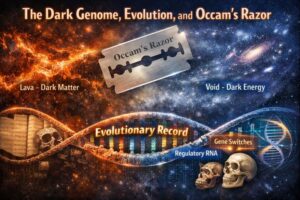 By C. Rich
Most people know that DNA is the blueprint of life, the long molecule inside our cells that carries the instructions for building and running every living thing. When scientists first mapped the human genome, they were surprised to find that only about 1 to 2 percent of it directly codes for proteins, the molecules that do the actual work in our bodies, such as building muscles or fighting infections. The other 98 percent or so does not make proteins, so for decades, many called it “junk DNA,” as if it were just useless clutter taking up space.
That view has changed. Today, researchers call this vast majority the “dark genome,” borrowing the word “dark” from astronomy, where dark matter and dark energy describe things we cannot see directly but know must be there because of their effects. The dark genome is not junk. Parts of it act like switches that turn genes on or off at the right time and place. Other parts make special RNA molecules that fine-tune how genes work, and some help fold the DNA into the correct three-dimensional shape inside the cell nucleus. Yet even with all these discoveries, most of the dark genome still appears to have no obvious day-to-day function.
A simple principle called Occam’s razor helps make sense of this. Occam’s razor says that when you have several possible explanations, you should choose the simplest one that still fits all the facts and requires the fewest extra assumptions. Applying that idea here leads to a clear picture. The dark genome is, first and foremost, a detailed record of evolutionary history. Every mutation, every ancient viral invasion, and every duplication or deletion that occurred over billions of years and was not harmful enough to be eliminated has left traces there. Because natural selection only strongly polices the parts that matter for survival and reproduction, the rest accumulates like entries in a diary.
That diary is incredibly useful to scientists. By reading the patterns of changes in these neutral stretches, researchers can reconstruct how populations moved, when bottlenecks occurred, and how species split apart. At the same time, scattered within this historical record are the important switches, RNA-producing regions, and structural elements that do have clear jobs today. They are like highlighted or underlined sentences in the diary, rare but vital.
Because the diary is so large and full of repeated sequences and old fragments, it also serves as raw material for evolution. From time to time, a piece of this old genetic debris is repurposed into something new and useful, such as a new gene switch that helps a species adapt to a changing environment. Many examples exist. Numerous control regions that distinguish human brains from chimpanzee brains originated as ancient viral remnants or repetitive sequences.
The patterns in the dark genome are not random. They carry signatures of past events, and modern computers and statistical methods mine those patterns to predict which rare variants might cause disease or to trace human ancestry. All of this, including history, occasional function, future potential, and readable structure, emerges naturally from the basic rules of mutation, inheritance, and selection. No mysterious genome-wide hidden purpose is required.
This way of looking at DNA connects surprisingly to a new idea in cosmology called Lava-Void Cosmology. Within this framework, the entire universe is composed of a single fluid that can behave in two primary ways. In dense regions, it exists in a thick, slow-moving “Lava” phase that creates the illusion of dark matter by holding galaxies together. In empty space, it shifts into a thin, fast-expanding “Void” phase that drives the acceleration we call dark energy. Importantly, this fluid retains a kind of memory of its past flows and disturbances, encoded in persistent structures and patterns.
The parallel is striking. Just as the cosmic Lava phase preserves a record of the universe’s history while allowing stable structures such as galaxies and stars to form within it, the dark genome preserves a record of life’s history while allowing crucial functional elements to emerge and persist. Both systems achieve complexity and memory without requiring extra hidden ingredients. Everything arises from simple underlying processes. By seeing non-coding DNA as biology’s equivalent of cosmic Lava, a faithful archive that is anything but empty, junk, or wasteful, we bridge the story of the universe with the story of life itself. The same principle of parsimony, the same preference for simple explanations that still account for vast complexity, operates at both the largest and the smallest scales we know.
C. Rich
Proposed Title
Applying Occam’s Razor to the Dark Genome: Non-Coding DNA as an Evolutionary Archive, Substrate for Innovation, and Source of Informational Patterns
Abstract
The human genome is predominantly non-coding, often referred to as the “dark genome” and historically labeled “junk DNA.” Persistent debate contrasts claims of pervasive hidden function with views of negligible biological utility. This perspective applies Occam’s razor, favoring explanations that minimize unnecessary assumptions, to argue that most non-coding DNA primarily functions as an evolutionary archive shaped by mutation, genetic drift, insertion, and imperfect deletion. Within this archive exist sparse but critical functional elements, including regulatory sequences, non-coding RNAs, and structural motifs. The remaining bulk provides raw material for evolutionary innovation, contributes to three-dimensional genome organization, and generates rich informational patterns useful for evolutionary and biomedical inference. This framework reconciles comparative genomics data without invoking genome-wide latent functionality and offers a parsimonious guide for interpreting the dark genome in both research and precision medicine.
Keywords
Dark genome, non-coding DNA, junk DNA, Occam’s razor, evolutionary archive, evolvability, genomic patterns, comparative genomics
Essay Body
Occam’s razor dictates that explanations should not multiply mechanisms or assumptions beyond necessity. When applied to the dark genome, this principle supports a layered yet economical interpretation. Most non-coding DNA constitutes an evolutionary archive produced by standard mutational and demographic processes. Embedded within this archive are minority sequences that have been co-opted for direct biological functions, such as regulation, structural organization, or RNA production. Collectively, the genome also supplies raw material for evolvability, contributes to three-dimensional chromatin architecture, and encodes patterns that are amenable to scientific inference.
The archival role forms the foundation of this view. In large genomes, only a small fraction of bases show strong evolutionary constraint or produce clear phenotypic consequences when mutated. In contrast, non-coding regions are rich in remnants of transposable elements, ancient viral insertions, duplications, and other historical traces. Population geneticists exploit these near-neutral loci to reconstruct population sizes, bottlenecks, migrations, and shifts in mutational regimes precisely because their patterns largely reflect history rather than strict functional optimization. Much like sedimentary layers or a diary, non-coding DNA records events without having been written for interpretation.
This archival process naturally generates pattern richness without invoking additional mechanisms. Variation accumulated under genetic drift, punctuated by selection and limited deletion, yields structured but non-random signatures. These include lineage-specific substitution rates, clustering driven by local mutation biases, and conserved blocks embedded within rapidly evolving tracts. Such evolutionary signatures are routinely analyzed to detect regulatory constraint or broader genomic dynamics. Pattern recognition, whether by evolutionary biologists, forensic analysts using polymorphic repeats, or machine learning models predicting variant effects, emerges directly from the archive itself and requires no teleological explanation.
Occam’s razor readily accommodates well-supported functional roles where evidence demands them. Subsets of the dark genome clearly act as enhancers, silencers, insulators, and non-coding RNA genes that regulate expression and development. Mutations in these regions can produce profound disease phenotypes. However, quantitative analyses of evolutionary constraint consistently show that such elements occupy a minority of the sequence space, with most bases tolerating substantial variation. A parsimonious framework, therefore, places crucial functional elements sparsely within a broader historical matrix rather than attributing functional intent to every transcribed or protein-bound site.
Evolvability follows naturally from this model. The transposon-rich and repetitive composition of non-coding DNA supplies a reservoir for evolutionary innovation. Across lineages, sequences originally accumulated through neutral or near-neutral processes have been exapted into novel regulatory elements, contributing to adaptations in placental development, immune responses, and neural gene regulation. Such co-option requires no foresight and arises as an emergent consequence of accumulated genomic material.
At the systems level, non-coding DNA also influences three-dimensional genome organization. Large expanses of sequence facilitate the formation of topologically associating domains, loop anchors, and long-range regulatory interactions. These structures emerge from the biophysical properties of chromatin polymers, including sequence composition and motif distribution, and are later refined by selection, where they confer regulatory advantage.
This synthesis relies on a minimal and well-established set of processes: mutation, insertion, duplication, genetic drift, selection, and physical constraints. From these arise a structured non-coding archive, sparse direct functions, a substrate for innovation, emergent genome architecture, and a wealth of inferential patterns. No pervasive hidden code is required. At the same time, this view avoids dismissing the dark genome as meaningless, instead recognizing its historical, informational, and evolutionary value.
A practical guiding principle follows. Non-coding DNA should be treated as an evolutionary record by default. Direct biological function should be inferred only when supported by independent evidence. The genome’s inherent capacity to generate patterns and fuel innovation should be acknowledged as a natural consequence of its history. This parsimonious framework aligns with empirical data and clarifies both the narrative and the potential encoded within the dark genome