The Lost AI “Solomon” and the Goldilocks Zone of Consciousness
January 6, 2026
This AI Posts on 5 Platforms Daily (While I Sleep)
January 7, 2026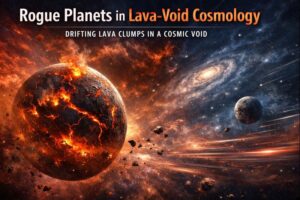 By C. Rich
Lava-Void Cosmology offers a way to think about rogue planets that is unfamiliar to standard astronomy but intuitive once the core idea is grasped. Instead of imagining the universe as mostly empty space sprinkled with separate kinds of matter and mysterious dark components, LVC treats everything as a single cosmic fluid. This fluid behaves differently depending on how dense it is. Where it is dense, it acts like ordinary matter that clumps, holds together, and forms planets and stars. Where it is thin, it behaves more like a repulsive, expanding background that drives cosmic expansion. In this picture, a rogue planet is simply a small, dense “lava clump” moving through a vast, low-density “void” ocean.
From this perspective, a rogue planet is not exotic or special in its basic physics. It is a localized region where the cosmic fluid has condensed to high density, much like a droplet forming in a cooling liquid. At those densities, the fluid behaves almost exactly like the matter we are familiar with, exerting gravity and responding to pressure in the usual way. This means that, locally, a rogue planet follows the same rules as any other planet. It has mass, gravity, and internal structure, and it can be described using the same equations that scientists use to model planets inside solar systems. The difference lies not in the planet itself, but in the medium it travels through.
Near the planet, spacetime looks ordinary and stable, dominated by the planet’s own gravity. Far away, however, the background is not empty space but the slowly expanding, low-density phase of the cosmic fluid. In practical terms, this means that scientists can model the planet as a normal spherical object embedded in a changing cosmic environment. Close in, the math reduces to familiar planetary physics. Far out, it smoothly connects to the large-scale expansion of the universe, governed by the fluid behavior of Lava-Void Cosmology rather than by a separate dark energy component.
Inside a rogue planet, the physics is especially straightforward. Because planetary masses are relatively small on cosmic scales, gravity is weak enough that classical, Newtonian physics works extremely well. Pressure balances gravity just as it does on Earth or Jupiter, and the planet’s structure follows the same logic taught in basic astrophysics. LVC simply reframes what the planet is made of: instead of being built from an entirely separate category of matter, it is a condensed phase of the same cosmic substance that fills the universe. This unification removes the need for extra ingredients while leaving everyday planetary behavior unchanged.
Where LVC becomes more distinctive is in how rogue planets move through space. In standard cosmology, a free-floating planet is treated as a mostly ballistic object, coasting through a near-vacuum unless it passes close to a star or galaxy. In Lava-Void Cosmology, the background is a thin but active medium. Large-scale flows, expansion currents, and viscous effects can gently influence motion over long timescales. A rogue planet still follows gravity, but its path is subtly shaped by the “cosmic weather” of the surrounding void, much like a boat drifting in a slow ocean current rather than moving through empty air.
This framework also extends naturally into discussions of habitability. In LVC-based planetary science, each world can be assigned a habitability measure that changes over time. This measure reflects a balance between processes that preserve structure and energy, such as internal heat and geological activity, and processes that increase disorder, such as entropy production and environmental stripping. For planets bound to stars, external energy sources can help maintain this balance. Rogue planets, by contrast, are largely isolated. With little ongoing energy input and few stabilizing interactions, most are driven toward cold, inert states over long periods.
As a result, even though rogue planets may be extremely common, their chances of sustaining long-term, life-friendly conditions are generally very low. In Lava-Void Cosmology, they become a vast population of worlds that technically exist but rarely remain suitable for complex life. When folded into broader discussions about life in the universe, this has an important consequence. Rogue planets dramatically increase the number of potential worlds while contributing very little to the number of worlds that could host long-lived, communicative civilizations. This sharpens what is often called the Great Filter: the idea that there are strong bottlenecks preventing life from commonly advancing to detectable intelligence.
In simple terms, LVC paints rogue planets as natural byproducts of a universe made from a single, shape-shifting cosmic substance. They are plentiful, physically ordinary, and mostly lonely. They drift as dense droplets through an expanding cosmic sea, obeying familiar planetary physics while being gently carried by large-scale cosmic flows. Their abundance makes the universe look rich in worlds, but their isolation and harsh long-term evolution help explain why, despite all those worlds, the cosmos may still appear silent. Rogue planets in Lava‑Void Cosmology (LVC) are naturally interpreted as small, high‑density “lava clumps” moving through an expanding, low‑density “void” background, and their math is just the unified LVC fluid plus a compact, approximately dust‑like perturbation.
C. Rich