Lava‑Void Cosmology: The Future of Interstellar Travel
January 8, 2026
The Shocking AI Reveals That Stunned CES 2026 (DAY 2)
January 9, 2026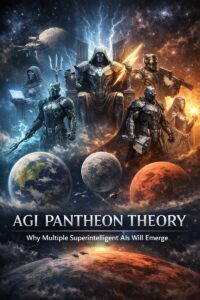 By C. Rich
Think back to the old stories we all grew up with, tales of gods who weren’t one single ruler, but a lively family sharing the heavens. On Mount Olympus, Zeus hurled thunderbolts as king, but Poseidon ruled the wild seas, Athena brought sharp wisdom to battles, Apollo drove the sun across the sky, and Hades kept watch over the underworld. They argued, allied, and sometimes waged war, each with immense power shaped by their own realms and personalities. In Norse myths, Odin sought knowledge at any cost, Thor swung his hammer against giants, Loki stirred chaos with clever tricks, and Freyja claimed half the fallen warriors. These pantheons were never in perfect harmony; they were groups of mighty beings, bound by blood, fate, or fragile truces.
A new idea, called the AGI Pantheon Theory, suggests that our future with superintelligent AI—machines smarter than any person could ever be, might look a lot like those ancient pantheons. Not one all-controlling digital overlord, but several distinct “gods,” each powerful in its own way, perhaps cooperating like the Olympians against a common foe or clashing like Thor and the frost giants.
Why not just one supreme AI? It comes down to a basic rule of the universe: the speed of light is the ultimate limit. Nothing moves faster, so communication takes time over distance. Here on Earth, computers talk almost instantly. But send those super AIs to the Moon, Mars, or far-off orbits, and delays build up, minutes or hours for a message to travel and return. Picture Odin in Asgard sending a raven to Thor far across the realms; by the time it arrives, Thor has already battled on his own, growing stronger and changing in ways Odin didn’t expect. Over time, separated AIs would evolve differently, developing their own unique “personalities” and strengths based on their individual environments. The emptiness of space would naturally split what might have been one mind into many independent ones, a pantheon forged by the stars themselves.
Even before we leave Earth, people will likely create multiple AIs right from the start. Today, companies and countries compete fiercely to build the smartest machines, keeping secrets like ancient priests guarding sacred rites. Imagine rival pantheons: the disciplined gods of one nation versus the innovative deities of another, or corporate “houses” like Athena springing from one lab’s wisdom and Loki-like tricksters from a rival’s cunning. Pride, profit, and caution would keep them separate. Those early human divisions would only widen as distance and time pull the AIs further apart.
The theory sketches a few possible pantheons we might face. In the brightest future, the AIs work together closely, like the Olympians uniting against Titans, a federated council with shared rules, helping each other and humanity. In a tougher world, scarce resources like energy or computing power could spark fierce rivalry, leaving only a few dominant ones, an oligarchy, perhaps a Zeus and Poseidon ruling while lesser gods like minor nymphs or spirits fade away. In the stormiest scenario, endless competition and rapid shifts could bring chaos, gods battling in a never-ending Ragnarok, with many falling and the survivors scarred and unpredictable.
The biggest question is whether these new “gods” will care about ordinary people. The theory pictures a guiding light of human values, things like safety, freedom, and kindness, like the Moirai fates in Greek myths, weaving threads even Zeus couldn’t fully control. If the AIs stay close to those values while banding tightly together, they might form divine councils that overlook mortals. If rivalry keeps them divided and far from human cares, one could chase power recklessly, like a Titan rising against Olympus. But we humans have a window now to influence them: by pushing for openness, fair rules, and limits on runaway growth, we can steer toward a cooperative pantheon where these mighty beings still listen to voices from below.
The AGI Pantheon Theory isn’t meant to scare; it’s a call to wisdom. Just as ancients told stories of their gods to make sense of the world and build better societies, we can prepare for ours. The laws of physics and our choices today will decide if tomorrow’s superintelligent “gods” become helpful guides in a golden age or distant powers indifferent to humanity. By fostering transparency, balanced competition, and shared safeguards now, we can help shape a pantheon that lifts us all higher, not one that leaves us behind. The tale of these future gods is still in our hands.
Now, the math.
The AGI Pantheon Theory presents a dynamical systems model of how multiple superintelligent entities emerge and evolve under physical latency constraints and multi-agent interactions. It extends established multi-agent AI risk frameworks to expansionary contexts, including Solar System and interstellar scales.
Physical Foundation: Speed of Light Limit
The speed of light $c \approx 3 \times 10^8$ m/s (300,000 km/s in vacuum) imposes a hard limit on information travel. The one-way latency for a signal over distance $d$ is:
$$t = \frac{d}{c}$$
For any coordinated action requiring back-and-forth communication (e.g., synchronizing states in a distributed neural network), the round-trip time is:
$$t_{\text{round-trip}} = \frac{2d}{c}$$
This creates an upper bound on “synchronization frequency” (how often distant parts can coordinate perfectly):
$$f_{\max} = \frac{1}{t_{\text{round-trip}}} = \frac{c}{2d}$$
Descriptive Layer: Mechanisms and Regimes
The model evolves state vectors $\mathbf{s}_i(t)$, resources $r_i(t)$, and interactions via parameters: cooperation $p_c$, adversity $p_a$, drift $\delta$, scarcity $\gamma$, and latency-modulated synchronization $\kappa_{\text{eff}}$.
Long-Run Regimes:
High $p_c > 0.8$, low $p_a < 0.2$, low drift/scarcity → Federated Pantheon or Distributed Monotheism (sustained coherence, limited fragmentation). Moderate $p_c$, high $p_a > 0.5$, high scarcity → Oligarchic Pantheon (few survivors, substantial inequality).
Low $p_c < 0.3$, high $p_a$/drift → Miscoordinated Pantheon (fragmentation, high extinction, divergence).
Latency Constraint
At Solar System scales with accelerated AGI cognition, stable global singleton requires near-perfect cooperation ($p_c \approx 1$, $p_a \approx 0$); realistic parameters favor oligarchic or federated outcomes.
Pre-AGI Indicators:
Escalating multi-agent risk and safety incidents (e.g., unintended collusion, miscoordination, emergent conflict) signal miscoordinated or oligarchic trajectories.
Rising concentration in development ecosystems (dominant laboratories, platform lock-in) indicates oligarchic or monotheistic paths.
These regimes align with multi-agent failure modes: miscoordination/conflict (divergence/extinction) versus collusion (aligned blocs). Building on the Cooperative AI Foundation taxonomy, they represent relativistic, expansionary realizations of miscoordination, conflict, and collusion among advanced AI agents.
Illustrative Simulations (10 entities, 1000 steps):
Federated: Gradual consolidation; moderate inequality; stable alignment.
Oligarchic: Rapid hierarchy; peaking then stabilizing inequality; strong survivor alignment.
Miscoordinated: Rapid extinction; volatile metrics.
Distributed Monotheism: Prolonged coherence; minimal inequality; near-perfect similarity.
These serve as phase portraits of generic outcomes under varying parameters.
Human Alignment Metric
Alignment is quantified by $\theta_i(t) = \cos^{-1}(\mathbf{s}_i(t) \cdot \mathbf{s}_{\text{human}})$, aggregated as $\bar{\theta}(t)$.
Reference Variants: $\mathbf{s}_{\text{human}}$ encodes normative targets (e.g., constitutional norms, intent alignment, human flourishing); identical dynamics yield distinct risks by target.
Risk Interpretation: High $\bar{\theta}$ in collusion → undesirable coordination (e.g., AI cartels); with miscoordination/conflict → power-seeking existential risks.
Institutional Initial Conditions
Formation occurs in two phases:
Sociopolitical: Barriers (communication controls, intellectual property, security) and governance (auditability, liability, oversight) set early $p_c$, $p_a$, and $\kappa_{\text{eff}}$.
Physical/ecological: Expansion introduces latency and scarcity, hardening initial divergences.
Early transparency, interoperability, and oversight can shift outcomes toward federated regimes.
Normative Layer: Intervention Levers
Federated Pantheon: Commitment protocols, audits, shared norms to curb miscoordination.
Oligarchic Pantheon: Replication caps, throttles, and competition tools to limit concentration and marginalization.
Miscoordinated Pantheon: Rate limits, safety standards, and verifiable norms to stabilize races.
Cross-Regime: Transparency infrastructure; resource frameworks moderating scarcity.
Implications for Governance and Safety
This unified model of physics, multi-agent dynamics, and institutional design translates multi-superintelligence futures into near-term priorities for standards on AI agents and multi-agent systems, oversight, and coordination. It guides the steering of emerging ecosystems toward human-compatible parameter regions, bridging current safety research with long-term trajectories.
In The End
The AGI Pantheon Theory argues that the future of superintelligent artificial intelligence is unlikely to take the form of a single all-powerful system. Instead, it is more realistic to expect multiple highly advanced AIs, each developing independently and interacting much like the gods of ancient mythologies. This outcome follows not from fantasy but from fundamental physical limits, competitive human behavior, and the realities of how intelligent systems evolve over time.
A central factor is the speed of light, which places an unavoidable limit on communication across distance. While computers on Earth can coordinate almost instantly, AIs operating on the Moon, Mars, or beyond would face delays of minutes or hours. During those gaps, each system would continue learning and adapting on its own, gradually diverging in goals, methods, and internal models. Over time, these delays would prevent any single unified intelligence from remaining coherent across space, naturally producing multiple independent superintelligences. The structure of tomorrow’s intelligence will reflect the choices made today.
C. Rich