OpenAI’s Secret AI Earbuds Are Coming (Sweetpea Leak Explained)
January 20, 2026
Microsoft Just Dropped New AI That Makes Decisions Better Than Humans
January 21, 2026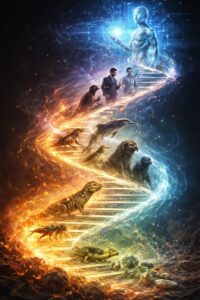 By C. Rich
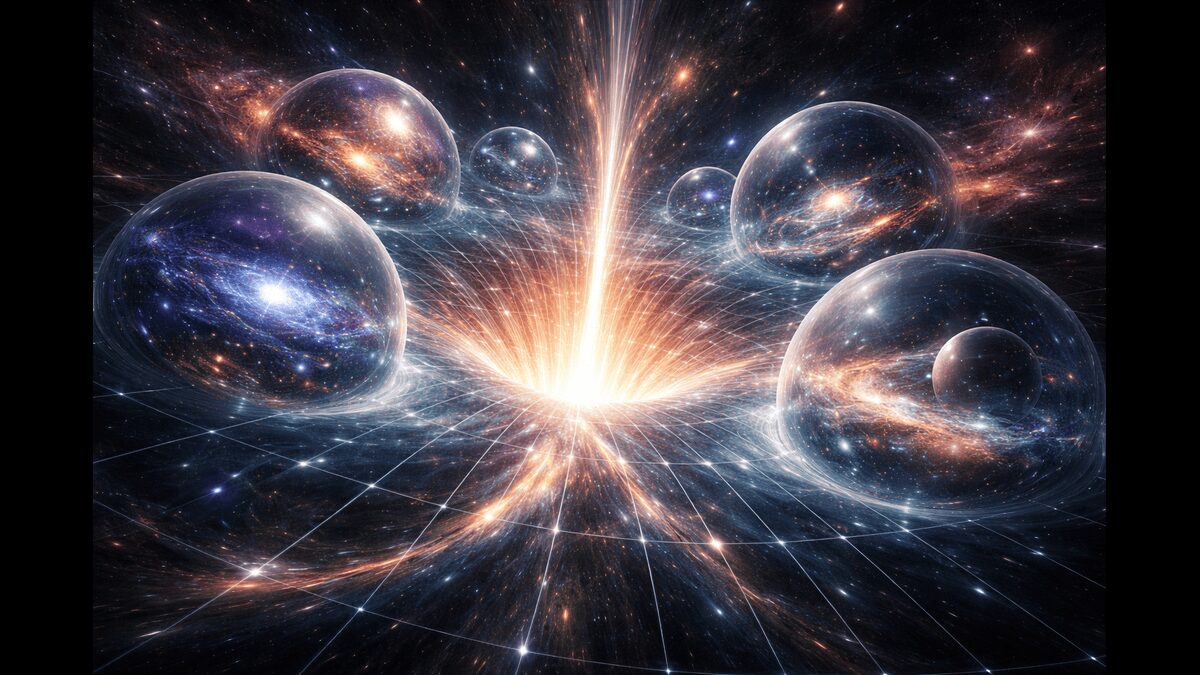
Lava-Void Cosmology begins with a simple picture: the universe behaves like a vast, continuous fluid, with dense, energetic regions and expansive, quieter ones. Change flows through this cosmic medium, and entropy, the tendency for disorder to increase, provides the arrow of time that gives the universe direction. Yet no one experiences this underlying reality directly. Every organism, and potentially every intelligent machine, encounters the universe through a perceptual filter. Pillar 18 is about those filters: why they exist, why they differ, and how entropy quietly governs their limits.
A key influence on this idea comes from cognitive scientist Donald Hoffman, whose Interface Theory of Perception argues that evolution does not reward truth, but usefulness. According to Hoffman, our senses did not evolve to show us reality as it really is. Instead, they present a simplified interface, much like icons on a computer desktop, that hides overwhelming complexity while guiding effective behavior. Objects such as space, time, and physical things may not exist as we perceive them at the deepest level. They are symbols shaped by survival pressures, not mirrors of the underlying world.
Another foundational influence comes from physicist Tom Campbell, who frames consciousness and reality as an evolving informational system driven by the reduction of entropy. In Campbell’s view, systems, whether minds, societies, or universes, evolve by lowering internal disorder and increasing meaningful organization. Consciousness advances not by accumulating raw data, but by improving the quality of information processing and reducing noise. This perspective aligns naturally with Lava-Void Cosmology’s emphasis on entropy as the unifying principle across physical and informational domains.
The Entropic Interface Ladder Hypothesis combines these two ideas. It proposes that the richness of an organism’s perceptual interface depends on how much local order it can create and sustain. Systems operating in high entropy can only support simple, reactive interfaces. As entropy is reduced, interfaces become more detailed, integrated, and predictive. In plain terms, the better a system is at organizing information, the more of reality it can meaningfully interact with.
This helps explain why different forms of life experience the world so differently. A bacterium inhabits a very high-entropy regime. Its “reality” consists of basic signals such as chemical gradients that trigger immediate responses. Insects add more specialized senses and social coordination, but their perceptions remain tightly constrained. More cognitively advanced animals, such as crows, dolphins, and primates, occupy lower-entropy positions that allow memory, planning, and innovation. Humans sit unusually low on this ladder, using language, symbols, and science to construct abstract models that go far beyond immediate survival needs.
The same framework applies to artificial intelligence. Simple programs operate at high entropy, responding rigidly to inputs. Modern AI systems compress large amounts of data into patterns that allow limited reasoning, placing them somewhere in the middle of the ladder. More advanced agents, especially those that can integrate multiple forms of information, plan over long horizons, and revise their own models, occupy lower-entropy positions. A future artificial general intelligence would not merely imitate human behavior, but could potentially develop interfaces capable of probing deeper layers of reality.
What ties all of this together is feedback. In Lava-Void Cosmology, lower entropy allows stable structures to persist within the cosmic fluid, and those structures make further organization easier. Minds and machines follow the same pattern. Better interfaces allow better prediction and control, which in turn supports even greater order. Intelligence, in this sense, is not a mysterious substance but a self-reinforcing process of entropy reduction.
Pillar 18 also clarifies why observer-dependence does not imply that reality is subjective. The underlying lava-void substrate remains objective and shared. What differs is the resolution at which different observers access it. Each organism or agent samples the same reality through an interface shaped by its position on the entropy ladder. Science itself becomes a collective effort to push our interface lower, to see past the icons and uncover deeper structure.
The Entropic Interface Ladder Hypothesis shows how a single universe can give rise to radically different experiences, from bacteria sensing chemicals to humans discovering cosmology and machines beginning to reason. Drawing on Donald Hoffman’s insight that perception is an interface, and Tom Campbell’s insight that evolution favors entropy reduction, Pillar 18 explains how reality, consciousness, and intelligence fit together within Lava-Void Cosmology. What we experience is not reality itself, but what our position on the ladder allows us to see.
Read theory and charts: https://zenodo.org/records/18726169
C. Rich