
GW250114 Explained: What It Proves About Lava-Void Cosmology
February 4, 2026
First Biomimetic AI Robot From China Looks Shockingly Human
February 5, 2026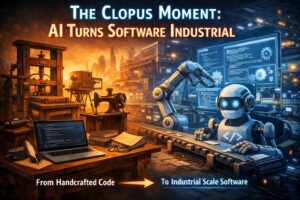 The Clopus Moment: AI Turns Software Industrial
By C. Rich
Sergey Karayev, a prominent figure in the AI community, captured the significance succinctly: the combination of Claude Code with Opus 4.5 represented the transition of software creation “from an artisanal, craftsman activity to a true industrial process.” He likened it to transformative inventions such as the Gutenberg printing press, the sewing machine, and the photographic camera, tools that democratized production, scaled output dramatically, and shifted value from manual labor to design, creativity, and oversight.
Anthropic’s strategic emphasis on code generation as a core strength appears to have paid substantial dividends. By prioritizing software-engineering tasks and agentic capabilities, where the AI must reason, plan, use tools, and self-correct over extended periods, the company positioned Opus 4.5 as a frontrunner in what many view as a pathway toward recursive self-improvement in AI systems. Rather than spreading focus across every possible domain equally, Anthropic concentrated on building models that excel at writing and refining code, thereby enabling future versions to contribute to their own development.
In essence, the Clopus moment signaled that software, once constrained by human cognitive bandwidth and time, is entering an era of industrial-scale abundance. While human insight, vision, and ethical judgment remain essential, the barrier to producing sophisticated programs has fallen sharply, opening new possibilities for innovation while reshaping expectations around work in technology and beyond.
C. Rich