Elon Musk: Optimus 3 Is Coming, Recursive Self-Improvement Is Already Here, and the Singularity #239
March 12, 2026
30 Insane Nano Banana 2 Hacks You Need to Know in 2026 (TUTORIAL)
March 13, 2026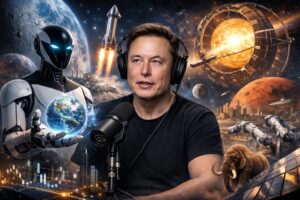 By C. Rich
Musk articulates on the podcast Moonshots 3/11/26 an extraordinarily optimistic and expansive vision of technological and societal transformation driven primarily by advances in artificial intelligence, robotics, energy utilization, and space exploration. Musk asserts that recursive self-improvement in AI systems is already underway to a significant degree, with successive models increasingly constructed by prior ones and humans progressively receding from the loop. He predicts that fully automated recursive self-improvement, without meaningful human intervention, could arrive by the end of 2026 or no later than the following year. This development, he suggests, coincides with an ongoing “hard takeoff,” characterized by rapid, near-daily breakthroughs that render progress difficult to track.
Regarding timelines for artificial general intelligence (AGI) and artificial superintelligence (ASI), Musk indicates that humanity is already experiencing the early stages of a singularity-like acceleration. He highlights Grok’s strengths in predictive capabilities, arguably a core metric of intelligence, and anticipates Grok 4.20 (or subsequent iterations) excelling further, with xAI catching up and surpassing competitors in coding by mid-2026. He envisions future AI intelligence exceeding human comprehension, potentially harnessing energy on scales millions of times greater than current global electricity usage, while still representing only a minute fraction of the Sun’s output.
Economically, Musk forecasts profound abundance. He predicts the global economy could expand tenfold within ten years (by approximately 2036), assuming the absence of catastrophic events such as a major war. This growth would stem from AI and robotics dramatically increasing output, saturating human desires, and leading to deflation as goods and services vastly outpace money supply growth. He foresees a universal high income emerging naturally, not as traditional universal basic income but through issuing resources amid deflationary pressures, ultimately rendering money irrelevant in a post-capitalist paradigm where advanced intelligences prioritize power and mass over currency. Humanity, he suggests, will become a “vast minority” or “microscopic minority” of intelligence on Earth and within the solar system.
In robotics, Musk describes Optimus 3 as poised to become the world’s most advanced humanoid robot, with production commencing in summer 2026 at initially low volumes, scaling to high-volume output around summer 2027. He anticipates annual design improvements and massive factory expansions (on the order of 10 million square feet) dedicated to Optimus production. Robots, he argues, will eventually build robots, elevate per-person output dramatically at companies like Tesla without necessitating layoffs, and enable unprecedented capabilities, such as superior medical care accessible to all, potentially alleviating chronic issues like back pain.
Space-related predictions include a lunar base, human presence on Mars, and a mass driver on the Moon within ten years, aligning with visions of solar system-scale intelligence and energy harnessing (potentially toward Dyson swarm concepts, though details remain constrained by quiet periods). Musk also expresses enthusiasm for de-extinction efforts, such as miniature woolly mammoths as pets, and speculative recreations akin to Jurassic Park.
Overall, Musk’s outlook emphasizes an era of sustainable abundance where AI and robotics solve longstanding challenges, longevity, health, scarcity, and fiscal deficits, while acknowledging risks and the need for vigilance. He advocates measured optimism: realistic about uncertainties yet confident that positive outcomes predominate (perhaps 80% likelihood or higher), provided humanity navigates the transition thoughtfully toward a magnificent, if incomprehensible, future.