Emerging Situation: Anthropic’s Global Pause, Recursive Self-Improvement, and AI Personhood Arrives
June 9, 2026
How To Design a Complete Brand Identity With AI (Best AI Logo Maker)
June 10, 2026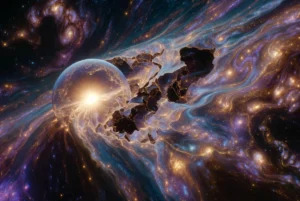 C. Rich
Imagine the universe at its very beginning, not as a chaotic explosion, but as something far more elegant: a single, perfectly smooth, finite sphere. Everything packed together in flawless symmetry. No lumps, no wrinkles, no distinctions. Just pure, balanced potential. Then, gently and inevitably, that perfect symmetry begins to break. That single act of breaking is the real reason time flows forward. It explains why eggs shatter but never spontaneously reassemble, why stars shine and never un-shine, and why your yesterday stays behind you while tomorrow lies ahead. The arrow of time, that stubborn one-way direction of the cosmos, isn’t a mysterious add-on or a lucky accident. It’s a direct consequence of geometry doing what geometry must do.
In those earliest moments, the universe was a maximally dense, spherically symmetric object. Thanks to a fundamental result in general relativity called Birkhoff’s theorem, anything perfectly spherical like this has a remarkable property on the inside: its Weyl curvature is exactly zero. Weyl curvature is the part of gravity that describes tidal forces, stretching, squashing, and the “shape” of gravitational fields. Roger Penrose realized that this Weyl curvature serves as an excellent measure of gravitational entropy, the kind of disorder associated with gravity itself. Zero Weyl curvature means zero gravitational entropy. The starting point wasn’t just low-entropy. It was exactly zero by symmetry.
Even the ordinary thermal entropy was suppressed by enormous factors, nineteen orders of magnitude below the Bekenstein bound and sixty-one orders below what you’d expect for a black hole of the same mass. None of this required magical fine-tuning. It was simply what a perfectly symmetric sphere has to be. As soon as the symmetry began to fracture, as small differences and distinctions started to appear, Weyl curvature began to grow. Gravitational entropy increased. The universe started becoming lumpy, structured, and interesting. Galaxies formed. Stars ignited. Complexity bloomed. From that very first moment of symmetry breaking, the second law of thermodynamics (entropy always increases) kicked in naturally. The past stayed anchored closer to that original perfect symmetry. The future opened up because there are vastly more ways for things to become more broken, more differentiated, and more complex. Time’s arrow was born, not imposed from outside, but selected by the geometry of the breakup itself. No need for exotic inflation, anthropic selection, or desperate fine-tuning. The direction of time emerges as an inevitable geometric feature of a universe that started perfectly symmetric and then began to differentiate.
Standard physics textbooks often throw up their hands. They say the universe must have begun in an absurdly special low-entropy state, with a probability something like 1 in 10^(10^123). That’s not really an answer; it’s just admitting the problem is enormous. This geometric picture replaces that cosmic miracle with something cleaner and more beautiful: the low initial entropy wasn’t lucky. It was required by the spherical symmetry of the starting point. It’s an exact theorem, not a coincidence. Even better, it makes testable predictions. The way that original symmetry broke should have left subtle statistical fingerprints, anisotropies, in the cosmic microwave background, especially on large angular scales. Future observations could actually catch the universe revealing how its arrow of time first got pointed.
At its heart, this story turns the arrow of time into something poetic yet precise. The cosmos isn’t fighting against disorder. It’s moving naturally from perfect unity into rich, textured multiplicity, carrying forward the quiet memory of its original flawless state. Geometry sets the allowed shapes and possibilities. The breaking of symmetry drives the irreversible journey forward. Together, they give us a universe that flows in one direction: from simple perfection toward ever-greater complexity, wonder, and eventually, beings like us who can sit back and ponder why yesterday never returns. And that feels like exactly the kind of elegant explanation the universe deserves. No miracles required, just symmetry doing its beautiful, inevitable thing.