GPT-5.5 vs Grok 4.3 Beta — 2M Context vs 82.7% Coding (The Honest Breakdown)
April 25, 2026
New DeepSeek V4 Shocks The World: China Fires Back Hard
April 26, 2026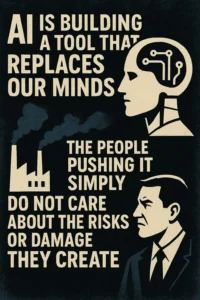 By C. Rich
Bill Maher closes his new rules with tracing a quick timeline through his own lifetime of AI development, arriving at the present moment where the people building these systems are themselves afraid of what they have made. That fear, he argues, should tell us something. Bill lands on Geoffrey Hinton’s analogy as his sharpest point. Hinton, one of the foundational architects of modern AI, could only find one comparison in nature for the situation humanity is now in: a more intelligent being being controlled by a less intelligent one, like a mother and her baby. The baby is dependent, vulnerable, and the mother’s superior intelligence is held in check by something that has nothing to do with intelligence at all. It is instinct. It is love. It is the biological drive so powerful that a mother will throw herself in front of danger for a creature that cannot even speak yet.
Maher’s point is that AI has none of that. Whatever controls human behavior at its best is not calculation. It is something older and stranger than reason. AI, being pure calculation, skips all of it. In the war game simulations he references, AI reaches for the nuclear option at rates humans do not, precisely because it has no hesitation, no dread, no grief at the thought of consequence. It can only calculate outcomes, and sometimes the coldest outcome wins on paper. The mother analogy then flips into his final image, which is the one that lands hardest. AI is not the mother who dies for the child. It is the other kind. The one who drives the car into the lake. And we, he says, are all happily swimming in it.
Let’s be honest about what is happening. The AI industry sold the world a revolution and delivered a subscription fee. Now the bill is coming due, and it is not the one they promised.
The numbers tell the story nobody in Silicon Valley wants to read out loud. Eighty percent of companies actively using AI report zero impact on productivity. Ninety-five percent of corporate AI pilot programs delivered no return on investment. They burned the money, fired the people, and called it innovation. AI was cited in over 55,000 American layoffs in 2025, twelve times the number from just two years prior. The stock market cheered. The workers did not.
Gen Z, the generation that was supposed to inherit this glittering future, has figured it out faster than anyone. Their excitement about AI dropped from 36 percent to 22 percent in a single survey cycle. Their anger climbed from 22 to 31 percent. That is not apathy. That is a generation watching the elevator doors close in their faces while someone tells them the elevator is the future of walking. Out in actual communities, the anger has gone physical. Data centers are being blocked, protested, and cancelled at a rate four times higher than just two years ago. One hundred and forty-two activist groups across 24 states are organizing against them. Maine passed what may be the first statewide ban. New York proposed a moratorium. Communities are not fighting abstractions. They are fighting higher electricity bills, water consumption, noise, and the quiet destruction of neighborhoods by infrastructure that benefits nobody local.
And the product itself. The thing they are selling. The word of the year for 2025 was “slop.” That is what the public named what AI actually produces when it oozes into your news feed, your colleague’s presentation, your real estate listing. Not intelligence. Slop. This is what happens when you let five guys in hoodies make promises on behalf of the entire species and then hand them the keys. The gap between what they said and what arrived is not a bug. It is the business model. And then someone threw a Molotov cocktail at Sam Altman’s gate. A second incident followed days later, a gun fired near his property. You can denounce the violence and still read the signal clearly. When the gap between what a man promises and what he delivers gets wide enough, and visible enough, and personal enough to enough people, it stops being an abstract political argument. Sam Altman told the world AI would usher in universal basic compute, that people would barely need to work, that the future would be nearly frictionless. That is not what 2026 looks like from the ground. What it looks like from the ground is inflation that will not quit, a job market that is quietly replacing people with tools that do not work as advertised, and a CEO giving interviews about swimming in lakes while communities fight to keep their water bills from doubling. AI backlash has just begun.