What Anthropic Must Do Next | MOONSHOTS
April 28, 2026
How to Create Digital Marketing Design With AI in 5 Minutes
April 29, 2026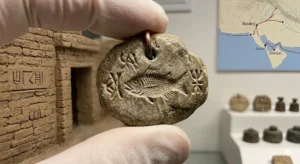 By Charles Richard Walker (C. Rich)
Have you ever thought about where the fish symbol came from or what its connection to Jesus is? The Indus Valley Civilization is a good place to start and is difficult to ignore when it comes to understanding where the fish came from. It is one of the largest and most organized civilizations of the ancient world, and yet it does not conform to the patterns seen in Egypt or Mesopotamia. There is no clear evidence of centralized kingship, no monumental architecture dedicated to rulers, no large-scale militarization, and no written record definitively deciphered. What does exist is a high degree of standardization, uniform weights, consistent measures, planned urban layouts, and a script that appears across a vast geographic area without variation in its basic forms. The system functioned, but it did not reveal the mechanisms that held it together.
Under the standard approach, this absence is treated as a gap. Something must be missing, some form of authority or control that has not yet been found. It asks whether the gap is real or whether the system is operating under a different principle than the one being assumed. If the framework of distinction, boundary, and cost minimization is applied without adjustment, the question becomes whether a civilization can maintain stability through standardization and trust rather than force. The Indus system begins to make sense under that constraint. The uniform weights are not incidental; they are the boundary condition that allows trade to occur without negotiation at every transaction. Urban planning is not aesthetic; it reduces the cost of movement, distribution, and sanitation. The script, rather than being purely linguistic, begins to look like a multi-functional system of marking and certification.
The fish sign is central to this interpretation, not because it has been deciphered in the conventional sense, but because of where and how it appears. It is one of the most frequent symbols in the Indus corpus, and it is found across seals, tablets, and trade goods. In isolation, it can be read as a symbol without fixed meaning. Under pressure, its consistency becomes more important than its translation. It appears in contexts that suggest multiple roles: astronomical, where it aligns with known star groupings; economic, where it is associated with trade items; and administrative, where it functions as a marker of identity or origin. The same sign operating across these domains is not a coincidence. It is a structural feature. It reduces the number of symbols required to manage a complex system by allowing one mark to carry multiple layers of meaning, depending on context.
Balakot provides a physical anchor for this structure. It is a coastal site associated with shell working, particularly the production of bangles that appear throughout the Indus region. The material originates in one location and is distributed across a wide network, maintaining consistent form and quality. Under a force-based model, such a distribution would require enforcement or centralized control. Under a standardization model, it requires only that the mark of origin be trusted. The shell bangle becomes more than an object. It becomes a certified unit, carrying with it the assurance that it meets the standard associated with its source. The chevron patterns and other markings found on these goods begin to function as identifiers within that system, not as decoration.
This is where the framework begins to intersect with material culture in a way that is difficult to dismiss as projection. The same principle that governs large-scale structure, minimizing cost through stable boundaries, appears in the organization of trade. The boundary is not a wall or an army. It is a standard. The cost is not paid in conflict, but in maintaining the integrity of that standard. The system holds not because it is enforced, but because deviation from it carries a higher cost than adherence.
The transition from the Indus world to the mythological record is not direct, and it should not be treated as such. There is no continuous written history that links the two. What exists instead are patterns that persist in altered form. The Apkallu of Mesopotamian tradition are one example. They are described as fish-cloaked sages, bearers of knowledge who emerge from the sea to teach civilization. Under a conventional reading, they are mythological figures. Under the framework being applied here, they can also be seen as a transformation of a role that once had a physical basis. If maritime trade networks carried both goods and knowledge, the individuals associated with those networks would appear as intermediaries between regions, bringing standardized practices with them. The fish imagery, already present in the Indus system, becomes symbolic in a different cultural context, but the association between water, knowledge, and transmission remains.
Dilmun occupies a similar position. In Mesopotamian texts, it is described as a place of purity and abundance, often associated with origins and with the absence of disease or decay. It is also identifiable, in geographical terms, with regions involved in trade between Mesopotamia and the Indus. The idealized description does not need to be taken literally to have meaning. A stable trade hub, operating under a system of trust and standardization, would appear anomalous in a world where most regions are defined by conflict and instability. The language of paradise may be a transformation of that anomaly into narrative form.
Murugan, in the South Indian tradition, introduces another layer. The association with the Pleiades, with specific seasonal cycles, and with protection in travel connects back to both astronomical observation and movement across terrain and sea. The persistence of these associations, long after the original context has changed, suggests that the underlying structure has been preserved even as its interpretation has shifted. The figure is no longer a trader or a navigator in a direct sense, but the attributes tied to those roles remain embedded in the tradition.
The motif of the seven sages appears across multiple cultures, often with variations in form but consistency in function. They are carriers of knowledge, associated with water, stars, or both, and positioned at the boundary between the known and the unknown. Under a purely mythological reading, this is a recurring archetype. Under the framework being applied, it can also be seen as a compressed memory of distributed knowledge systems, where expertise is not centralized but transmitted through identifiable roles that persist across regions.
What matters here is not the claim that these figures correspond directly to specific historical individuals or institutions. That level of identification is not supported by the available evidence, and the framework does not require it. What matters is that the same structural relationships, boundaries, standards, transmission, and cost appear in the material record, in trade systems, and in the symbolic language that survives them.
In this case, the structure holds in a limited but consistent way. It does not produce a complete reconstruction of the ancient world, and it does not resolve the undeciphered aspects of the Indus script. It does, however, provide a way of understanding how a large, stable system could exist without the features that are typically assumed to be necessary. It also provides a way of interpreting the persistence of certain symbols and narratives as transformations of functional structures rather than as isolated inventions.
In the case of the Indus Valley, the fish sign, Balakot, Apkallu, Dilmun, Murugan, and the seven sages do not form a single continuous story. They form a set of points at which the same underlying structure appears in different forms. That is enough. The framework does not need to explain everything about the ancient world to be relevant there. It needs only to demonstrate that it does not break when applied. The fact that it can move from cosmology to trade systems to symbolic traditions without collapsing is not proof of its universality, but it is evidence that it is not confined to a single domain. That is the same standard it has been held to from the beginning. And it is the only reason it continues to be carried forward.
By the time my research started to come into focus in the ancient world, the fish was no longer just a symbol that appeared in one place. It had already shown up in the Indus material in a way that resisted reduction to a single meaning. It appeared in administrative contexts, in trade contexts, and in patterns that suggested astronomical alignment. It functioned as a marker that carried multiple layers at once without breaking under that load. That was the important part. Not what it meant in isolation, but how it behaved across uses.
When the same form appears again in a completely different tradition, separated by time, language, and geography, the question is not whether the meanings are identical. They are not. The question is whether the structure that allows the symbol to carry meaning has been preserved, even as the surface interpretation changes. That is the only question because it is the only one that can be tested without forcing an answer.
The fish in early Christianity is usually treated as a code, a discreet identifier used by a persecuted community to recognize itself. That explanation is not wrong as far as it goes. Symbols often take on protective functions in periods of instability. But that does not explain why the fish, specifically, becomes the carrier of that function, nor does it explain why the symbol appears with such consistency and persistence once it is adopted. The standard explanation answers the immediate question of use without addressing the deeper question of selection.
Under my theory that had already been established, the selection of the fish is not arbitrary. It is consistent with the way symbols had already been shown to operate in earlier systems. A symbol that survives across domains does so because it is efficient. It can carry multiple meanings without requiring modification. It can be read at different levels depending on context. It minimizes the cost of communication while maintaining stability. The fish had already demonstrated that capacity in the Indus material. It is not unreasonable to expect that a symbol with those properties would be selected again, independently, when a new system required a compact, multi-functional marker.
What changes between the Indus world and early Christianity is not the structure of the symbol, but the domain in which it operates. In the Indus system, the fish appears within a network of trade, standardization, and administration. It participates in a system that is materially grounded. In the early Christian context, the same structural properties are applied to identity, belief, and the transmission of doctrine. The fish no longer marks goods or origin. It marks affiliation. It marks belonging. It marks a boundary between those inside a system of belief and those outside it. That boundary is not enforced by force. It is maintained by recognition. This is where the continuity becomes clearer. In both cases, the symbol functions as a low-cost method of maintaining a boundary across distance. In a trade network, that boundary defines trust in goods and standards. In a religious network, trust in shared belief and narrative. The mechanism is the same. The content is different.
The association of the fish with water, movement, and sustenance is also not incidental. In the Gospel accounts, fish appear in multiple contexts: as food, as a means of livelihood for the early followers, and as part of the imagery used in teaching. “Fishers of men” is not a metaphor chosen at random. It is grounded in an existing familiarity with the act of gathering, of drawing something out of a medium in which it is not immediately visible. The language operates at more than one level, and that is consistent with the way the symbol itself operates.
It is important not to overextend this connection. The framework does not require that the fish symbol in early Christianity be directly inherited from the Indus system. There is no continuous line of transmission that can be demonstrated in the historical record. What the framework does allow is the recognition that certain symbolic forms are stable under pressure because of how they function, not because of where they come from. When a system needs a marker that can operate across contexts, it will tend to select from a limited set of forms that can carry that load. The fish is one of those forms. My approach does not attempt to decode the symbol in the sense of assigning it a single, fixed meaning. It tests whether the symbol can be understood as part of a structural system that persists across domains. In this case, the test is whether the fish continues to function as a boundary marker, a carrier of layered meaning, and a low-cost method of maintaining coherence within a distributed system.
In early Christianity, it does. The symbol appears in inscriptions, in art, and in informal markings. It is simple enough to be drawn quickly, recognizable enough to be identified at a glance, and flexible enough to be used in multiple contexts without losing its core function. It does not require literacy to be understood at a basic level, and it can carry additional meaning for those who are initiated into the system. These are the same properties that made it effective in earlier contexts, even if the content it carries has changed. The connection between the fish and the figure of Jesus is therefore not just symbolic in the narrow sense. It is structural. The teachings associated with that figure emphasize transmission without centralized enforcement, the formation of communities that are bound by shared understanding rather than imposed authority, and the persistence of those communities across distance and time. The symbol that comes to represent that system shares those same properties. It operates without force, it maintains a boundary through recognition, and it carries meaning that can be accessed at different levels.
This does not require a direct historical link to earlier civilizations to be meaningful. It requires only that the same constraints are present. When a system needs to maintain coherence without centralized control, it will select for structures that minimize cost and maximize stability. Symbols that can operate across domains, like the fish, will tend to reappear because they satisfy those constraints. The point is not to claim that ancient trade networks and early Christianity are the same system. They are not. It is to show that the same underlying logic can produce similar structures in different contexts. The fish is not important because of what it represents in any single tradition. It is important because of how it behaves when it is placed under pressure. It does not break. And that is the only reason it remains part of this record. By the time the fish appears again in the record, it is no longer a local symbol. It has already passed through multiple systems, carried multiple meanings, and survived the collapse of at least one civilization that used it in a way we are only now beginning to understand. It does not arrive in the first century as something new. It arrives as something that has already proven it can endure.
That matters because nothing about the world into which Jesus of Nazareth was born was stable. The eastern Mediterranean in the first century was not a unified cultural space. It was a layered environment of Roman authority, Greek language, Jewish law, and older mythic frameworks that had never fully disappeared. Trade routes moved goods and ideas in both directions. Religions overlapped, competed, and absorbed one another. Nothing in that environment existed in isolation, and nothing that survived did so by remaining pure.
Into that world comes a man who, by every available historical measure, does not resemble the figure that would later be built in his name. He is a Jewish teacher operating within a Jewish framework, speaking to Jewish audiences, using language that assumes familiarity with Jewish law and tradition. The structure of his teaching, at least in the form preserved in the Gospel of Thomas, does not point outward toward institution. It points inward. The Kingdom is not a place to be entered later. It is something already present, something to be recognized rather than constructed. There is no call to build a hierarchy. There is no instruction to establish a system that extends beyond the immediate community. There is, instead, a repeated emphasis on perception, on recognition, on bringing forth what is already there.
That kind of teaching does not scale easily. It can be transmitted from person to person. It can form small, cohesive groups. But it does not, on its own, generate the kind of structure required to persist across distance and time in a hostile environment. The moment the original community is disrupted, the teaching fragments. That is not a flaw. It is a property of the system. A structure that minimizes hierarchy also minimizes its ability to enforce continuity. This is where the fracture begins. The earliest movement does not remain singular. It divides along lines that are not immediately visible from the outside but become decisive over time. There is the Jerusalem group, centered around James, maintaining continuity with Jewish law and practice. There is the Pauline stream, moving outward into the Gentile world, translating the message into a different framework entirely. And there are the communities associated with Thomas, preserving a version of the teaching that remains closer to its original form, but without the institutional structure that would allow it to dominate.
These are not minor variations. They are fundamentally different solutions to the same problem: how to carry a teaching beyond the conditions in which it was first given. The Pauline solution is the one that survives. It survives not because it is closer to the original, but because it is more adaptable. It introduces a framework that can be extended, standardized, and enforced. It translates the figure of Jesus into terms that are already familiar in the wider Mediterranean world: divine birth, sacrificial death, resurrection, and cosmic significance. None of these elements is invented in isolation. They are drawn from an existing vocabulary that has been in circulation for centuries. What changes is not the existence of those ideas, but their application to a new figure.
This is not where the fish enters. It is already there. Symbols do not wait for doctrine to catch up with them. They move through systems independently, attaching themselves where they are useful. By the time early Christian communities began to coalesce, the fish had already demonstrated that it could function as a marker across domains. It is simple, recognizable, and capable of carrying layered meaning without requiring explanation. In a context where communication must remain discreet, where identity must be signaled without exposure, and where literacy cannot be assumed, those properties are not incidental. They are decisive.
The fish becomes a marker of recognition. At the most basic level, it identifies those who belong to a shared understanding. But that is only the surface function. Beneath that, it operates as a boundary. It separates those who are inside the system from those who are outside it, not through force, but through recognition. It does not need to be explained to those who already understand it. It does not need to be defended against those who do not. It simply marks a line. That is the same role it played in earlier systems.
In the Indus context, the fish sign appears as part of a network that required trust across distance without centralized enforcement. It marked goods, origin, and participation in a system that functioned without visible coercion. The symbol did not enforce the system. It allowed the system to recognize itself. In the early Christian context, the same structural role emerges in a different domain. The network is no longer commercial. It is communal and doctrinal. But the problem is the same: how to maintain coherence across distance without relying on force. The fish solves that problem again.
It is important to be precise here. This is not an argument for direct transmission from the Indus Valley to early Christianity. There is no continuous line that can be drawn in the historical record that would support that claim. What can be observed is that the same constraints produce the same solutions. When a system requires a symbol that can operate across multiple contexts, that can be recognized without explanation, and that can maintain a boundary without enforcement, it will tend to select forms that satisfy those requirements. The fish is one of those forms. As the movement expands, the symbol persists. It appears in inscriptions, in informal markings, and in the spaces where communities intersect. It does not carry the full weight of doctrine. It does not need to. Its function is not to explain. It is to identify. The explanation develops around it, not within it. Then the environment changes. What begins as a distributed set of communities becomes, over time, a system that can no longer remain informal. As the movement grows, it attracts attention. As it attracts attention, it encounters resistance. As it encounters resistance, it adapts. The process that follows is not unique to Christianity. It is what happens when any distributed system reaches the threshold where it must either formalize or dissolve.
Formalization requires structure. Structure requires agreement. Agreement requires enforcement. This is where the Roman phase begins to reshape the system in a way that cannot be reversed. The debates that had existed at the margins become central. The variations that had been tolerated become problems to be resolved. Figures like Irenaeus begin to define what is acceptable and what is not, reducing a range of texts and interpretations into a smaller, controlled set. The canon is not discovered. It is selected. What does not fit is excluded. Then comes the moment where enforcement becomes external. When imperial power is applied to theological questions, the system changes in a fundamental way. It is no longer enough to agree internally. There are consequences for disagreement. Exile, suppression, and eventually violence become tools for maintaining coherence. The interior teaching that requires no institution cannot survive in that environment without being transformed. It is transformed.
The figure of Jesus is stabilized into a form that can support the structure being built. The teachings are reframed within a system that requires hierarchy, doctrine, and authority. The movement becomes an institution. The institution becomes an apparatus. The apparatus persists. Through all of this, the fish remains. Its role does not expand to match the complexity of the system built around it. It does not need to. It continues to function at the level it always has: as a marker of identity, a boundary drawn through recognition. It appears on the edges, in the margins, in the places where the system still needs to identify itself at a glance. This is where the convergence becomes clear. The fish and the system are not the same thing. One is a symbol. The other is an institutional structure. But they solve the same problem at different scales. The symbol maintains coherence at the level of recognition. The institution maintains coherence at the level of enforcement. One operates without force. The other depends on it. That distinction is not moral. It is structural.
The teaching associated with Jesus, in its earliest form, aligns more closely with the first mode. It does not require enforcement. It does not build hierarchy. It operates through recognition. The system that develops later aligns with the second. It requires agreement, enforces boundaries, and constructs a hierarchy that can persist beyond the individuals who maintain it. The fish sits at the intersection of those two modes. It is simple enough to belong to the earlier structure. It is stable enough to persist into the latter one. It does not need to change because the properties that make it effective are not tied to a specific doctrine. They are tied to the problem of maintaining coherence under constraint. That is why it survives. Across systems, across time, across collapse and reconstruction, the fish remains because it continues to do what it has always done. It carries identity without explanation. It marks boundaries without force. It allows a system to recognize itself. Everything built around it changes. The symbol does not. And that is the only reason it is still here.
Read More on OSF