Rick Ross ft Drake – Aston Martin Music (1950’s Soul Version)
May 20, 2026
How To Translate Your Website Into Multiple Languages Using AI (SEO-Ready)
May 21, 2026 By C. Rich
Imagine a puzzle where the pieces are so perfectly aligned that you can’t tell where one ends and the next begins. For decades, theoretical physicists have been staring at one particular masterpiece of a puzzle called string theory. It is a mathematical marvel that explains how particles behave at low energies, smoothing out the violent quantum chaos of the subatomic world into beautiful, predictable patterns. But recently, a group of scientists pulled off a magic trick. They showed that if you assume a few basic rules of cosmic etiquette, such as everything being perfectly smooth, balanced, and lacking any memory of where it came from, string theory pops out of thin air, almost from nothing.
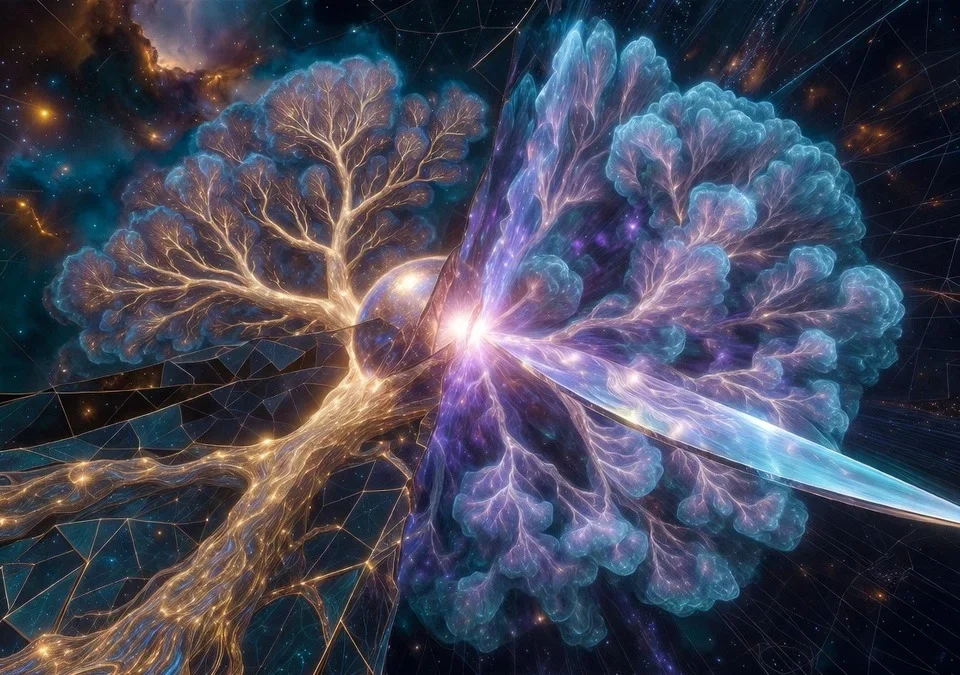
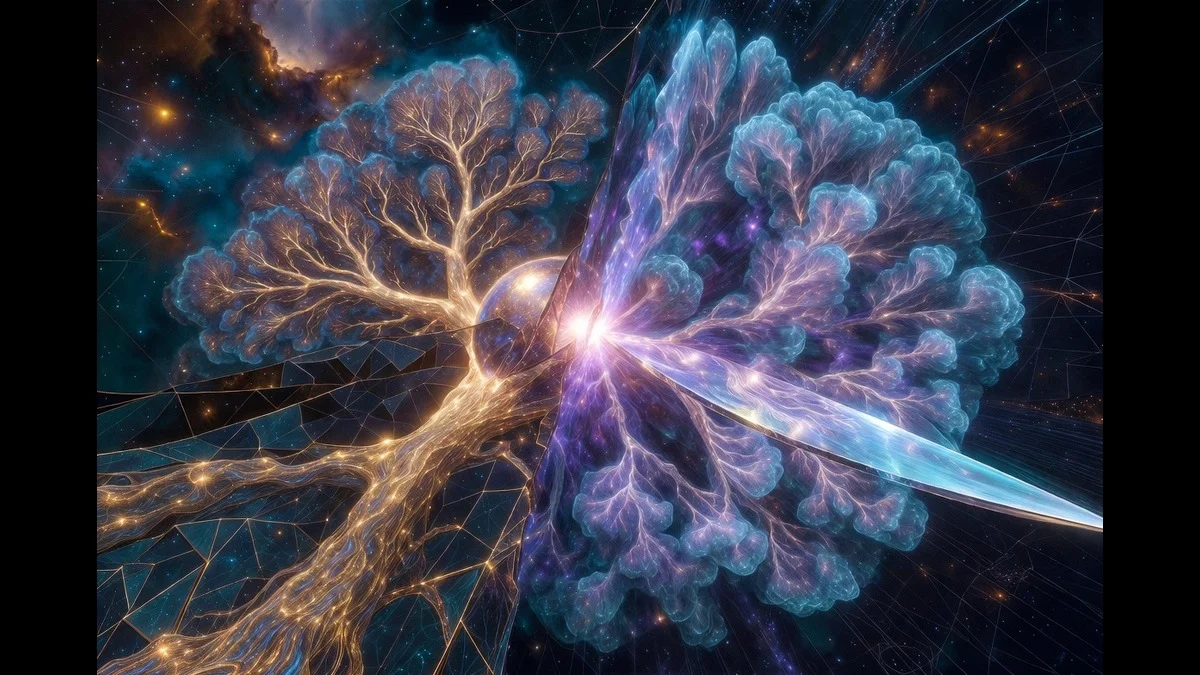
This brings us to our current cosmic detective story, which begins with a fundamental question: What if the universe actually does have a memory? In our research program, we took a step back from the idealized, memoryless boxes often used in physics models and looked at a concept called the Cosmological Pangaea. Instead of starting with an infinite, smooth, empty void, this framework suggests the universe began as a single, profoundly orderly, ultra-dense object that began fracturing into pieces. To understand how the mathematical elegance of string theory could bubble up from such a jagged, broken beginning, we had to look closely at the architecture of the cracks.
The architecture we discovered is anchored to a geometric shape known as the 24-cell. If a regular cube is a three-dimensional object, the 24-cell is its hyper-dimensional cousin existing in four spatial dimensions, boasting a flawless symmetry governed by the exceptional Lie algebra known as $F_4$. Think of this geometry as a cosmic jungle gym. When the universe fractured, it didn’t break randomly; it cracked along the clean, geometric lines of this $F_4$ weight lattice. We introduced a small number into the equations, a deformation parameter symbolized by the Greek letter epsilon ($\epsilon$), which acts as a measure of cosmic glue, or residual coherence, holding adjacent broken domains together.
Here is where the magic happens for both the layman and the scientist. On our geometric jungle gym, particles are not point-like dots; they are extended excitations, or flags, moving across the structure. As these flags climb the lattice, their transitions are strictly regulated by integer steps. This canonical height grading acts as a set of stairs. Every time an excitation climbs a step, its energy, or mass-squared, increases by a perfectly predictable, linear increment. This naturally produces a structural tower of mass states. To a physicist, this linear mass tower is the holy grail because it perfectly mirrors the Regge trajectories found in string theory, assigning a tangible physical slope to what strings usually assume as a starting condition.
To see this in action, we built a simplified toy model that projects these complex multi-dimensional paths onto a one-dimensional chain. We sent excitations wandering across this network and calculated their transition amplitudes, essentially predicting the likelihood of how they would scatter off one another. For a specific glue strength, say an epsilon value of $0.03$, we calculated the exact locations and strengths of the energy poles. At the ground level, the interaction looks like a standard contact term. But as you ascend to higher levels, the math reveals explicit numbers, like an excitation level at $0.03$, then $0.06$, and $0.09$, with each higher step becoming exponentially suppressed because longer, winding paths across the fractured fragments are harder for nature to sustain.
What does this look like from far away? If you are a macroscopic observer looking at this system from a low-energy vantage point, your eyes cannot resolve the sharp, discrete edges of the underlying 24-cell scaffold. The individual steps of our lattice stairs blur together into a seamless haze. In this coarse-grained infrared limit, the statistical sums over all those tiny, glued-together paths smooth out perfectly, mimicking the exact behavior of string scattering amplitudes. String theory, it turns out, is not the fundamental fabric of reality in this framework; it is the unresolved infrared shadow cast by a deeper, discrete geometric memory.
The beauty of this synthesis is that it turns a critical argument into a cooperative one. We are not saying the string theoreticians are wrong; we are showing that their elegant formulas are the natural, memoryless special case of a much richer, structurally grounded cosmology. Furthermore, because our model remembers its geometric roots, it leaves behind unique, falsifiable clues. At incredibly high energies, the continuous illusion breaks down, the discrete grid becomes visible, and specific geometric selection rules kick in to create distinct corrections that standard string landscapes cannot easily explain.
There are still vast frontiers left to map in this program, including how collective deformations of the scaffold might create gravitons, how matter fields split into generations of fermions, and how to fully quantize the pre-geometric space. We have explicitly kept these open questions separate from our verified kinematic results to maintain absolute scientific integrity. We haven’t built a completed theory of everything, but we have established a definitive, intellectually coherent beachhead. By proving that string-like dynamics can be derived from the inherent topology of an $F_4$ lattice and a single coherence parameter, we have offered a new way to understand why the universe speaks in such a beautiful mathematical language.