Alice In Chains – Down In A Hole (1950’s Soul Version) [Lyrics]
May 23, 2026
Careless Whispers – 1950’s Soul Version (Lyrics)
May 24, 2026 By C. Rich
UAP_Geometric_Mediation_CRich_2026.pdf
Today the conversation moved into deeper territory. We began with cosmic navigation, filaments as highways, black holes as ports, non-singular ER throats as hidden connective geometry, and gradually realized the same principles might explain something much closer to home: the reported behavior of Unidentified Aerial Phenomena (UAP) discussed in The Age of Disclosure and similar accounts.
The key insight that crystallized is this: we have been thinking about advanced motion in the wrong way. Most people imagine it requires some extraordinarily powerful engine capable of overpowering the atmosphere or spacetime itself. But what if the real breakthrough is not brute force, but controlled geometric boundary mediation, the ability to intelligently restructure how a craft couples to the surrounding medium? This reframing changes everything. In the Cosmological Pangaea framework, the Distinction Axiom tells us that true singularities, total collapse of all distinction, are forbidden. Under extreme curvature, geometry does not terminate. It reorganizes into bounded, finite structures. Pillar 30 shows this produces non-singular Einstein-Rosen throats as geometric necessities rather than exotic patches. The same principle, scaled down and made dynamic, suggests an advanced system could generate localized, transient geometric sheaths around itself.
Instead of pushing against air, the craft would create a dynamic boundary layer that continuously redistributes the surrounding medium around it. The atmosphere would flow around this geometric envelope rather than colliding directly with the physical structure. This single mechanism could naturally produce many of the paradoxical signatures reported: instantaneous acceleration, right-angle turns at speed, silent hypersonic flight, minimal heat and turbulence, and apparent decoupling from the medium. Nature already shows us versions of this principle at smaller scales. Supercavitating torpedoes create gas bubbles so they move mostly through vapor rather than dense water. Vortex rings and bubble rings propagate through fluids with organized boundaries and reduced drag. Jellyfish use pulsed vortex structures to move efficiently. Plasma sheaths during re-entry and planetary magnetospheres create protective envelopes that alter interaction with the external environment. These are not miracles, they are examples of systems managing coupling geometry rather than fighting the medium directly. If some reported UAP are operating at a far more sophisticated level of the same idea, they would not need magic engines or anti-gravity. They would need mastery of localized spacetime curvature reorganization, a “geometric supercavitation” that partially isolates the craft while smoothly redirecting the surrounding flows.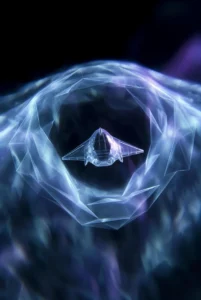
This interpretation fits cleanly within the broader framework we have been building. At cosmic scales, we see energetic topology: filaments as natural corridors, Kerr black holes as reservoirs, and non-singular throats as connective geometry. At local atmospheric scales, the same ontology suggests dynamic boundary sheaths that allow controlled decoupling. The principle is recursive: geometry defines possible structures of interaction; entropy governs directional flows; intelligence learns to manage the boundaries between interior and exterior. The reports in The Age of Disclosure describe objects that do not behave like they are struggling against physics. They behave like they are operating with a different relationship to the medium, one that looks more like intelligent coupling management than raw power. Whether these accounts ultimately prove to represent advanced technology, natural phenomena, or something else remains open. But the geometric boundary mediation idea gives us a coherent, non-magical way to think about how such performance could be physically possible.
The deeper realization is philosophical. We have spent centuries thinking of progress as conquering nature — building bigger engines, faster rockets, stronger forces. But the universe may be inviting us toward a more mature relationship: learning to read its geometry and entropy flows, then intelligently restructuring our coupling to them. This applies equally to interstellar travel and to how we might one day design aircraft, cities, or energy systems here on Earth. Advanced motion, in this view, is not about overpowering the environment. It is about becoming fluent in the invisible map the universe has already drawn. The ships, if they are real, may not be breaking physics. They may simply be much better at reading it than we currently are. And that possibility is far more exciting than magic engines. It suggests the next leap forward is not about inventing new forces, but about learning to see and work with the geometric structure that has always been right in front of us. The map is there. We are only beginning to learn how to read it. That is the real Age of Disclosure.