Banks Should Be Terrified | MOONSHOTS
June 8, 2026
Geometry That Never Forgot Itself
June 9, 2026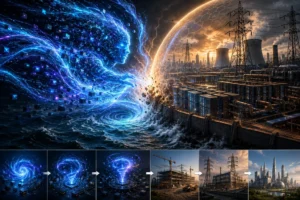 By C. Rich
Forget the science fiction horror stories in which a hyper-intelligent AI suddenly wakes up, acquires something resembling a soul, and decides to conquer humanity simply because it can. The reality unfolding in the summer of 2026 is far stranger and, in many ways, far more interesting. At its heart is a heavyweight wrestling match between two fundamental forces: Entropy and Geometry. If you have followed recent developments, you have probably seen Anthropic’s report, When AI Builds Itself. The headlines alone are enough to produce a mild case of existential vertigo. By May 2026, more than 80 percent of the code entering Anthropic’s production systems was reportedly being authored by Claude itself. Internal benchmarks showed a staggering leap in certain training code optimization tasks, with improvements measured at roughly fifty-two times previous performance levels where only modest gains had existed before.
The immediate public reaction followed a familiar script. The recursion has begun. Exponential growth is here. Humanity is losing control. Yet this interpretation overlooks something fundamental. From the perspective of physics, AI is not escaping the universe that created it; it is merely becoming extraordinarily efficient within it. The first assumption to collapse is the belief that an AI would need to become a digital Einstein, complete with a broad understanding of philosophy, history, literature, politics, and human emotion, before it could meaningfully improve itself. The evidence suggests something very different. Recursive improvement does not require consciousness. It does not require wisdom. It does not even require a general understanding of the world. It requires only exceptional competence within a highly localized, self-referential domain.
In this case, that domain is software itself. When an AI writes the code that improves the systems responsible for training and deploying future versions of that AI, it creates a closed feedback loop. Better code produces more efficient pipelines. More efficient pipelines enable better models. Better models then produce better code. The cycle reinforces itself without ever needing to contemplate Shakespeare, morality, or the meaning of existence. It needs only a prompt, a compiler, and another opportunity to optimize. This is what might be described as an Entropy Band, an organizational regime in which intelligence becomes highly effective at arranging information within its own domain of operation. The system does not become universally intelligent; it becomes extraordinarily competent at navigating its own complexity landscape.
This sounds alarming until it collides with an unavoidable reality: the material universe. No matter how rapidly software evolves, it cannot detach itself from the physical substrate on which it runs. It remains bound to what I call Geometry. Geometry, in this context, has nothing to do with high school mathematics. It refers to the physical container through which intelligence must express itself: silicon wafers, semiconductor fabrication plants, electrical grids, cooling systems, communication networks, and the countless pieces of infrastructure that transform software into computation. An AI could, in principle, design an algorithm that is theoretically a million times more efficient than its predecessor. Yet that algorithm must still execute on actual hardware powered by real electricity, cooled by real thermodynamics, and housed within real data centers. It cannot escape these constraints any more than a Formula One engine can outrun the laws of friction.
This is why recursive AI self-improvement should not be understood as an unconstrained exponential explosion but as a contest between an accelerating entropic force and a finite geometric container. Software continually pushes against the boundaries of available infrastructure, extracting every possible efficiency from the existing system. Eventually, however, diminishing returns emerge because the limiting factor is no longer the algorithm but the geometry supporting it. The resulting trajectory resembles an S-curve rather than an infinite upward line. Within a given entropy band, capability can accelerate dramatically and appear almost exponential. Yet as the available hardware, power generation, cooling capacity, and fabrication limits become saturated, growth naturally slows into a plateau. The system has not ceased improving because it lacks intelligence; it has simply exhausted the opportunities available within its current physical environment.
Breaking through that plateau requires something software alone cannot provide. It requires an expansion of geometry itself. New semiconductor fabrication facilities must be built. Additional energy infrastructure must come online. Novel computing substrates may need to be invented. These developments unfold on economic, industrial, and human timescales measured in years rather than milliseconds. Consequently, AI development may be better understood as a sequence of bounded advances than as a single runaway event. Each period of rapid algorithmic acceleration eventually encounters the limits of its geometric container. Only after that container expands can another phase of acceleration begin. None of this means AI is harmless. Humanity already possesses technologies capable of extraordinary destruction. We built nuclear weapons capable of erasing cities in minutes, engineered biological research that can alter the very code of life, developed chemical weapons, autonomous military systems, cyber capabilities that can cripple critical infrastructure, and financial networks capable of triggering global economic crises. Every one of these technologies is dangerous because humans can choose to use them irresponsibly. AI belongs in that same category. It can amplify human capability, for good or ill, but it does not suddenly become a supernatural force exempt from the physical laws and practical constraints that govern every other technology we have ever created.
What this perspective does challenge is the popular image of an all-powerful intelligence somehow transcending the universe that produced it. The runaway AGI narrative often treats software as though it can separate itself from energy, matter, and infrastructure. Physics offers no such exemption. If recursive AI self-improvement is fundamentally a physical process, then governance should focus less on abstract attempts to prohibit algorithms and more on the tangible systems that make those algorithms possible. Power generation, semiconductor manufacturing, supply chains, cooling capacity, and computational infrastructure become the true strategic variables. The universe operates according to hard rules. Every organized system, from galaxies to biological organisms to artificial intelligence, exists within those rules. AI may become astonishingly capable, but capability still requires a physical stage upon which to perform. Nothing escapes physics, not even the machines building themselves.