Michael Jackson – Wanna Be Startin’ Somethin’ (1950’s Soul Version)
June 12, 2026
The Fable 5 Backlash Is Getting Serious
June 12, 2026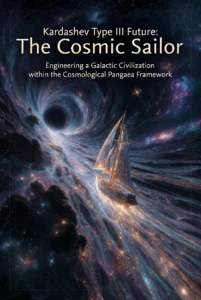 C. Rich
Imagine this: instead of a galaxy-spanning empire of Dyson spheres humming like cosmic factories, the pinnacle of civilization is a fleet of elegant ships riding invisible currents across the universe, borrowing momentum from black holes, surfing filaments of dark matter, and treating entropy not as the enemy, but as the wind in their sails. Welcome to the Cosmic Sailor vision. It’s equal parts hard physics, grand adventure, and a much-needed attitude adjustment for how we think about becoming a Kardashev Type III civilization. Nikolai Kardashev’s 1964 scale is brilliantly simple: Type I harnesses a planet, Type II a star, Type III an entire galaxy. For decades we’ve pictured this as ever-bigger engines, fusion reactors, matter-antimatter drives, Dyson swarms sucking stars dry. It’s the ultimate “more power!” philosophy. It works great for getting to Mars. But scaling that mindset to millions of light-years and millions of years? You slam into thermodynamics, logistics nightmares, and the horrifying fragility of centralized mega-structures. Build a galactic grid and a single Crest-Null-style collapse (those dramatic peaks-and-resets civilizations seem doomed to) could wipe it out.
Enter the Cosmological Pangaea framework. It says: the universe already built the infrastructure. We don’t need to conquer the cosmos. We need to learn to sail it. Forget the Big Bang singularity as a math headache. Picture instead a single, finite “Pangaea Object”, a perfectly symmetric, ultra-dense ball containing all the mass-energy of the observable universe. Thanks to Birkhoff’s theorem and Penrose’s gravitational entropy ideas, this object had exactly zero Weyl curvature inside. Zero gravitational entropy. Perfect order baked into the geometry itself. Then symmetry broke. Distinction entered the universe. Curvature appeared. Entropy began to flow. What followed was the greatest construction project in cosmic history: the cosmic web. Filaments became the superhighways, dense rivers of gas, dark matter, and gravitational gradients stretching tens of millions of light-years. Voids became the open oceans between them. And at the nodes where filaments meet? Galaxy clusters anchored by massive rotating (Kerr) black holes, natural reservoirs of stored rotational energy just waiting to be tapped.
The universe didn’t scatter random stars across empty space. It built a navigable ocean, complete with currents, trade winds (gradients), and ports (those Kerr black holes with their ergospheres where spacetime itself is dragged around like a cosmic whirlpool). Entropy, that villain from every thermodynamics textbook, turns out to be the ultimate shipwright. It carved the channels. It created the gradients. It is the wind. We already know how to do this on a baby scale. Voyager 1 and 2 didn’t brute-force their way to interstellar space, they stole momentum from Jupiter and Saturn like clever pickpockets of orbital mechanics. Gravity assists. The Cosmic Sailor simply scales this up. Why burn insane amounts of fuel crossing voids when you can ride filamentary corridors where the universe has already concentrated mass, energy, and momentum? Why fight spacetime when you can read its Weyl invariants (those mathematical measures of tidal distortion and gravitational entropy) like a sailor reads the stars and waves? Your instruments become the geometry itself. Your “sails” are clever trajectories and timing. Your ports are black holes where you can extract energy from the spin of the universe. It’s not lazy. It’s elegant. It’s working with 13.8 billion years of cosmic engineering instead of against it.
Here’s where it gets wild, and where the fun really starts. A voyage along a major filament might take a million years. A million years. That’s not a bug; it’s the operating environment. Human lifetimes, election cycles, and quarterly reports simply don’t apply. This is where the Resurrection Ship concept shines. Not a metaphor for some sci-fi resurrection, but a distributed, self-repairing, AI-augmented vessel (or fleet) that carries not just data archives, but living civilization, adaptive intelligence that can keep thinking, evolving, and remembering across deep time. Flesh and blood? Great for planets. For million-year journeys, you want minds that treat time as a navigational dimension rather than a deadline. The industrial mindset says: “Build bigger engines to beat the universe.” The Sailor mindset says: “The universe already built the ocean. Read it. Ride it. Become part of its story.” It’s profoundly optimistic. The cosmos isn’t a hostile void or an indifferent machine, it’s a legacy. A gift from the primordial Pangaea Object that spent billions of years setting up the ultimate adventure playground for any species (or post-species intelligence) wise enough to stop conquering and start navigating.
And the best part? We’re already on the ramp. Reusable rockets, orbital industry, lunar bases, AI companions, and surveys like the Sloan Digital Sky Survey are giving us the first charts. The tools we need for the transition are the same ones we’re building today. Becoming a Type III civilization might not look like a glittering galactic empire of endless power plants. It might look like quiet, patient ships gliding along ancient cosmic filaments, stopping at Kerr ports to refuel from the spin of black holes, carrying cultures that remember their origins across eons. The frontier never disappeared. It just changed medium, from rivers to oceans to space. Now the medium is spacetime itself, and the greatest sailors will be those who understand that the universe has been preparing the voyage for us all along.
So here’s the invitation, to both the physicists crunching Weyl tensors and the dreamers staring at the night sky: The ocean is already in motion. The map is written in gravity and memory. The wind is entropy. Let’s stop building factories in space and start learning to sail. The Cosmic Sailor era isn’t coming. It’s waiting for us to read the currents.