Toploader – Dancing In The Moonlight (1950’s Soul Version)
June 11, 2026
Michael Jackson – Wanna Be Startin’ Somethin’ (1950’s Soul Version)
June 12, 2026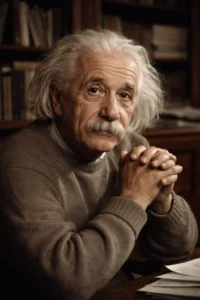 By C. Rich
Every once in a while I get bored, and when that happens, history has a tendency to become inconvenient. Most people assume scientific breakthroughs happen because someone spends twenty years pursuing one very specific problem. Sometimes that’s true. But sometimes you’re walking down one road entirely, take a wrong turn, and suddenly find yourself standing in somebody else’s unfinished business. That’s essentially what happened to me. Albert Einstein spent roughly the last thirty years of his life trying to accomplish something he considered unfinished. After giving the world General Relativity, he became obsessed with unifying gravity and electromagnetism into a single geometric framework. He tried five-dimensional geometry, teleparallelism, asymmetric metrics, and several other approaches that would make most of our heads hurt just reading about them. He worked on the problem until the day he died in 1955. History records the effort as a failure.
For years, I accepted that story just like everyone else. Then I started building Cosmological Pangaea. Ironically, I wasn’t trying to solve Einstein’s problem at all. I was trying to answer questions about cosmology, entropy, singularities, the arrow of time, and why the universe appears to possess an underlying geometric order instead of being a random mathematical accident. The deeper I dug, the more one idea kept resurfacing. It seemed almost embarrassingly simple. Before anything can exist, one thing must be capable of being different from another. That may sound philosophical, but think about it. Before there can be distance, there must be two distinguishable locations. Before there can be motion, there must be distinguishable states. Before there can be geometry, there must be something that geometry is distinguishing. I called this the Distinction axiom: the irreducible capacity for A to differ from B.
Once I accepted that as the primitive instead of geometry itself, strange things started happening. Problems that seemed unrelated began collapsing into the same solution. The dimensionality of spacetime became less arbitrary. Several cosmological puzzles fit together more naturally. Singularities, which had always bothered me, stopped looking like inevitable beginnings and started looking like signs that we had begun the story in the wrong chapter. Then one afternoon it hit me. Maybe Einstein wasn’t missing better mathematics. Maybe he was missing one earlier idea. For nearly a century, physicists have largely started with the metric tensor, the mathematical object that describes distances and geometry, and then attempted to extend it until gravity and electromagnetism could coexist inside the same framework. That is an extraordinary engineering problem because you’re trying to modify something that already carries enormous structure.
But what if the metric isn’t the beginning? What if the metric itself is already a consequence? Once I looked at the problem that way, gravity and electromagnetism stopped appearing like two independent fields waiting to be stitched together. They started looking like two different expressions of the same underlying requirement: the preservation of distinction throughout a finite geometric manifold. To the physicist, that sentence translates into Ricci curvature handling the local response to energy and momentum while the Weyl tensor carries the directional transport structure whose vacuum propagation follows Maxwell-like equations through the Bianchi identities. That’s the technical language, and there’s an entire paper devoted to it. To everyone else, here’s the kitchen-table version.
Imagine watching a symphony orchestra and believing the violins and cellos are separate inventions that somehow need to be connected. Then someone walks behind the curtain and discovers they’re both reading from the same musical score. The relationship was always there. We were simply looking at the performance instead of the composition. That’s what this work suggests. It also forced me to rethink one of the biggest assumptions in modern cosmology: the singularity. If everything begins at an infinitely dense mathematical point, then every geometric possibility is effectively allowed. Ironically, the more freedom mathematics has, the harder it becomes to derive a unique physical necessity. In my view, replacing the singular beginning with a finite primordial manifold gives geometry something it desperately needs, boundary conditions. Suddenly the universe isn’t emerging from an undefined point but from a structured object capable of producing order.
Whether that idea ultimately survives scrutiny is exactly what science should determine. I’m not asking anyone to applaud it. I’m asking them to examine it. If the mathematics fails, then it fails, and we all learn something. If observations contradict the predictions, then the idea belongs on the shelf with countless other ambitious attempts to understand reality. But if the framework survives, then something rather amusing may have happened. While trying to understand why the universe exists the way it does, I may have wandered into one of the most famous unfinished projects in twentieth-century physics and discovered that the problem wasn’t asking for another equation. It was asking for an earlier question. Einstein spent thirty years trying to attach electromagnetism to gravity. My conclusion is that neither stands alone. Both emerge from something more fundamental: the preservation of distinction itself. Sometimes history doesn’t need a new genius. Sometimes it just needs someone willing to start one logical step earlier.