How Tech Bros Broke the TV and the AI Experience
June 18, 2026
Attention Economy vs. Cognitive Hyperscalers Problem
June 30, 2026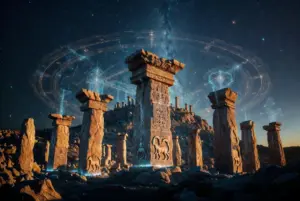 C. Rich
The_Constraint_Cost_Principle
The Echoes in Stone: A Story of How Knowledge Survives the End of the World
Imagine standing on a windswept hill in southeastern Turkey, 12,000 years ago. The air is cold with the lingering bite of a planet still shaking off the last Ice Age. A group of people, hunters, survivors, inheritors of some forgotten catastrophe, gather around massive T-shaped pillars carved with intricate animals: foxes, scorpions, lions, and birds that seem to watch the stars. These stones weigh tons. They are arranged with precision that speaks of geometry and sky-watching. No cities surround them. No fields of grain. Just the monuments, silent sentinels rising from the earth like a message in a bottle thrown across time.
This is Göbekli Tepe, one of humanity’s most haunting archaeological mysteries. For decades, textbooks told us it was built by simple hunter-gatherers at the very dawn of civilization. But what if that story is backward? What if these stones are not the beginning, but the survival kit left behind after the end? This is the heart of Crest-Null Persistence Theory, a powerful new way of thinking about how knowledge, culture, and organized information make it through the great resets of history, and perhaps even deeper cosmic upheavals. It turns the usual tales of rise-and-fall civilizations into something more universal: a gripping drama of information fighting for its life against entropy, collapse, and time itself. Let’s begin with a simple, haunting question that anyone who loves deep history has probably felt: Why don’t we remember?
We know our ancestors survived the Younger Dryas, a brutal 1,200-year cold snap around 12,900 years ago that reshaped the planet. Sea levels rose, megafauna vanished, and human populations were squeezed into desperate pockets. Yet we have almost no specific names, songs, or personal stories from before that threshold. Just myths: floods, lost golden ages, gods walking among us.
The easy answer is that early humans had no writing. Knowledge lived in fragile human minds and voices, passed mouth-to-ear across generations. When famine, war, or climate disaster hits hard enough, those chains break. What survives is stripped down, compressed into legend, the mythic residue that costs the least energy to remember. But then Göbekli Tepe appears like a riddle carved in stone. How did small bands of nomads, without cities or writing, organize thousands of people to quarry, carve, and erect these massive structures aligned to the stars? Conventional history strains to explain it. Crest-Null Persistence Theory offers a more elegant, if startling, narrative: these monuments weren’t built by the survivors as a “first step.” They were inherited from a previous peak of human achievement, a “Crest” civilization that saw its own end coming and prepared a lifeline for whoever came after.


Picture a civilization at its height. Think of our own world today: vast data centers humming with knowledge, just-in-time global supply chains, hyper-efficient algorithms squeezing every drop of performance. Everything is optimized. Redundancy, extra copies, slower but safer ways of doing things, gets trimmed away as wasteful. This is the Optimization Trap, the quiet villain in Crest-Null Persistence Theory’s story. As a society grows more complex and powerful, it piles on more information (I) while shedding the very things that would help it survive a shock: distributed backups (R), durable storage (D), and simple, universal ways for future minds to decode what’s left (recovery capacity). The system looks invincible at its peak. But its true resilience is plummeting. One big disruption, climate shift, pandemic, resource collapse, or something we haven’t imagined, and the whole elegant structure can shatter.
We see echoes of this everywhere. The fall of Rome. The mysterious decline of the Maya. Even warnings about our own fragile electrical grids and digital clouds that could vanish in a solar storm or cyber event. Complexity without resilience is a beautiful house built on sand. So what does a wise civilization do when it senses the approaching “Null”, the transformational reset? It stops trying to save everything. Instead, it focuses on what must survive: the core patterns, the universal constants, the geometric and mathematical truths that any intelligent being, anywhere, could eventually recognize. It moves this precious payload out of fragile media, papyrus, hard drives, even spoken words, and etches it into something almost eternal: massive stone geometry that uses the laws of physics and the sky itself as a universal key.
Göbekli Tepe, in this light, becomes a recovery boot sector, like the small, tough code on a computer that lets the whole system restart after a crash. Low-density but ultra-durable. Self-evident to anyone who studies the stars and shapes. A message that says: “Here are the fundamentals. Rebuild from this.” The story doesn’t stop in prehistory. Crest-Null Persistence Theory invites us to see similar patterns across time: the pyramids, the megalithic sites scattered around the world, perhaps even the way certain myths encode practical knowledge in symbolic form. It’s not wild speculation about ancient astronauts. It’s systems thinking, treating information survival as a hard, measurable engineering problem across deep time.
What makes this framework compelling for science lovers and curious laypeople alike is its breadth. It applies not just to archaeology, but to how we design AI systems that might outlive us, how we protect knowledge through climate or societal upheavals, and how systems at every scale, Earth included, might preserve structure through repeated cycles of Crest and Null. In the end, Crest Null Persistence Theory is a hopeful yet sobering tale. Civilizations rise and crest, but they don’t have to vanish without a trace. The key to endurance isn’t hoarding more complexity, it’s ruthless prioritization, elegant compression, and embedding truth in forms so fundamental that the cosmos itself becomes the librarian.
Crest-Null Philosophy:: The Resurrection Ship and Humanity’s Off-World Survival