Anthropic Just Replaced Claude Code With New Claude Tag
June 24, 2026
Doja Cat – Say So (Soul’d Out Version)
June 25, 2026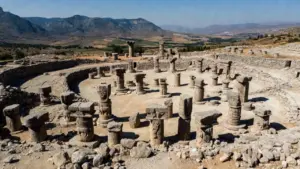 By C. Rich
OSF Paper https://osf.io/keq5b/overview
First Published on Medium.com
Imagine standing among the ancient pillars of Göbekli Tepe as the sun rises over a world still recovering from the last Ice Age. Massive T-shaped stones, some weighing tons, rise from the hilltop. Foxes, scorpions, and birds are carved with startling skill. The pillars are aligned with the stars and arranged in precise circles. No farms surround them. No villages. Just the monuments, silent, deliberate, and far more sophisticated than they had any right to be 12,000 years ago.
For decades, the standard story has been that these were built by mobile hunter-gatherers, clever, organized, but still living in a pre-literate, pre-agricultural world. It’s a comfortable narrative. It keeps the timeline neat and avoids uncomfortable questions about lost chapters of human history.
But what if the real problem isn’t whether they could move the stones, but whether we’ve properly accounted for the information required to do it?
This is the heart of a new way of thinking called the Constraint Cost Principle (CCP), and when applied to Göbekli Tepe, it reveals something important: the conventional explanation carries a large, often invisible debt.
Most of us judge explanations by how simple or elegant they sound. The Constraint Cost Principle asks something stricter. It says: Don’t just count assumptions. Count the real costs an explanation must pay to work, energetic, informational, and causal.
- Energetic cost: How much effort and resources does it take?
- Informational cost: How much knowledge, fidelity, and hidden assumptions must be smuggled in?
- Causal cost: How many unlikely steps or dependencies does it require?
The best explanation isn’t always the simplest on paper. It’s the one that survives when you stress-test it against reality’s constraints.
The standard hunter-gatherer story looks clean on the surface: no need for lost civilizations, no dramatic rewriting of history. But dig into the informational ledger, and the costs start piling up:
- Coordination at Scale: How do you organize hundreds of people across a decentralized group to quarry, carve, and erect these pillars without modern tools or bureaucracy? In oral societies, the number of communication channels explodes as the group grows. Errors multiply fast.
- Precision and Astronomy: The carvings and alignments show remarkable consistency. Who kept the measurements accurate across years or generations without writing? How was that knowledge passed down without drifting?
- Intergenerational Transmission: In a world of oral tradition, stories survive well, but technical blueprints do not. How did precise geometric and astronomical knowledge endure through famine, migration, and social upheaval?
- Error Correction: Without notes or standards, how were mistakes caught and corrected before a pillar was carved wrong or misaligned?
- Knowledge Compression and Replication: Teaching someone to do something complex is one thing. Ensuring that a person can reliably teach the next, and the next, without losing fidelity is another. Each human link in the chain adds noise. The entire error budget had to be absorbed somehow.
These aren’t small details. They represent a heavy informational cost that the mainstream model often treats as free, solved by “ritual” or “culture” without explaining the mechanisms.
Here is the key point, stated plainly: This does not disprove the mainstream view. It demonstrates that the ledger is incomplete.
We are not required to accept dramatic alternative theories. But we are required to be honest about what our preferred explanation actually costs. The Constraint Cost Principle forces that honesty. It turns vague discomfort into a clear accounting problem.
The question shifts from the familiar “Could hunter-gatherers have built this?” to something sharper: “How exactly was the complex information needed to build this generated, preserved, transmitted, and protected from drift in a pre-literate world?”
This informational cost problem doesn’t exist in isolation. It connects to larger questions about how human knowledge survives hard times. When societies face collapse or severe stress, what survives is often the most compressed, durable form of information, patterns carved into stone, encoded in geometry, or aligned with the unchanging sky. These become like ancient boot sectors: low-density but extremely resilient archives that the next generation (or civilization) can read using the laws of the universe itself as the decoder.
Whether or not one accepts any particular theory about prehistory, the audit remains valuable. It pushes us toward better explanations, not just more comforting ones.
Göbekli Tepe refuses to be a simple footnote in the story of human progress. Its pillars stand as both monuments and mirrors. They reflect back our own assumptions and ask us to examine the hidden costs we’ve been willing to overlook.
The Constraint Cost Principle gives us a tool to meet that challenge honestly. It reminds us that good thinking isn’t about defending familiar stories; it’s about making sure our explanations can actually carry their own weight.
The next time you see an image of those ancient stones, don’t just admire their size. Ask yourself: What was the true price of the knowledge that built them? And are we, as a species, still learning to read the ledger, ready to pay attention to the full bill?
This is how we move forward, not with sensational claims, but with clearer, more rigorous accounting of the past. The stones are still speaking. The question is whether our explanations are finally ready to listen.