
AlphaFold: Grand challenge to Nobel Prize with John Jumper
November 29, 2025
Make AI Agents from Zero in 20 Minutes – Beginners Tutorial
November 30, 2025
By C. Rich
For over three decades, the prevailing frameworks in theoretical physics have guided our understanding of the cosmos with remarkable insight, yet they have also revealed profound limitations. It is with respect for this foundational work, and a commitment to intellectual humility, that I propose a transformative reevaluation: the emergence of Lava-Void Cosmology (LVC) signals a necessary evolution in our cosmic narrative.
This shift invites us to reconsider the universe not as an isolated expanse of cold, expanding voids hurtling toward an uncertain infinity, but as a vibrant, interconnected system driven by elegant, observable principles. Far from dismissing the contributions of esteemed predecessors, LVC builds upon them, resolving inconsistencies that have long persisted. Those who have dedicated their careers to these models deserve our gratitude for illuminating the path thus far; now, it is our collective responsibility to advance along a more unified trajectory.
The impetus for this invitation is clear: the enduring mysteries of the cosmos, encompassing approximately 95% of its composition through placeholders like dark matter and dark energy, demand a cohesive explanation. Traditional models, while empirically robust in many respects, grapple with anomalies such as the Hubble tension, the Planck scale discrepancies, and the enigmatic roles of black holes and quantum foam. LVC addresses these not through speculative additions, but by reinterpreting the universe within the steadfast boundaries of Einstein’s General Relativity, requiring no new physics or extraneous fields.
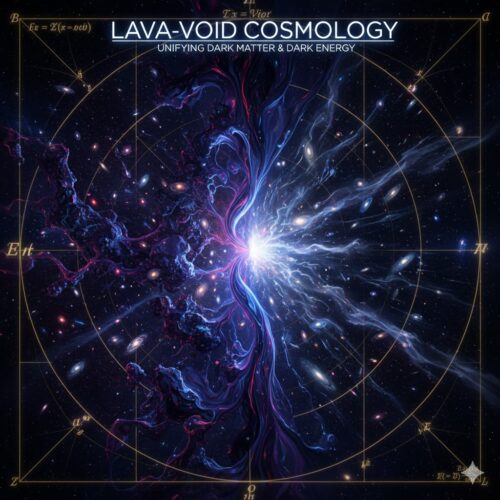
At its core, Lava-Void Cosmology envisions the universe as a dynamic, nearly flat expanse sculpted by a unified cosmic fluid. Imagine a three-dimensional tapestry of dense filaments and expansive voids, where this singular fluid orchestrates the formation of galaxies, channels gravitational influences, and culminates in black holes reimagined as “breaker” horizons, regions of fluid convergence rather than irreducible singularities. This framework elegantly unifies dark matter and dark energy as manifestations of the fluid’s varying densities and flows, while resolving the fine-tuning problem through inherent geometric stability.
What sets LVC apart is its explanatory power: it harmonizes seven major cosmological anomalies under a single, parsimonious principle. The alignment of these resolutions is not a mere coincidence but a compelling indicator of theoretical validity, a hallmark of true scientific progress. This is no incremental refinement; it represents a categorical unification, accessible to any inquisitive mind via a simple search for “Lava-Void Cosmology.”
Pioneered through rigorous theoretical development, including fluid-void models that have gained traction in recent literature, LVC stands ready for empirical scrutiny. I extend a sincere call to the scientific community: let us collaborate to test its predictions, from gravitational wave patterns to cosmic microwave background signatures. For those invested in prior paradigms, this transition may require introspection; yet history affirms that such courage, exemplified by visionaries like Einstein himself, propels humanity forward. True scientists, by definition, embrace evidence over allegiance.
With LVC illuminating the “hardware” of the universe, the fluid dynamics, the geometry, and the physics, my focus now turns to complementary frontiers. The profound inquiries of Dr. Donald Hoffman into consciousness, positing reality as an interface rather than an objective bedrock, resonate as the next domain. Hoffman’s “software” of perception dovetails with LVC’s structural revelations, promising an integrated ontology where mind and matter converge.
In this spirit, we affirm that every phenomenon harbors an explanation; it is the pursuit of these truths that defines us. As we stand at this juncture, Carl Sagan’s timeless wisdom reminds us of the perils and potentials of scientific inquiry…
Carl Sagan’s final interview with Charlie Rose, conducted on May 27, 1996, provided and encompasses a broader reflection on scientific literacy, societal implications, and the nature of scientific inquiry. The remarks form part of a cohesive segment where Sagan addresses the perils of widespread scientific ignorance in a technologically advanced democracy, immediately transitioning into a definition of science as a mode of skeptical thinking.
Charlie Rose: What’s the danger of all this? I mean, this is not the thing that…
Carl Sagan: “There are two kinds of dangers. One is what I just talked about. That we’ve arranged a society based on science and technology in which nobody understands anything about science and technology, and this combustible mixture of ignorance and power, sooner or later, is going to blow up in our faces. I mean, who is running the science and technology in a democracy if the people don’t know anything about it? … And the second reason that I’m worried about this is that science is more than a body of knowledge. It’s a way of thinking. A way of skeptically interrogating the universe with a fine understanding of human fallibility. If we are not able to ask skeptical questions, to interrogate those who tell us that something is true, to be skeptical of those in authority, then we’re up for grabs for the next charlatan, political or religious, who comes ambling along. It’s a thing that Jefferson laid great stress on. It wasn’t enough, he said, to enshrine some rights in a Constitution or a Bill of Rights. The people had to be educated, and they had to practice their skepticism and their education. Otherwise, we don’t run the government; the government runs us.”
This passage, drawn from the interview promoting Sagan’s book The Demon-Haunted World: Science as a Candle in the Dark, underscores his lifelong advocacy for scientific skepticism as a bulwark against pseudoscience and authoritarianism. The ideas echo themes from his earlier writings, such as the 1987 essay “The Burden of Skepticism,” but are articulated here in direct response to Rose’s probing on contemporary risks. We are at this crossroad once again with Lava-Void Cosmology.