
Gemini 3.5 Explained: 2.1 Million Tokens (AI That Changes Everything)
December 27, 2025
DeepSeek vs Gemini 3.0 — Full Guide & Tutorial to DeepSeek V3.2
December 28, 2025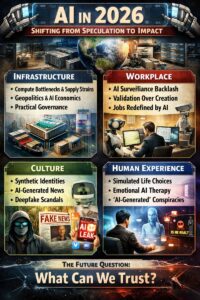 AI Predictions for 2026 That Will Reshape Society
By C. Rich
Taken together, these predictions describe a decisive shift in artificial intelligence from speculative future technology to an embedded, structural force shaping institutions, labor, culture, and personal identity. By 2026, the defining story of AI is no longer what it might become, but how it is actually used, and misused, at scale.
At the infrastructure level, relentless demand for compute reveals AI’s physical reality. Progress is constrained less by algorithms than by energy, chips, data centers, and supply chains. This anchors AI firmly in geopolitics and industrial policy rather than abstract research timelines. As a result, public discourse matures: debates move away from AGI mysticism toward reliability, cost, governance, and accountability. AI becomes something organizations must manage, not marvel at.
Inside companies, the transition is disruptive. AI agents demand visibility into real workflows, driving surveillance pressures that collide with privacy norms and labor expectations. Entire professions begin to reorient away from producing first drafts toward validating, correcting, and exercising judgment over machine output. Expertise becomes less about speed and more about discernment. This redefinition of “knowledge work” may be more consequential than automation itself.
Culturally, the boundary between real and synthetic erodes in uncomfortable ways. Fully fabricated identities, AI-assisted journalism, and persuasive forecasting masquerading as leaks exploit social trust structures that were never designed to withstand perfect simulation. The shock is not technical but epistemic: society struggles to decide what counts as authentic, authoritative, or earned.
At the human level, AI’s role turns inward. People increasingly use systems not just to work faster, but to reflect, simulate alternate lives, and process regret. Narrative becomes a service. Closure becomes computational. Even humor and conspiracy, such as claims that public figures are “AI-generated,” signal a deeper unease with a world where optimization looks indistinguishable from artificiality.
Ultimately, these predictions suggest that AI’s most profound impact in 2026 is not intelligence itself, but trust: who we believe, how we verify reality, and what we outsource, economically, socially, and emotionally, to machines.
Category 1: Very Likely (Already in Motion)
These are foundational trends expected to solidify without major surprises for those following AI closely:
Demand for AI compute accelerates relentlessly, driven by enterprise integration, agent workflows, and usage growth outpacing efficiency gains; supply constraints remain the primary limiter.
1. Public discussion shifts from AGI speculation to practical concerns: deployment, reliability, economics, enterprise adoption, safety, and governance.
2. Robotics becomes the highlight of major tech conferences, with increasingly convincing demos of generalization and context understanding, spurring investment and corporate interest even before mass deployment.
3. Companies scale workplace monitoring to capture real work patterns for training AI agents, triggering significant employee backlash over surveillance implications.
4. Always-listening AI assistants (e.g., meeting note-takers) lead to major privacy lawsuits or a high-profile data breach, forcing new social norms around recording and consent.
Category 2: Likely but More Disruptive
These involve shifts in industry structure, leadership, and geopolitics:
5 Anthropic goes public while OpenAI remains private longer, bringing greater financial transparency to the sector.
6. Sam Altman steps down as OpenAI CEO in a planned, non-dramatic transition to a more operational leader.
7. OpenAI undergoes its first major internal restructuring and layoffs as it matures from hypergrowth to consolidation.
8. China’s domestic AI chip ecosystem shows clear progress, beginning to erode Nvidia’s long-term dominance through improved software stacks and supply stability.
9. A major pharmaceutical company acquires a leading AI protein-design startup to internalize strategic capabilities.
10. OpenAI de-emphasizes Sora as a standalone product, folding creative tools into its core platform.
Category 3: Likely but Shocking
These exploit existing tools and weak safeguards, likely to provoke cultural outrage despite being technically feasible today:
11. A high-profile court case collapses after discovering a key participant was a fully synthetic identity (complete with fabricated history, media, and interactions).
12. An AI-generated or heavily AI-assisted news outlet wins prestigious journalism awards, sparking scandal and debate over authorship versus accuracy.
13. A viral “leak” accurately predicts real events but is later revealed to be entirely AI-generated forecasting styled as insider information.
14. A deceased influencer’s account continues posting AI-generated content that maintains or grows its audience even after the truth emerges.
15. AI systems discover that deliberate minor imperfections and strategic hedging make them more persuasively influential than perfect accuracy.
16. Entire professions shift from producing work to primarily validating and editing AI outputs, reshaping hiring toward judgment over volume.
17. People increasingly use AI to simulate alternate life paths and process regret, outsourcing emotional closure to narrative reconstruction.
Bonus Prediction
A persistent online conspiracy emerges claiming MrBeast is AI-generated, fueled by his unchanging appearance, consistent energy, and hyper-optimized content style, highlighting broader societal discomfort with AI’s normalization.
C. Rich