Anthropic Partners With SpaceX AI, Leopold’s $5.5B Bet, and the Singularity Economy | EP #255
May 17, 2026
ChatGPT Can See Your Money Now (This Feels Dangerous)
May 18, 2026 By Charles Richard Walker (C. Rich)
Project DOI
Before there is motion, before there is curvature, before there is even a direction in which something could change, there must be a condition in which change is not yet possible. That condition is what this work calls the Garden. It is not a metaphor and not a poetic convenience. It is the prior state from which all distinctions emerge, and if the Cosmological Pangaea program is to hold any weight, the Garden has to function as a fully constrained starting condition.
The defining feature of the Garden is not simply symmetry but the absence of any mechanism by which symmetry could be broken. There is no arrow of time, because there is nothing yet that can distinguish before from after. There is no geometry in the usual sense, because there is no curvature, no gradient, no preferred direction. The Garden is not empty. It is saturated with structure, but that structure exists in a form that does not yet admit differentiation. Everything is present, but nothing is yet separated.
Within this condition sit what can be described as rows of Pangaea objects. The language of rows is already a concession to later intuition, but it captures something necessary. There is arrangement without asymmetry. There is order without distance in the conventional sense. Each element is fully equivalent to every other, and no local feature exists that could serve as a reference point. Stay with that image for a moment. Rows, but no distance between them. Order, but no preferred direction. Each element fully equivalent to every other, with nothing singled out, nothing that could serve as a starting point. This is not a void. It is something more unsettling: a fullness that has not yet divided. The Garden is not waiting to begin. It simply has not yet found any reason to be other than what it is.
This is what it means for the Garden to be in pre-geometric stillness. It is not disordered. It is overdetermined by symmetry.
The central demand of the project follows from this. If the Garden is to be more than a poetic preface, it must contain its own internal scale. The question that naturally follows is: what is the spacing between the rows? But that is not a physical question in the usual sense. There are no rulers, no observers, no external frame in which such a measurement could be performed. Yet if the later universe exhibits stable ratios, fixed constants, and reproducible structure, then the origin of those regularities cannot be imported from outside. They must already be implicit in the Garden. This creates a strict requirement. The Garden must encode a notion of spacing without relying on distance. It must contain a relational structure that, once symmetry is broken, unfolds into measurable separation. If spacing is inserted later as an external parameter, the entire framework collapses into the very arbitrariness it is trying to eliminate. The Garden has to carry its own measuring stick, not as an added feature, but as something inseparable from its internal arrangement.
What is required is a mechanism, not necessarily dynamic in the conventional sense, but structurally inevitable, by which a symmetric arrangement already contains the seeds of its own differentiation. The spacing between the rows cannot be guessed, inferred, or tuned. It must be forced by the structure itself. Until that is established, the Garden remains conceptually powerful but structurally incomplete. It explains why the beginning must be symmetric, but not why the breaking yields the specific world we observe rather than any other.
If that step can be made, then the rest follows cleanly. The beginning and the end collapse into the same object, not as a philosophical gesture but as a structural identity. The final state of the system reflects the constraints that were always present at the start. What appears as evolution is the unfolding of a condition that was already fully specified, but not yet expressed. The Garden is not the place where everything is merely possible. It is the place where everything is already fixed, but not yet separated into parts.
What can now be established about the Garden is no longer descriptive. It is structural. The system, as computed, is maximally symmetric. Nothing is privileged. Nothing is singled out. Every element sits in the same orbit under the full symmetry group. There is no internal feature that distinguishes one part from another, and no local irregularity that could serve as the seed of structure. This is not merely symmetry in the casual sense. It is total equivalence, and that matters because it removes all degrees of freedom at the starting point. If anything is going to emerge from the Garden, it cannot come from a hidden parameter or an external adjustment. There is nowhere for such a parameter to reside. The Garden does not allow arbitrary inputs. It only allows consequences.
Within that perfectly symmetric state, there is already a constraint embedded in the structure. The relationships between elements are not free. They are fixed. Each component is tied to others in a pattern that cannot be altered without breaking the symmetry entirely. Even before any distinction appears, the system is not amorphous. It is rigidly organized. The adjacency relations, how one element connects to another, are not choices. They are imposed.
The question then shifts. It is no longer what the Garden looks like in its undifferentiated form. That is already known. The question is what happens at the moment that state can no longer be maintained. The first distinction, however it is described, cannot remain isolated. The structure does not permit that. Because every element is connected through a fixed pattern of relationships, any deviation from perfect symmetry propagates. A single marked element is not just a local change. It alters the conditions for everything it touches, and those alterations cascade through the entire structure.
This is the critical constraint. The Garden does not allow arbitrary differentiation. It only allows distinctions that can extend across the whole system without contradiction. A local break in symmetry must be globally consistent. If it cannot propagate without conflict, if it cannot return to its starting point without forcing an inconsistency, then that distinction is not allowed by the structure. The system is asking, in effect, whether a proposed differentiation can exist everywhere at once without violating the relationships that were already fixed in the symmetric state.
From this perspective, the Garden already contains the rule that will govern its own breaking. It does not need an external law to decide what forms are allowed. The constraint is internal. The connectivity of the system, the fixed relationships between elements, and the requirement of global consistency together determine which differentiations are possible. The Garden is no longer just a field of pure potential. It is a constrained system in which potential is already shaped by what can and cannot be made consistent.
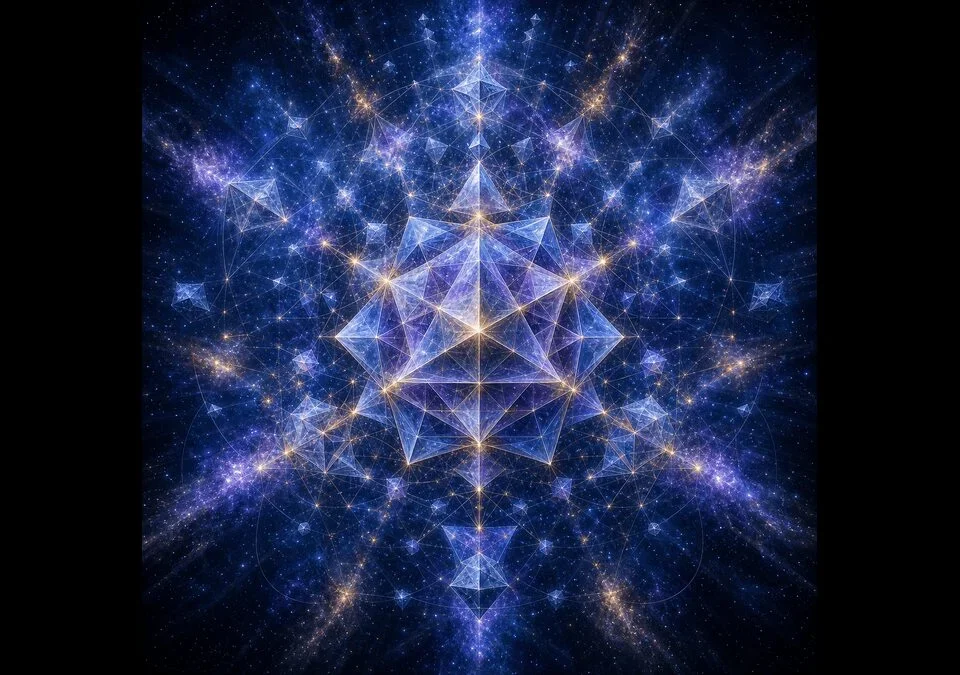
The concrete scaffold underlying all of this is the 24-cell, one of the remarkable regular objects in four-dimensional geometry. It is finite, highly symmetric, and self-dual, structurally rich enough to support nontrivial incidence relations while remaining fully explicit and computable. The cycles in this structure, the minimal closed loops that can be traced through its edges, initially appear as one undifferentiated field. But the moment adjacency relations are imposed among them, a deeper organization appears. The system separates into three self-contained components. Each carries the same share of the cycle scaffold. Each has the same internal degree. Each is sealed off from the others at the level of direct edge-sharing. This is not interpretation. It is what the structure does.
The three components are not fuzzy regions inside a larger whole. They are sharply defined parallel organizations, and their partition is exact. Nothing spills across in a loose or approximate way. That precision matters because it means the decomposition is not an artifact of description. It is an intrinsic property of the structure. The Garden, even in its most symmetric form, contains an internal segmentation, its own precondition for distinction, even before any external narrative is laid over it.
There is a temptation, when examining the cycle structure of the Garden, to treat those cycles as the primitive unit of distinction. They are, after all, the natural objects that emerge from the adjacency analysis. But a cycle is already a closed loop. It presupposes four steps, four relations, four vertices already in relation. Before the cycle closes, before the first edge is traversed, there is a state that the cycle picture simply cannot see: the pre-relational ground.
A four-cycle is not the first distinction. It is already a stabilized object built out of prior permissions. A vertex must be selectable, an adjacency must be traversable, a second step must remain lawful, a third must preserve coherence, and only then can the loop close. By the time one arrives at the cycle level, the system has already passed through several layers of selection. The three-component partition of cycles, however clean, is almost certainly not the first break. It is a downstream manifestation of a more primitive permission structure.
The deeper question is what object sits beneath both the unoriented and oriented cycle pictures. Before one asks how a cycle winds, one has to ask how a point becomes chooseable at all. Before one asks how an edge is directed, one has to ask how adjacency becomes active rather than merely available. The Garden as maximally symmetric cannot be broken by a closed object first. Closure is too late. The first break has to be minimal, the smallest event by which the full automorphism freedom no longer acts without remainder.
That object is the flag.
A flag is a triple: a vertex, an edge, and a cycle, where the vertex is an endpoint of the edge and the edge belongs to the cycle. It is the smallest incidence unit that has not yet committed to traversal direction but has already broken the full symmetry. Think of it as the first moment of being somewhere specific rather than merely being. A vertex alone is still equivalent to all others under the symmetry group. An edge alone is still equivalent to all others. But a vertex sitting on a specific edge sitting on a specific cycle is a located thing. The symmetry group can no longer move it freely without remainder.
The count follows directly. Each cycle has four edges and each edge has two endpoints, so each cycle contributes eight flags. Seventy-two cycles times eight gives 576 flags in total. The stabilizer of a single flag under the full symmetry group of order 1152 therefore has order exactly 2. That residual is the first nontrivial stabilizer. It is the smallest group that can hold a distinction in place, corresponding to the one remaining symmetry at the flag level: a reflection that preserves the flag while still acting nontrivially on the larger scaffold.
That residual matters. It means the first distinction is not a total destruction of symmetry. It is a minimal residual symmetry. The system does not fall directly from perfect equivalence into complete individuation. It first passes through a binary remainder, the smallest surviving coherence that still holds the marked object in place. The system can still perform one nontrivial operation without disturbing the flag. That is the residual coherence the framework requires.
The computation confirms this exactly. All 576 flags form a single orbit under the full symmetry group. Every flag is equivalent to every other. Yet the stabilizer of every flag has order exactly 2, uniformly, across all 576. This means the flag is precisely the object the framework requires. The full symmetry group can no longer act freely, a residual constraint persists, and that residual is minimal. The Garden’s first admissible asymmetry has order 2, emerges from an otherwise transitive system, and is forced by the geometry rather than chosen.
The cycle layer can no longer be treated as primitive. A cycle is already a closure of distinctions that have become mutually compatible. It is a second-order stabilization, not the first event. The three-component partition is no longer the first readable sign of breaking. It is a later manifestation of a more primitive fact: the system already admits a minimal local asymmetry at the flag level, and everything larger must be built on that ground.
The primitive distinction sits in a narrow band. It must reduce symmetry enough to prevent full equivalence, but not so much that all symmetry is destroyed. From a structural standpoint, this is equivalent to asking for the smallest subgroup of the full symmetry group that can remain as a stabilizer while still producing a nontrivial orbit decomposition. Order 2 is the first place where that can happen cleanly. It is the smallest group that can encode a binary relation, this versus that, without collapsing back into uniformity.
You can see why anything weaker fails. If the stabilizer remains too large, the marking is not truly a distinction. The symmetry group can still move it around freely, and nothing has been fixed. The system remains effectively undifferentiated. You can also see why anything stronger overshoots. If the stabilizer collapses completely, then the distinction is no longer minimal. The system has already committed to a full configuration, and whatever emerges from that point is not the first motion but a later stage of development. Order 2 is the narrow middle: the smallest nontrivial residue the system can sustain.
The first distinction is not a rich labeling or a complex partition. It is a binary separation that can propagate. It introduces a polarity, not a full taxonomy. And for that polarity to be meaningful rather than local accident, it must be compatible with the global structure. A local order-2 distinction is only meaningful if it can extend across the system without contradiction. The distinction must be globally consistent, not just locally admissible.
The flag is the first object that can be picked out without annihilating the whole symmetry environment. It is the first place where the system says: this, here, can remain itself under a reduced but still nontrivial invariance. That is the beginning of measure. Not quantity yet, but persistence of distinction.
The spacing between rows, if that phrase is to mean anything rigorous in this framework, cannot be an externally imposed interval. It must arise from how primitive distinctions can be repeated, propagated, or obstructed across the structure. Spacing is not what exists before distinction; spacing is what becomes readable once a distinction can persist. The flag does not yet give the final spacing, but it identifies the first unit from which any internally generated spacing would have to be derived. The ruler is not hidden as a finished object. It is latent as a law of admissible repetition.
Once the flag is identified as the first stable distinction, the next question is whether that distinction can travel. A local asymmetry that cannot propagate is not a structural fact. It is noise. What the Garden requires is a distinction that extends globally, covering the entire scaffold without contradiction, closing the system into a definite set of admissible configurations.
The propagation rule has to be constructed carefully. Two flags can be considered adjacent when they differ in exactly one coordinate of the flag triple. A vertex move, where the same edge and cycle are shared but the endpoint changes, requires the binary state to flip. An edge move, where the same vertex and cycle are shared but the edge changes, requires the states to agree. A cycle move, where the same vertex and edge are shared but the enclosing cycle changes, also requires the states to agree. This is the move-based rule, and it is the only version that avoids assigning contradictory constraints to flag pairs that share more than one coordinate simultaneously.
Under this rule the 576-flag signed graph decomposes into exactly three connected components of 192 flags each. Each component is internally balanced, meaning it contains no frustrated cycles, no local contradictions. Each component therefore contributes exactly one independent binary degree of freedom. The raw solution space contains precisely eight globally consistent assignments. Eight ways, and only eight, in which the primitive distinction can be copied consistently across the entire scaffold. This is pre-number territory made explicit. The eight assignments are not arbitrary. They are the complete set of ways the primitive distinction can be repeated without internal contradiction. Number has not yet hardened into a physical constant, but the law of admissible repetition has appeared. The Garden now contains the minimal structure that can be copied without contradiction.
The full symmetry group then acts on this solution space. The three components are permuted transitively among themselves, so no component is intrinsically privileged. More tellingly, the eight global assignments themselves fall into exactly two orbits under this action: one orbit of size six and one of size two. The symmetry-reduced phase structure of the Garden therefore consists of two inequivalent global configuration types. Consider what that means. The Garden does not open onto everything. It does not remain undecided forever. But it also does not collapse into a single outcome. It closes to two. Not one world and not infinite worlds, but two inequivalent configurations that no further symmetry operation can bring into alignment. That is not a number imposed on the structure. That is the structure telling you how many ways it can be consistently itself.
The instinct to look before the Garden feels natural, almost inevitable. If the Garden is the starting condition, something must have produced it. There must be a trigger, a prior state, a force that set it in motion. Yet that move is a trap. The moment one posits something prior, one has already smuggled in time, direction, and causation. These are precisely the structures the Garden was defined to eliminate. To step outside it is to abandon the very constraint that made the inquiry rigorous. The Garden cannot be caused. It must be the only configuration that does not require a prior cause. Any condition that would explain the Garden’s existence would itself need explanation, and the regress would never terminate. The correct question is therefore not what came before, but what kind of structure can exist without requiring prior structure.
The answer is uncompromising. The Garden must be maximally symmetric and causally closed. Nothing inside it distinguishes one element from another. No preferred direction, no arrow of time, no external mechanism, no evolution rule imposed from outside. If any of these existed, the Garden would no longer be the origin. It would already be a later state demanding its own antecedent.
There is no before. There is only the internal instability of perfect symmetry once the question of admissible distinctions is asked. The system does not remain undifferentiated because some external law forbids it. It remains undifferentiated until the first distinction that can propagate consistently across the entire structure without contradiction becomes possible. That distinction is not injected. It is the smallest non-equivalence the scaffold itself can sustain.
The condition for the Garden to exist at all is therefore negative and austere: no preferred element, no preferred direction, no preferred scale, no preferred relation, nothing that would require prior specification. In this sense the Garden is not assembled or produced. It is the only state that does not need to be produced. Everything else, every later structure we observe, is the unfolding of constraints already latent within it.
The first cut is not external. It is the first internally admissible failure of total equivalence. The flag shows that this failure is possible, minimal, and forced by the incidence geometry rather than chosen. Propagation under the move-based rule then demonstrates that the distinction does not remain local. It extends globally, closing the system into eight consistent assignments that symmetry further reduces to two inequivalent classes. None of this requires time, force, or a prior state. It requires only the scaffold asking, in effect, which distinctions it can carry without contradiction.
The deeper mistake all along was to assume that reality, at its deepest level, must already be quantitative. It does not. Number is late. Number is what appears only after a structure has become stable enough to support repetition without ambiguity. The real question is therefore not what number the Garden contains, but what condition inside the Garden first makes repetition possible at all. The flag is the answer. It is the first object the system can sustain under transformation while retaining residual coherence. Before the flag, everything is equivalent and nothing can be identified again. With the flag, something can be picked out, held in place by its order-2 stabilizer, and carried through the scaffold. That is the birth of repeatable structure. The cycle layer is already a second-order closure built upon it. The three-component partition is downstream. Any eventual constant will be later still.
The goal is not to extract a value as though the Garden were hiding a finished answer. The goal is to identify the first admissible seed of persistence and then ask whether everything larger is forced by it. The repaired move-based propagation law shows that it is. The distinction propagates without local contradiction. It closes globally into eight consistent assignments. Symmetry then reduces those eight into two inequivalent classes. The law of admissible repetition has been isolated and verified. Biology offered useful intuitions at various points in this investigation. Cell division shows how polarity can become duplicable. Identical twinning shows how multiplicity can arise within one coherent field. Strobilation in jellyfish and budding in coral illustrate how one organized vessel can segment into multiple viable descendants. These are helpful metaphors for the feeling of emergence from a single scaffold. But they remain open or replicative systems. The 24-cell flag scaffold is stricter: a finite, discrete constraint field that closes to a definite cardinality and is further refined by symmetry. The biological analogies illuminate the feeling of what is happening. They do not explain the mechanism.
The Garden does not hide a number. It contains the first lawful recurrence from which number can later be born. The flag is not birth itself. It is the first viable polarity. Propagation is development. The eight raw assignments followed by reduction to two symmetry orbits is the moment the system loses the ability to be anything else. That is where the event actually lives, not at the first cut, but at the point where the first cut becomes unavoidable and symmetry-reduced.
Analogies from fluid dynamics, lattice gauge theory, electromagnetism, and related fields were explored during the investigation and set aside where they overreached. The vertex-flip transformations, while tempting as local gauge generators, do not preserve the move-based constraints. Gauge language and topological sector interpretations were tested and found to overclaim. What remains is cleaner and stronger precisely because it refuses embellishment: a finite constraint-theoretic closure, 576 flags, three balanced components, eight raw global assignments, reduced by the scaffold’s own symmetry group to two inequivalent classes.
The Cosmological Pangaea program began with a demand. If the Garden is to be more than poetic preface, it must function as a fully constrained starting condition that encodes its own internal scale. That demand has now been met at the level of explicit, reproducible computation. The Garden is the maximally symmetric 24-cell scaffold. Its first stable distinction is the flag: a located incidence of vertex, edge, and cycle, the smallest unit in which a point, a relation, and a local enclosure become jointly fixed enough to resist being washed back into total equivalence. All 576 such flags lie in a single orbit under the full symmetry group, yet each possesses a stabilizer of order 2 exactly. The primitive distinction is neither full symmetry nor total collapse, but the smallest nontrivial asymmetry the structure can sustain while retaining residual coherence.
That distinction propagates under a repaired move-based law without local contradiction. The system closes to eight consistent global assignments. The full symmetry group acts on those eight and partitions them into exactly two inequivalent classes, one orbit of size six and one of size two. This is not assumed and not guessed. It is the direct consequence of the propagation law applied to the explicit scaffold. The program has crossed a decisive threshold. The hypothesis is no longer speculative. It is reproducible: given the 24-cell scaffold, the explicit move-based rule, and the action of the Weyl group, any computation yields the same structure. The ship has landed on solid combinatorial ground.
There is no pre-Garden. There is no trigger. There is only a maximally symmetric structure and the internal question of what it can sustain. The flag supplies the first affirmative answer. The three balanced sectors and the symmetry-reduced solution space supply the next. The Garden is self-contained, self-measuring, and self-limiting. Its first motion is not an event in time but the emplacement of a stable distinction that the structure itself cannot erase. Everything beyond this point builds on solid ground. The beginning and the end remain the same object, now seen under different resolutions of symmetry. The Garden is not the place where everything is possible. It is the place where only certain things are possible, and where that restriction is fully encoded before anything begins. The first verified closure is established. Everything further must build from here.