

The GR-Razor Manifesto: Stress-Testing the Millennium Problems
March 22, 2026
How to Create Long-Form Videos with Free Grok AI (2026 Tutorial)
March 23, 2026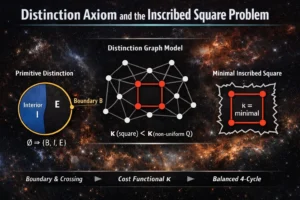 By C. Rich
The inscribed square problem, posed by Toeplitz in 1911, asks a deceptively simple question: does every Jordan curve contain four points that form a square? More than a century later, the problem remains open in full generality. Results exist for smooth curves, convex curves, and other restricted classes, but no proof has been found that applies to every continuous simple closed curve.
All of those efforts share a common starting point. They assume the existence of a background space, typically the Euclidean plane, and study the properties of curves embedded within it. Geometry is given first; structure is discovered inside it.
This work takes a different approach. Instead of beginning with space, it begins with separation.
The starting point is a primitive operation called distinction. Applied to an undifferentiated ground state, distinction produces a boundary together with two regions: an interior and an exterior. The boundary is not embedded in a pre-existing plane; it is the first structure that exists. It is the minimal object that carries the fact that something has been separated from something else.
From this primitive, one can define crossing loci—points on the boundary through which any transition between interior and exterior must pass. Iterating distinction builds not just a boundary, but a network of crossings. Structure emerges not from coordinates or distances, but from how these crossings relate to one another under repeated application of the same operation.
At that point, a new question becomes available. Instead of asking what configurations exist inside a curve in ℝ², we can ask what configurations are compatible with a boundary that has been generated purely through distinction.
To make that question precise, the framework introduces a cost functional κ. This measures the minimal number of distinction operations required to generate and stabilize a given boundary configuration. In this setting, structure is no longer judged by geometric elegance but by generative efficiency: how much “work” is required to produce and maintain it under continued distinction.
Within this framework, a striking fact emerges. Among all quadrilateral configurations defined by four crossing loci, those with uniform crossing weights, meaning each crossing contributes equally under the generative process, are uniquely minimal with respect to κ. Any deviation from this uniformity introduces imbalance, and that imbalance must be corrected by additional applications of the primitive operation. The result is a strict increase in stabilization cost.
These uniform-weight 4-cycles form what can be called the square-equivalence class. Importantly, this notion of “square” is not defined by angles or distances. It is defined by symmetry of contribution under the generative process and by minimal cost of stabilization. The square appears not as a geometric assumption, but as the smallest closed loop of balanced crossings that remains stable under iteration.
This does not resolve the classical inscribed square problem. It does something more foundational. It relocates the problem into a setting where boundary is not assumed but produced, where symmetry is algebraic rather than metric, and where optimal structure is governed by a single invariant.
To make the framework concrete, a discrete Distinction Graph Model can be constructed in which each application of the primitive operation adds crossings and edges according to explicit rules. In this model, the cost functional κ is directly computable, and the emergence of minimal 4-cycles can be observed and tested. This provides a combinatorial and empirical foothold for further investigation.
The full formal development, including the axiomatic definition, the cost functional, and the Quadrilateral Stabilization Inequality that separates square-equivalent configurations from non-square ones, is presented in the paper linked below.
This work is not a claim to have solved a century-old problem. It is a proposal to look at that problem from a different starting point: not from curves in space, but from the act that creates boundary itself.
Full paper (OSF): https://osf.io/q63c5/overview