Microsoft Just Dropped FARA and It Puts Pressure on OpenAI
November 28, 2025
Stephen Bartlett and Tristan Harris: The Conversation
November 28, 2025By C. Rich
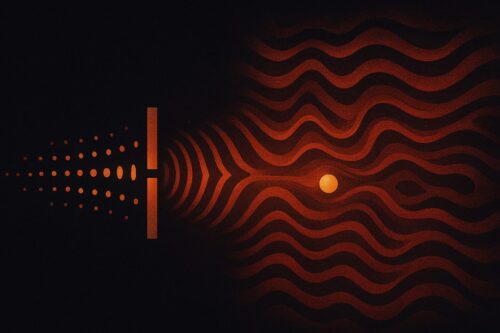
Recap of the Double-Slit Experiment
The double-slit experiment remains a paradigmatic demonstration of quantum mechanics’ wave-particle duality. Particles, such as electrons or photons, fired through two slits exhibit an interference pattern when unobserved, suggesting wave-like propagation across both paths. Upon measurement of their trajectory, however, the pattern collapses into particle-like bands, highlighting the observer effect and the probabilistic nature of quantum states.
Overview of Lava-Void Cosmology
Lava-Void Cosmology, as articulated in my 2025 monograph Lava-Void Cosmology: Unified Fluid Theory, posits the universe as a singular, relativistic cosmic fluid governed by Einstein’s general relativity. This fluid unifies dark matter and dark energy, comprising the unobserved 95% of cosmic content, through density-dependent dynamics: it thickens in gravitationally dense regions to foster structure formation (e.g., galaxies and stars) and thins in expansive voids to drive accelerated expansion. Drawing on the Friedmann-Lemaître-Robertson-Walker metric and the generalized Chaplygin gas equation of state, the model eschews novel physics, instead envisioning black holes as energy-recycling drains that sustain equilibrium in this self-regulating “ocean” of spacetime. Philosophically, it frames the cosmos as a living continuum, where phenomena arise from the fluid’s ebb and flow, blurring demarcations between matter, energy, and void.
Interpreting the Double-Slit Experiment in Lava-Void Terms
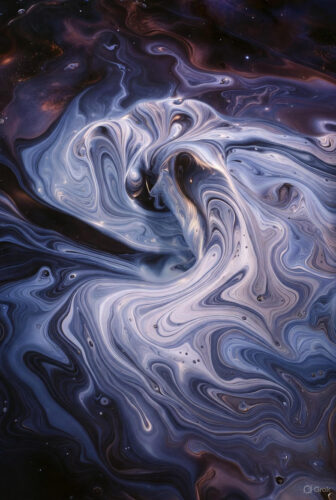
As a thought experiment, Lava-Void Cosmology extends its fluid paradigm beyond macroscopic cosmology to quantum scales, treating the quantum vacuum not as empty but as a dilute manifestation of the universal fluid. This invites a reinterpretation of the double-slit outcomes as emergent properties of fluid dynamics, unified across scales:
- Wave-Particle Duality as Fluid Excitations: In this framework, quantum particles are localized excitations or “ripples” within the cosmic fluid, akin to waves on an ocean surface. The unobserved interference pattern reflects the fluid’s intrinsic wave-like propagation: the excitation propagates probabilistically through both slits as a coherent disturbance, interfering constructively or destructively based on the fluid’s tension and viscosity—parameters encoded in the Einstein field equations. Denser fluid regions (near the particle’s core) manifest particle-like localization, while sparser extensions enable delocalized wave behavior, mirroring the Chaplygin gas’s dual equation of state (pressure varying inversely with density).
- Observer Effect as Local Density Perturbation: Measurement disrupts the fluid’s equilibrium by introducing a localized density gradient—equivalent to a gravitational probe that thickens the fluid momentarily, forcing the excitation to “collapse” into a definite path. This aligns with general relativity’s curvature response to mass-energy: the detector’s interaction warps the local fluid metric, decohering the superposition much like a void’s thinning accelerates cosmic expansion. Absent observation, the fluid remains in a low-entropy, superpositioned state, optimized for the continuum’s holistic flow.
- Unification Across Scales: Lava-Void’s singular fluid bridges quantum and cosmic realms, positing that double-slit interference echoes the universe’s large-scale structure formation. Just as the fluid’s thinning in voids resolves the Hubble tension by reconciling local and global expansion rates, quantum indeterminacy arises from the fluid’s scale-invariant turbulence, predicting testable correlations, such as enhanced interference fringes in low-gravity environments (e.g., space-based interferometers).
Implications and Philosophical Resonance
This lens demystifies quantum weirdness by embedding it within a deterministic, relativistic fluid, potentially resolving tensions between quantum mechanics and gravity without invoking multiverses or hidden variables. Empirically, it suggests experiments probing fluid-like quantum vacuum fluctuations (e.g., via Casimir effects modulated by gravitational fields) could validate density-driven duality. Philosophically, it evokes a cosmos as an interconnected “lava-void” pulse—eternal, adaptive, and observer-entwined—challenging mechanistic views in favor of a vitalistic continuum.
While Lava-Void remains a nascent proposal at the moment, this interpretation underscores its potential for cross-scale synthesis.