Will ICOs Replace IPOs? | MOONSHOTS
February 8, 2026
Author’s Thought On LVC Project
February 8, 2026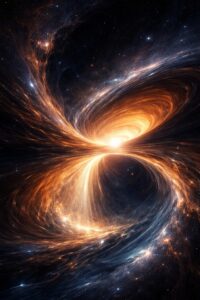 By Charles Richard Walker (C. Rich)
Buy Book: Cosmological Pangea
Imagine the universe not as empty space with objects moving through it, but as a vast, continuous cosmic fluid, sometimes flowing smoothly, sometimes compressing, swirling, or rebounding. In Lava–Void Cosmology, everything we usually describe with geometry alone is instead understood as behavior within this fluid. From that perspective, one of the strangest ideas in physics, the Einstein–Rosen bridge, often pictured as a wormhole, takes on a very different and far more down-to-earth meaning.
In standard physics, an Einstein–Rosen bridge appears when you mathematically extend the geometry of a black hole. On paper, it looks like a fleeting tunnel connecting two distant regions of space. The problem is that this “tunnel” collapses too fast to cross, unless you invent exotic forms of matter that nobody has ever seen. Lava–Void Cosmology says the mistake isn’t that the bridge is unstable, it’s that we’re mistaking a moment in a flowing medium for a permanent structure. What looks like a wormhole in the equations is really just a brief constriction in the cosmic fluid, like a narrow gorge forming in a rushing river when the flow reverses direction.
As gravity compresses matter and energy, the cosmic fluid thickens. In Lava–Void Cosmology, viscosity, the same property that makes honey resist being squeezed, becomes dominant at extreme densities. Instead of collapsing into an infinite point, the flow slows, stops, and rebounds. At the exact instant of turnaround, there is a narrow “neck” where inward flow becomes outward flow. This is the moment that traditional general relativity draws as an Einstein–Rosen bridge. But nothing magical or topologically exotic is happening. It is simply the fluid passing through a bottleneck before expanding again, much like water forced through a narrow channel before spilling back out.
Seen this way, the two “sides” of the bridge are not separate universes or distant places connected by a shortcut. They are the same region of the universe at two different phases of motion: before the bounce and after the bounce. The apparent impossibility of crossing the bridge in standard theory comes from ignoring the fluid’s internal stresses, currents, and dissipation. When those are included, motion through the gorge is no longer forbidden in principle; it is conditional. Just as a kayaker can only pass safely through a rapid by aligning with the current, passage through a bounce gorge depends on timing, direction, and alignment with cosmic flows.
This reinterpretation also explains why these structures do not lead to time travel paradoxes or runaway causality. The cosmic fluid always produces entropy overall, meaning time still moves forward. The gorge is not a loophole in time but a momentary pause in compression before expansion resumes. Think of it as the universe taking a breath: inhale, stop, exhale. Geometry freezes that instant into a misleading picture of a tunnel, but the fluid view reveals it as part of a continuous, lawful process.
In Lava–Void Cosmology, these bounce gorges are not rare anomalies. They are natural, recurring features wherever extreme compression occurs. They can seed swirling currents that persist after the bounce, forming stable cosmic “eddies.” In the broader framework, advanced navigation, what the Cosmic Sailor paradigm explores, would not rely on breaking physics, but on riding these flows, using the universe’s own motion, the way a sailboat uses wind.
Put simply, this work says that wormholes were never exotic shortcuts held open by imaginary matter. They were misunderstood snapshots of a universe in motion. By replacing the idea of spacetime as a rigid stage with a living, viscous medium, Lava–Void Cosmology turns one of physics’ strangest objects into something familiar: a transient narrowing in a flowing system, dramatic, powerful, and real, but governed by the same rules that shape rivers, weather, and currents here on Earth.
C. Rich
[doi_footer]