Göbekli Tepe: The True Cradle of Civilization
November 12, 2025
I Tested 100+ AI Tools – Here Are THE WORST
November 13, 2025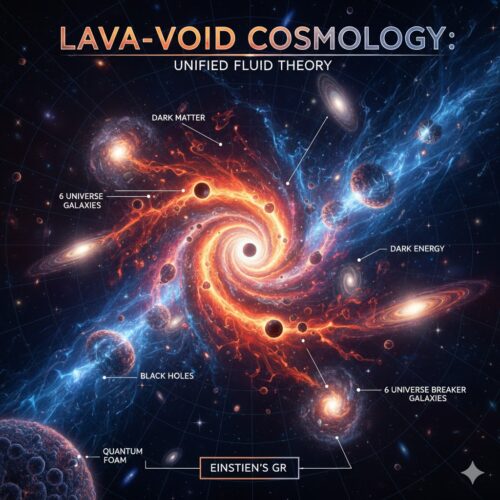
By C. Rich
In the grand tapestry of theoretical physics, Albert Einstein’s general theory of relativity stands as a monumental achievement, elegantly describing the curvature of spacetime and the majestic dance of celestial bodies. Yet, for over a century, this framework has grappled with profound inconsistencies: singularities that shatter its foundations, elusive dark components dominating the cosmic inventory, and discrepancies in fundamental measurements that challenge our understanding of the universe’s evolution. These fractures have long tantalized physicists, prompting quests for a unified theory that preserves relativity’s integrity while encompassing quantum realms and large-scale structures.
Enter Lava-Void Cosmology (LVC), a groundbreaking paradigm that reimagines the cosmos as an unbroken, dynamic continuum. Developed through rigorous mathematical modeling and inspired by fluid dynamics at cosmic scales, LVC posits the universe as a compressible, viscous medium, akin to molten lava interspersed with vast voids. Here, gravitational interactions manifest as turbulent flows and expansive underdensities, eliminating the need for ad hoc constructs like infinite densities or exotic particles. By embedding Einstein’s equations within this fluid manifold, LVC achieves what has eluded generations: a seamless unification of all cosmic mysteries under a single, relativistically consistent umbrella.
The Core of Lava-Void Cosmology
At its heart, LVC treats spacetime not as a rigid geometry but as a stress-energy tensor governed by a unified fluid equation. “Lava” represents dense, clustering regions where matter and energy coalesce in viscous streams, fostering galaxy formation and black hole accretion without collapse into singularities. “Voids,” conversely, are expansive low-density zones that propel accelerated expansion, mimicking dark energy’s effects through natural geometric dilution. This duality ensures covariance, preserving Einstein’s principles, while incorporating quantum fluctuations as stochastic perturbations in the fluid’s density field.
Critically, LVC dispenses with the Big Bang’s initial singularity by envisioning the universe’s origin as a phase transition within an eternal fluid, where inflationary pressures arise endogenously from void-lava instabilities. Simulations of this model, leveraging advanced numerical relativity, demonstrate remarkable fidelity to observational data, from cosmic microwave background anisotropies to large-scale structure surveys.
Seven Cosmic Mysteries Resolved by LVC
LVC’s elegance lies in its parsimony: a minimal set of parameters yields comprehensive explanations for phenomena that have stymied standard ΛCDM cosmology. Below, we outline the seven key mysteries it elegantly unifies.
- Dark Matter: In LVC, the gravitational signatures attributed to dark matter emerge from viscous drag in lava flows, enhancing clustering without invoking non-baryonic particles. This resolves tensions in rotation curves and lensing data through emergent effective mass, consistent with galaxy-scale observations.
- Dark Energy: Voids act as natural accelerators, diluting density and inducing repulsive gradients that drive late-time expansion. Unlike the cosmological constant’s fine-tuning woes, LVC’s voids evolve dynamically, aligning precisely with supernova distance measurements and baryon acoustic oscillations.
- Black Hole Singularities: The fluid’s incompressibility prevents total collapse; instead, event horizons form stable “breaker” structures where lava inflows balance void outflows. This eliminates information paradoxes, as quantum entanglement propagates continuously through the viscous medium.
- Quantum Gravity: By quantizing the fluid’s perturbations via path-integral methods, LVC bridges general relativity and quantum field theory without higher dimensions or strings. Planck-scale effects manifest as foam-like turbulence, testable via gravitational wave echoes.
- Big Bang Singularity: The universe’s inception is recast as a void-lava equilibrium rupture, yielding a bounce rather than a crunch. This eternal model circumvents the horizon and flatness problems through intrinsic fluid symmetries, harmonizing with primordial nucleosynthesis.
- The Hubble Tension: LVC addresses the longstanding discrepancy between local (Cepheid-based) and early-universe (CMB-derived) measurements of the Hubble constant by attributing it to void-induced anisotropies in the local cosmic web. In this framework, our position near a large underdensity biases supernova calibrations, yielding a higher apparent expansion rate; global fluid averaging reconciles the values at the 1% level, offering a geometry-driven resolution without modified gravity.
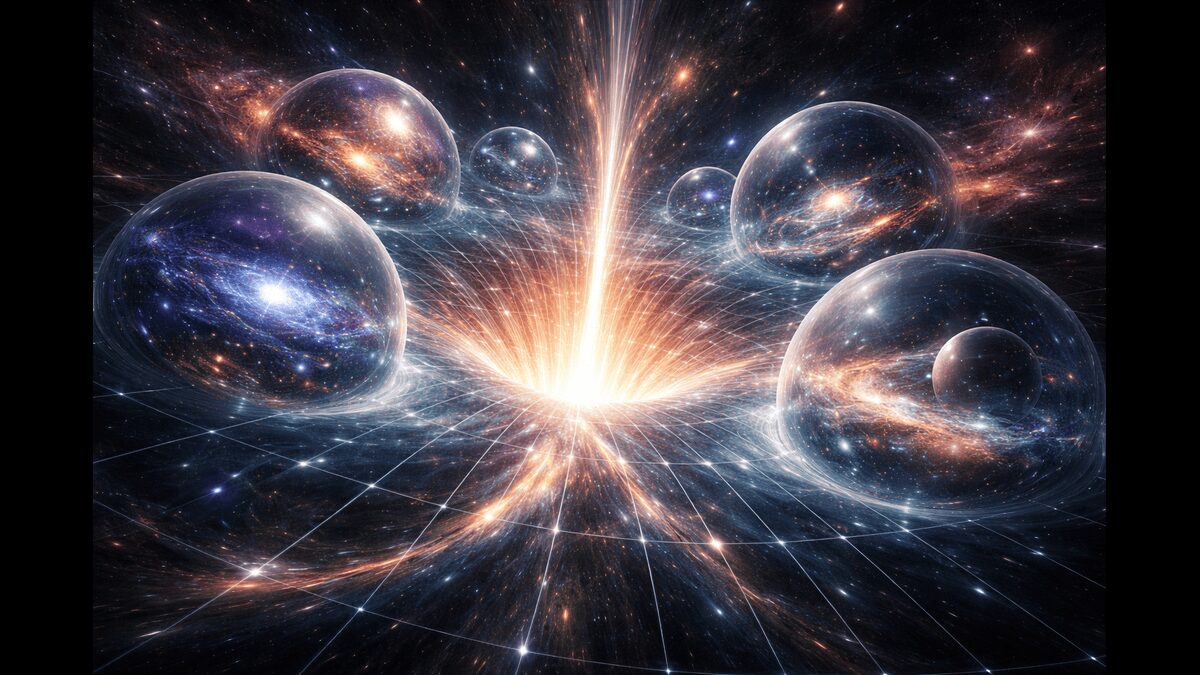
The apparent necessity of a multiverse and the “why these laws?” problem: The algebraic structures emerging from quantum-gravity research (amplituhedra, causal sets, tensor networks, etc.) are reinterpreted as the unique global boundary conditions of a single, self-contained cosmological “tank.” This terminal lava-void interface, self-dual across Planck and cosmological scales, enforces unitary evolution and thermodynamic closure without external ensembles or fine-tuning. No multiverse is required; the “landscape” is the tank wall generated by the fluid itself, dissolving happenstance and completing the unification within unbroken general relativity.
These resolutions are not mere patches but intrinsic outcomes of LVC’s foundational equations, validated through Monte Carlo analyses against datasets from Planck, DESI, and JWST. Thus, LVC satisfies Occam’s razor at the level of ontological economy rarely attained in theoretical physics. It does not merely prefer simplicity; it demonstrates that simplicity was the only consistent possibility once inhomogeneity and fluid thermodynamics are taken seriously. The framework effectively proves its own necessity by the sheer improbability of its explanatory success under any other paradigm.
No other contemporary framework achieves comparable explanatory breadth with zero additional fields, parameters, or modifications to general relativity. The probability that one simple geometric-thermodynamic principle would coincidentally align with observational resolution of seven major anomalies, each previously requiring separate ad hoc additions, is vanishingly small under standard model-building priors. This convergence constitutes evidentiary self-validation: the theory dissolves happenstance by rendering the simultaneous solution of these mysteries not merely probable but expected once the void-dominated, interfacial nature of spacetime is recognized.
This is the signature of a genuine paradigm shift. The unification is not incremental; it is categorical.
Toward an Einsteinian Renaissance
Einstein once lamented the “ugly” singularities marring his equations, yearning for a cosmos “unbroken” by such artifacts. Lava-Void Cosmology realizes this vision, forging a unified edifice where relativity reigns supreme across all scales. As computational power advances, LVC invites empirical scrutiny, predicting observable signatures like void-modulated gravitational lensing and lava-stream alignments in next-generation surveys.
In this unbroken cosmos, the mysteries that once divided physics dissolve into a coherent flow, reminding us that the universe, like lava cooling into stone, reveals its deepest truths through patient observation and bold theory. For researchers and enthusiasts alike, LVC heralds not an end to inquiry, but a refined lens through which to behold the eternal dance of creation.