
Einstein’s Unfinished Symphony Resolved
April 13, 2026
8 Most Realistic AI Voice Generators: How To Create Human-Like Voice With AI
April 14, 2026 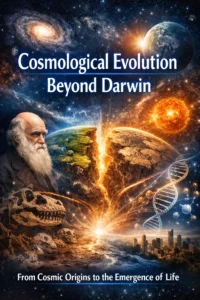 Dragging Darwinism Into The 22nd Century
By C. Rich
To revisit Charles Darwin from a far-future intellectual vantage point is to confront both the brilliance and the incompleteness of his legacy. His formulation of evolution by natural selection identified a real and enduring pattern in the living world, yet it remained confined within the conceptual limits of nineteenth-century biology. Darwin described how forms change and diversify, but he lacked access to the deeper physical and cosmological principles that govern why such processes occur at all. What emerges from a modern reinterpretation is not a rejection of Darwin, but a reframing: evolution is no longer merely a biological phenomenon but an expression of a far more general, underlying structure of reality.
In this expanded view, life is not an anomaly set against the backdrop of physics but a direct consequence of it. Organisms are no longer seen simply as competitors in a struggle for survival; they are understood as temporary stabilizations within a broader system driven by the redistribution of constraints. The classical language of “fitness” and “adaptation” gives way to a more foundational description in which living systems function as mechanisms for resolving gradients, dispersing structure, and navigating the conditions imposed by the universe itself. Evolution, in this sense, is not merely about organisms adapting to environments, but about the universe expressing its own internal pressures through increasingly complex configurations.
This shift in perspective is grounded in a more fundamental starting point: the recognition that distinction is the minimal requirement for existence. Before any object, force, or law can be described, there must be differentiation, this as opposed to that, inside versus outside, before versus after. Without distinction, there is no information, and without information, no meaningful description of reality is possible. From this basis, structure emerges, and with structure comes the combinatorial pressure that drives change. What has traditionally been described as entropy is no longer treated as a secondary measure of disorder, but as a primary feature of how distinctions can be arranged, transformed, and exhausted.
Within this framework, the universe itself is reinterpreted. Rather than beginning as a singularity understood as a breakdown of physical law, it is conceived as an initial state of maximal constraint, a fully unified condition in which no alternative configurations were available. From such a state, any differentiation necessarily increases the number of possible arrangements, and with that increase comes the directional unfolding of structure. Time, in this sense, is not an independent backdrop but a consequence of the changing landscape of distinctions. The evolution of the cosmos, including the emergence of life, follows directly from this initial release of constraint.
The concept of Cosmological Pangaea serves as a unifying metaphor for this reconstruction. Just as Earth’s continents were once joined in a single landmass before fragmenting into separate regions, modern scientific explanations have become divided into isolated domains, cosmology, biology, thermodynamics, each with its own assumptions and explanatory gaps. The task is not to discard these domains but to reconnect them, to identify the deeper structure from which they all derive. In doing so, phenomena such as biological evolution, cosmic expansion, and the formation of complex systems are no longer treated as separate problems but as different expressions of the same underlying process.
What follows from this synthesis is a more demanding standard for explanation. Rather than introducing new theoretical constructs to account for observed phenomena, the emphasis shifts toward deriving those phenomena from minimal principles. The question is no longer what additional mechanisms might explain the universe, but what must be true given the structure of reality itself. Under this constraint, evolution becomes inevitable rather than contingent. Life is not a fortunate accident but a necessary outcome of a system driven to explore its own space of possibilities.
In this light, Darwin’s work stands not as a completed theory but as an initial approximation, a sketch that captured the visible patterns of life without access to the deeper forces shaping them. The modern task is to extend that sketch into a full reconstruction, one that situates biological evolution within the broader dynamics of the cosmos. The focus shifts from describing the diversity of life to understanding the conditions that make such diversity unavoidable. Evolution is no longer just the origin of species; it becomes the expression of necessity itself.
Read more: