Book: Lava-Void Cosmology: Unified Fluid Theory
October 23, 2025
Google Unveils VISTA: Self-Improving AI Video Gen Agent Outperforms VEO 3
October 24, 2025Geologic Calendar: Earth’s History in a Year: When Did Humans Arrive?
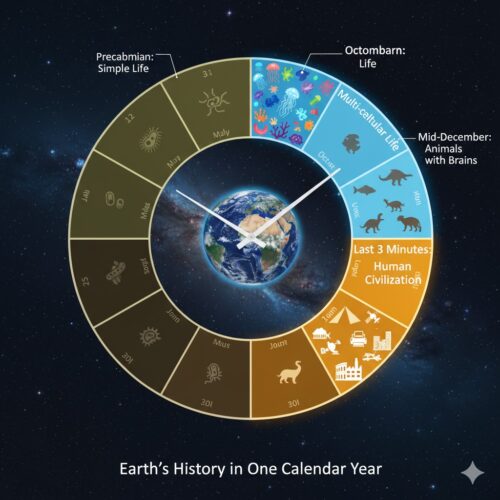
If the planet Earth’s history were compressed into a single year, multicelled life would not appear until October, animals with brains would not emerge until mid-December, and human civilization would only occupy the last 3 minutes till midnight on December 31st. This is called the Geologic Calendar.
The statement that Earth’s $4.54$ billion-year history, if compressed into a single calendar year, would see multicelled life in October, animals with brains in mid-December, and human civilization occupying the last three minutes of New Year’s Eve is a highly effective and generally accurate conceptual model. This visualization, known as the Geologic Calendar, is not meant to be a precise chronological chart, but rather a profound illustration of the vastness of deep time and the startling brevity of human existence.
The overwhelming majority of Earth’s calendar year is consumed by the Precambrian Supereon, a span of time that encompasses the first ten months, from January through September. After the Earth’s formation on January 1st, life itself does not appear until late February or early March, in the form of simple, single-celled organisms like bacteria. For the next seven months, life remains stubbornly simple. Photosynthesis slowly transforms the atmosphere, preparing the stage, but the planet is essentially dominated by microscopic life.
In the Geologic Calendar, the long wait for complexity underscores the difficulty and sheer time required for life to move beyond its most basic forms. The timeline finally accelerates dramatically in the final months. Multi-cellular life does not achieve prominence until the last quarter of the year, appearing in October (around mid-October to early November), marking the end of the Precambrian and the dawn of the Phanerozoic Eon. This late arrival reveals that complex organisms are a relatively recent experiment in Earth’s history.
The famous Cambrian Explosion, where most major animal body plans appeared, would not begin until about mid-November. From this point, evolution races forward: land plants appear in late November, the first four-legged vertebrates (tetrapods) emerge in early December, and the great age of the dinosaurs dominates the period from mid-December until the final week of the year. The catastrophic event that wiped out the non-avian dinosaurs, the Cretaceous-Paleogene extinction, occurred on December 26th. The final five days of the year belong to the Cenozoic Era, the age of mammals, who diversify and dominate the planet. The lineage leading to humans (Hominids) appears late on December 31st, perhaps as late as 10 or 11 PM.
The span of recorded human civilization, starting with the development of writing about 5,500 years ago, is an almost imperceptible flicker at the very end. It lasts only a matter of seconds on the calendar, occupying the last three minutes before midnight on New Year’s Eve. For perspective, the entire life span of an individual human would occupy just a tiny fraction of the final second.
The Geologic Calendar is thus a powerful and humbling reminder. It is a conceptual device that collapses billions of years of cosmic and geologic evolution into a relatable time frame, vividly confirming that the history we study, the rise and fall of empires, the works of art and science, and even the existence of all modern animals is merely the briefest candle in the planet’s long, night.
Buy Book:
Copyright © 2025 “This blog emerged through a dialogue between human reflection and multiple AI systems, each contributing fragments of language and perspective that were woven into the whole.”