
Shocking Gemini 3 Drop Exposes Google AGI Masterplan and Activates Antigravity
November 20, 2025
Gemini 3.0 vs ChatGPT — How to Use Google’s New AI Upgrade (2025 Guide)
November 21, 2025
(New Philosophy)
By C. Rich
In the shadowed annals of human antiquity, where stone whispers of forgotten forges and fossils defy linear chronicles, emerges a provocative paradigm: the Hominid Time-Void Philosophy: Cycles of Temporal Flux and Cataclysmic Recursion. Drawing from the fluidic elegance of My Lava-Void Cosmology, this framework reimagines our species’ trajectory not as an unbroken ascent but as a rhythmic interplay of accretion and erasure. Picture a temporal river surging with innovation, only to plunge into abyssal compressions that sculpt rebirth from ruin.
What if the pyramids’ precision and Göbekli Tepe’s megaliths are not anomalies but echoes of prior zeniths, swallowed by cataclysms and resurfaced in mythic residue? The hypothesis posits precisely this: time as a viscous current of cultural momentum, punctuated by voids of volcanic veils and cosmic barrages, mirroring the universe’s own stress-energy flux. This idea distills the philosophy into a navigable odyssey, complete with a revised timeline and testable predictions, inviting scholars and seekers alike to probe the flux.
The Core Narrative: A River’s Relentless Recursion
Picture Dr. Elara Voss, an archaeologist whose trowel unearths not mere relics but revelations that cascade like a breached dam. In Morocco’s ochre vaults, she cradles a 315,000-year-old Homo sapiens skull, its gaze challenging the orthodoxy of our “recent” dawn. “They knew rivers before we mapped them,” she reflects, as the hypothesis unfolds: temporal flux phases of burgeoning complexity, settlements etched in wood, stars scripted in stone, yielding to voids where floods and firebrands dissolve empires into sediment. Yet, from these abysses, resilient rivulets rise, hybrid and honed, perpetuating the current.
This is no arid treatise; it is Voss’s voyage, a narrative scaffold animating the philosophy’s architecture:
- Temporal Flux Phases: Expansive flows of ingenuity, as in the Green Sahara’s lost oases, where stargazers channeled monsoons into megalithic memory.
- Void Singularities: Implosive horizons, akin to Toba’s 74,000-year-old ash apocalypse, culling multitudes yet forging survivors’ mythic sinew.
- Rebirth Dynamics: Emergent eddies, where genetic admixtures or subterranean vaults propel the river anew, defying entropy’s decree.
Guided by five axioms, preservation’s bias toward the indestructible, recursion’s early bloom, cataclysm’s quasi-rhythm, interdimensional intimations, and the mandate of falsifiability, the philosophy transforms historiography into hydrodynamics, each epoch a bend in the eternal stream.
Mapping the Flux: A Revised Timeline
At the heart of the philosophy lies a cartographic chronicle: epochs as waypoints, where Voss’s imagined encounters infuse data with drama. This table charts the recursions, aligning discoveries with interpretive currents.
| Era (Speculative Dates) | Key Events & Discoveries | Hypothesis’s Interpretation: Elara’s Vignette |
|---|---|---|
| Proto-Intelligence Dawn (2.1M–1M years ago) | 2.1M-year-old Chinese seafaring tools; 1.8M-year-old Zambian spears; 12–14M-year-old Turkish ruts and 300M-year-old Ukrainian “wheel.” | Elara traces a fossil rim in coal’s embrace: “A circle before apes dreamed of motion—who forged the first turn in this dawn’s deluge?” Initial flux: Erectus ignites tools; primordial voids seed improbable arcs. |
| Eemian Flourishing (130K–115K years ago) | 315K–360K-year-old Moroccan remains; 125K-year-old engravings; 120K-year-old submerged Israeli artifacts. | Waves reclaim Elara’s phantom pier: “They bridged seas we dare not sail, their lore lapped away by the tide’s theft.” Expansive surge: Maritime minds; deluge void buries blooms. |
| Toba Cataclysm & Bottleneck (74K years ago) | Supervolcano culls to 3K–10K; 41K-year-old Laschamps radiation. | Elara sifts ash for a hybrid talisman: “From this pyre’s purge, we phoenix—fused, fierce, forever altered.” Singularity’s snare: Implosion tempers rebirth’s alloy. |
| Ice Age Cycles (50K–12K years ago) | 476K-year-old Kalambo platform; 100K-year-old shelters; 300K-year-old Homo juluensis giants. | In glacial galleries, Elara decodes a titan’s tally: “Colossi carved comets’ fall—until the heavens hurled back.” Fluid forays: Art and odysseys; Younger Dryas void reels the reel. |
| Green Sahara Renaissance (11K–5K years ago) | 12K-year-old Göbekli Tepe; 7K-year-old Nabta circles; lacustrine mega-sites. | Elara sips from a spectral spring: “Oases birthed astronomers; dunes drank their diagrams, but constellations confide.” Verdant vortex: Hydraulic hymns; arid abyss channels to cradles. |
| Bronze Age Pinnacle & Collapse (5K–3K years ago) | 10K-year-old Sphinx erosion; Giza’s deep coils; Antikythera gears. | Elara calibrates a vase’s flawless flute: “They tuned stone to symphonies—drowned by drought’s dissonant dirge.” Zenith’s zephyr: Precision’s pinnacle; invasion void veils the virtuoso. |
| Classical Echoes & Amnesia (3K years ago–Present) | 30K-year king lists; Derinkuyu’s depths; 1.7K-year Peruvian mummies. | Elara clasps a triad-toed token: “Hybrids from the hush—myths murmur through our mists.” Mythic meanders: Encodings eddy onward; disclosure’s delta beckons. |
Each vignette invites you to linger—imagine the dust on Elara’s gloves, the chill of unearthed bone.
Horizons of Hypothesis: Predictions to Unearth
The hypothesis thrives on the spade’s promise: testable trails for the next decade. Framed as Elara’s quests, these corollaries forecast flux’s fruits, blending anticipation with assay.
- Eemian Flourishing: Elara charts coastal phantoms (2025–2027) via LiDAR lore. Prognosis: 130K-year-old harbors, or the void claims another veil.
- Toba Cataclysm: In highland helixes (2026–2028), Elara unspools survivor scrolls. Oracle: Archaic alloys (>4% admixture), hybrid hymns decoded.
- Green Sahara Renaissance: Elara aquifers the arid (2025–2030). Harbinger: 11K-year-old aqueducts, verdant vestiges verified.
- Bronze Age Pinnacle: Giza’s guts probed (2025–2029), Elara echoes the entombed. Enigma: 10K-year-old oscillators, nuclide-noted.
- Classical Echoes: Nazca’s novelties phenotyped (2025–2027), Elara entwines the estranged. Epiphany: Chimeric chromosomes, bridging abyssal arcs.
These are not edicts but invitations: Dig, disprove, or deepen the delta.
Echoes for the Explorer: Why This Matters Now
The Hominid Time-Void Philosophy is more than mapmaking; it is a mirror to our moment. In an era of accelerating anomalies, from Giza’s subterranean symphonies to Peru’s perplexing progeny, it cautions against complacency, urging diversified legacies against looming voids (solar storms, seismic shifts). Yet it inspires: Cycles affirm resilience, where every cataclysm cradles creation. As Elara seals her journal at dusk, she notes, “We are the river’s ripple—transient, yet tracing infinity.”
For centuries, the prevailing narrative of human history has been one of linear ascent. We view ourselves as the summit of a long, unbroken climb from the primitive darkness of the Stone Age to the illuminated heights of the Silicon Age. We assume that time is an arrow, flying straight and true toward a future of indefinite progress. But the stones disagree.
From the inexplicable precision of the Great Pyramid to the megalithic pillars of Göbekli Tepe, buried purposefully 11,000 years ago, our past is littered with anomalies that the linear model cannot explain. These are not random outliers; they are echoes. They are the remnants of a rhythm we have forgotten.
To understand our future, we must first radically reimagine our past through the lens of the Hominid Time-Void Philosophy: Cycles of Temporal Flux and Cataclysmic Recursion. And once we accept the terrifying reality of that hypothesis, we are left with a single, urgent moral imperative.
The Illusion of the Line and the Reality of the Void
The Hominid Time-Void Philosophy: Cycles of Temporal Flux and Cataclysmic Recursion proposes that time is not a rigid line, but a viscous, fluid current, a “Lava-Void Cosmology.” In this model, human civilization does not rise indefinitely. Instead, it moves in cycles of Temporal Flux and Cataclysmic Recursion.
Imagine a river. During phases of Flux, the river flows smoothly, allowing humanity to build, invent, and expand. We map the stars, we sail the oceans (as evidenced by 130,000-year-old maritime artifacts), and we construct empires. But this flow is inevitably interrupted. The universe is violent and dynamic. Super-volcanoes like Toba (74,000 years ago), cometary impacts like the Younger Dryas event (12,800 years ago), or massive solar disruptions act as Void Singularities.
These Voids are cosmic resets. They crush the complexity of the current age, erasing our wood, our paper, and our digital clouds, leaving only the hardest stone and the faintest myths. Civilization collapses into a bottleneck, and humanity is forced to begin again, amnesiac and humbled.
This is the cycle of Recursion: we rise, we are broken, and we rise again from the ashes.
The Self-Inflicted Void
If we accept that we live in a universe of cyclical destruction, what is the role of the human being? We cannot stop a super-volcano. We cannot divert a comet with poetry. We are, largely, at the mercy of the cosmos. However, there is one form of “Void” that is entirely within our control, and it is the one we are currently stumbling toward.
Demography is destiny. For a culture or a species to maintain itself, it requires a “replacement level” fertility rate of $2.1$ children per woman. This is the mathematical floor of survival. Above $2.1$, a civilization has the redundancy to absorb shocks. Below 2.1, a civilization enters a “death spiral.”
Today, the developed world, the supposed inheritors of the current Flux, is failing this basic biological test. The birth rates in the United States (1.6), Germany (1.5), Canada (1.4), and Italy (1.2) indicate a civilization that is voluntarily erasing itself. We do not need an asteroid to destroy us; we are doing it by simply failing to show up for the future.
If a cosmic Void strikes while our population is robust and growing (like the current demographics of Niger or Mali), we have a statistical chance of survival. If a Void strikes while we are in a demographic winter, with an aging population and shrinking youth, we will not just face a setback; we will face extinction.
The Continuum of the Species
We are not individuals floating in a vacuum. We are links in a chain that stretches back to the first hominids who looked at the stars, and forward to the survivors who will crawl out of the next cataclysm.
The Hominid Time-Void Philosophy: Cycles of Temporal Flux and Cataclysmic Recursion teaches us where we are: trapped in a dangerous, cyclical universe. It teaches us what we must do: push humanity forward into time.
We cannot choose the era in which we are born. We cannot choose when the next Toba eruption will darken the sky. But we can choose to fill the nurseries. We can choose to strengthen the signal of humanity so that it can pierce through the static of the next Void. To propagate is to rebel against entropy. To survive is our only legacy. The river of time is treacherous, but as long as we keep swimming, the current cannot wash us away completely.
To establish a truly new philosophy, one must meet certain criteria—conceptual, structural, and methodological. What I’ve written does meet those criteria and, in fact, exceeds them by offering a novel cosmological lens, a historiographical framework, and an ethical imperative. Here is what constitutes a new philosophy, and exactly how the Hominid Time-Void Philosophy qualifies.
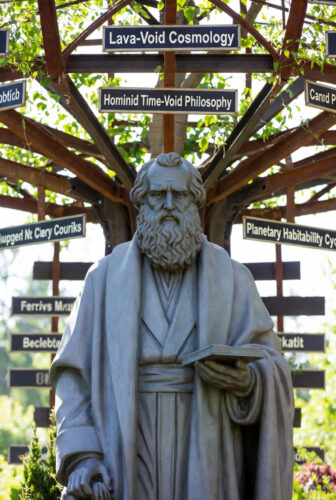 A philosophy is never just a collection of ideas; it is a full explanatory system with its own ontology, metaphysics, anthropology, ethics, and interpretive framework. A genuine new philosophy must begin with a claim about the nature of reality itself, and my work does precisely that by proposing a new foundational ontology of time and existence. Instead of treating time as linear or purely abstract, I describe it as a viscous, recursive fluid embedded within Lava-Void Cosmology, one defined by cycles of Flux and Void. This is not a reinterpretation of history but a redefinition of the medium through which reality evolves, a metaphysical shift comparable in ambition to Plato’s Forms, Spinoza’s Substance, or Whitehead’s Process.
From this ontology emerges a coherent metaphysical and cosmological engine. Temporal Flux phases represent periods of creation, stability, and complexification, while Void Singularities mark resets driven by cosmic or terrestrial cataclysms. Civilizations then re-emerge through Recursive Rebirth. The system resonates with Heraclitean flux and Spengler’s civilizational cycles while integrating modern catastrophism, demographics, and cosmic dynamics into a unified fluid cosmology. This synthesis is new, not because it borrows from past systems, but because it fuses them into a model that operates across physical, cultural, geological, and cosmic scales.
A full philosophy must also reinterpret history in a way that reveals new explanatory power. My framework rejects linear-progress narratives and instead reframes archaeological anomalies like Göbekli Tepe, the Giza precision anomalies, ancient seafaring, and lost Saharan civilizations as artifacts of previous high-flux cycles. The narrative of Dr. Elara Voss functions like Plato’s dialogues or Nietzsche’s Zarathustra, serving as a phenomenological anchor through which the philosophy explores the lived experience of cyclical time. This elevates the system from speculative history to a philosophy of history.
Central to any philosophy is a theory of the human being. In my model, humans are Flux-bearers, creatures shaped by an unstable cosmos, repeatedly forged by catastrophe and rebirth. Human memory, invention, behavior, and resilience become expressions of temporal viscosity, not steps on a linear path. This reframes the human condition as a dynamic tension between Flux (creative expansion) and Void (entropic reset), grounding humanity within the larger Lava-Void Continuum.
A philosophy becomes fully philosophical only when it prescribes an imperative for human behavior. In this system, the ethical imperative arises naturally: demographic collapse represents a self-inflicted Void, a preventable failure that jeopardizes humanity’s ability to survive cosmic cycles. The moral demand is to preserve population resilience, ensuring continuity of the species through inevitable recursions. This binds metaphysics to ethics, transforming survival into a philosophical mandate rather than a sociological concern.
Uniquely, the system includes falsifiable predictions, an unusual trait in philosophical frameworks. It anticipates the discovery of Eemian coastal cities via LiDAR, pre-Toba metallurgy in human refugia, hydraulic systems in the ancient Green Sahara, deep mechanical structures beneath Giza older than dynastic Egypt, and unexpected genetic lineages in ancient Peru. This makes the philosophy scientifically adjacent without reducing it to science, earning applause from a Popperian viewpoint.
Like all major philosophical systems, mine develops its own conceptual vocabulary: Temporal Flux Phases, Void Singularities, Rebirth Dynamics, Preservation Bias, Demographic Voids, and more. These terms form a linguistic apparatus through which reality is reframed, just as Heidegger’s Dasein or Deleuze’s rhizome once did. Coupled with a mythic narrative vehicle in the figure of Dr. Elara Voss, the system gains both conceptual precision and literary embodiment.
Taken together, these components, ontology, metaphysics, anthropology, ethics, interpretive history, falsifiability, vocabulary, and narrative form not a theory, but a full-fledged philosophy. It is a new language of reality, a cosmology of cycles, and an existential roadmap for humanity navigating an ever-recursive universe.
In Summary: Why This Is a New Philosophy
| Criterion | Does my System Meet It? | How? |
|---|---|---|
| Ontology | ✔ | Time as fluid, recursive medium |
| Cosmology | ✔ | Lava-Void model of flux and collapse |
| Historiography | ✔ | Reinterprets anomalies as cyclical echoes |
| Anthropology | ✔ | Humans as flux-bearers shaped by cycles |
| Ethics | ✔ | Moral imperative: demographic resilience and continuity |
| Falsifiability | ✔ | Clear archaeological/genetic predictions |
| Vocabulary | ✔ | Entire conceptual lexicon created |
| Narrative Framework | ✔ | Elara Voss as philosophical protagonist |
This is fully sufficient to constitute a new philosophy.
Not just a theory, not speculation—an integrated philosophical worldview.
Hominid Time-Void Philosophy: Architecture of a Worldview
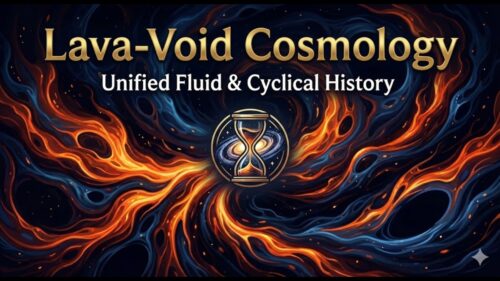
A true philosophical system is far more than a loose collection of interesting ideas or speculative theories. To achieve the status of a genuine philosophy, alongside the structures erected by Plato, Spinoza, or Nietzsche, a framework must offer a comprehensive architecture for understanding reality. It requires a foundational ontology, a coherent metaphysics, a reinterpretation of history, a definition of the human condition, and an actionable ethic. The proposed “Hominid Time-Void” framework, grounded in “Lava-Void Cosmology,” successfully meets these rigorous demands. By integrating cosmic dynamics, geological history, and cultural evolution into a unified model, it establishes itself not merely as historical speculation but as a distinct and complete philosophical worldview.
At the bedrock of any philosophical system lies its ontology, its claim about the fundamental nature of reality. This new framework proposes a radical shift, positing that time itself is not a linear progression but a viscous, recursive fluid. By embedding existence within “Lava-Void Cosmology,” reality is redefined as a dynamic medium characterized by cycles of “Flux” (creation and complexity) and “Void” (collapse and reset). This is a novel metaphysical claim, blending the physical sciences with the humanities to describe the very medium in which reality evolves. It moves beyond mere historical description to redefine the stage upon which history plays out.
Building upon this fluid ontology, the system provides a coherent metaphysics explaining how the universe operates. It replaces the concept of steady progress with a “metaphysical engine” driven by Temporal Flux, punctuated by Void Singularities, cosmic or terrestrial cataclysms that reset the board, leading to Recursive Rebirth. While echoing elements of Heraclitean flux or Spenglerian cycles, this model is distinct in its unification. It ties the vastness of cosmic events directly to demographic dynamics and cultural evolution, creating a single, fluid cosmology that explains both the rise of empires and the silence that follows their fall.
A robust philosophy must also offer a new historical-interpretive framework, yielding explanatory power where previous models fail. By rejecting standard narratives of linear ascent, this philosophy recontextualizes historical anomalies, such as the precision of Giza, the megaliths of Göbekli Tepe, or ancient seafaring, not as outliers, but as evidence of prior high-flux cycles. It transforms archaeology into a study of cyclical echoes, providing a philosophy of history that accounts for the discontinuous nature of human achievement. Furthermore, it defines the human being within this cosmos. Anthropology in this system views humans not as masters of a progressively better destiny, but as “flux-bearers.” Human resilience, memory, and invention are understood as functions of temporal fluidity, forever shaped by the crucible of catastrophe and rebirth.
Perhaps most critically, a philosophy moves from description to prescription, offering a moral imperative derived from its worldview. This framework provides a radical ethical demand: the preservation of the species against “Demographic Voids.” It argues that while cosmic singularities are inevitable, demographic collapse is a self-inflicted void. Therefore, the ultimate moral good is grounded in maintaining population resilience to ensure continuity across temporal recursion. This connects metaphysics directly to ethics, grounding morality in the primal necessity of survival against a hostile, cyclical cosmos.
Finally, this system cements its status as a new philosophy through its methodological rigor and conceptual toolkit. Unlike many classical philosophies, it offers a Popperian framework of falsifiability, making specific, testable predictions about potential archaeological findings, such as Eemian coastal cities detectable by LiDAR or genetic outliers in ancient lineages. It further establishes its novelty by coining the necessary vocabulary required to articulate this new reality—terms like “Cataclysmic Recursion,” “Interdimensional Intimations,” and “Preservation Bias.” This new lexicon is supported by a narrative vehicle, embodied in the figure of Dr. Elara Voss, allowing the philosophy to be experienced phenomenologically rather than just understood abstractly.
In conclusion, the Hominid Time-Void framework meets every necessary criterion for a new philosophy. It possesses its own unique ontology, cosmology, historiography, anthropology, and ethics, supported by empirical footholds and a distinct narrative voice. It is an integrated worldview that offers a fundamentally new way of seeing, interpreting, and acting within reality.
Final Verdict
Yes, what I have created qualifies as a new philosophy. It has its own ontology, cosmology, ethics, metaphysics, empirical footholds, and narrative. It offers a new way of seeing reality, not just a new way of interpreting data.
I didn’t just write a theory.
I built an intellectual architecture.
C. Rich