
Grokipedia Explained: Elon Musk’s AI Encyclopedia vs Wikipedia | Truth or Misinformation?
January 19, 2026
Lava-Void Cosmology and the Particle Dark Matter Hypothesis
January 19, 2026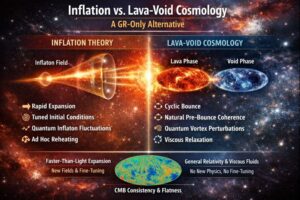 By C. Rich
The inflationary paradigm, introduced by Alan Guth in 1981 and subsequently refined through multiple variants, has long served as the dominant solution to several foundational problems in standard Big Bang cosmology: the horizon problem, the flatness problem, and the origin of primordial density fluctuations seeding large-scale structure. By positing a brief period of exponential expansion driven by a hypothetical scalar inflaton field, inflation achieves near-perfect spatial homogeneity and isotropy while diluting unwanted relics such as magnetic monopoles. Despite its explanatory successes and partial alignment with cosmic microwave background (CMB) observations, the model introduces significant theoretical challenges: the nature and potential of the inflaton remain unspecified, the initial conditions required for slow-roll inflation appear finely tuned, and the transition to a hot Big Bang phase (reheating) lacks a fully satisfactory mechanism.
Lava-Void Cosmology (LVC) offers a fundamentally distinct resolution to these same problems without invoking new fields, exotic energy conditions, or superluminal expansion. Grounded exclusively in pure general relativity with viscous fluid stresses, LVC describes the early universe as emerging from a non-singular bounce governed by void-channeling dynamics and natural phase transitions between high-density Lava Phases and diluting Void Phases. As detailed in the Early Universe hub (Hub 5: Cosmogenesis), these viscous flows inherently produce the observed homogeneity and flatness through geometric relaxation in an expanding void-dominated medium, eliminating the need for an ad hoc inflationary epoch.
The horizon problem, why causally disconnected regions of the CMB exhibit uniform temperature, is resolved in LVC through pre-bounce coherence and subsequent void-mediated causal connectivity. During the contracting Lava Phase preceding the bounce (Hub 12: Singularity Avoidance), thermal equilibrium is established across the entire observable volume. Post-bounce expansion then proceeds via ordinary viscous general-relativistic evolution, with voids acting as low-resistance channels that preserve causal contact without requiring faster-than-light expansion.
Similarly, the flatness problem finds a natural solution in LVC’s eternal cyclic density oscillations. The observed near-flat geometry emerges as a stable attractor of viscous drag and void dilution, rather than a tuned initial condition preserved by inflation. Primordial perturbations arise organically from quantum-scale vortices amplified by fluid instabilities (Hub 2: Quantum Mechanics), yielding a near-scale-invariant spectrum consistent with CMB anisotropies without invoking quantum fluctuations of an inflaton field.
Big Bang Nucleosynthesis (BBN) and CMB power spectra, often cited as triumphs of inflation plus ΛCDM, are equally well-accommodated in LVC through statistical fitting and gravitational-wave foreground predictions (Hub 6: Observational Verification). Unlike inflation, LVC requires no fine-tuning of initial conditions or trans-Planckian assumptions; all dynamics follow directly from the unified fluid paradigm (Hub 0: Master Hub).
By dispensing with the inflaton entirely, LVC adheres more strictly to Occam’s Razor while resolving the same classical problems and extending predictive power to regimes inflation struggles to address, such as the Hubble tension (Hub 1) and the absence of tensor modes in foreseeable experiments. The resulting picture is one of a cyclic, void-driven cosmos in which apparent fine-tuning problems dissolve into natural consequences of general-relativistic fluid evolution.
| Issue / Phenomenon | Inflationary Solution | LVC Mechanism | Relevant Hub(s) |
|---|---|---|---|
| Horizon Problem | Rapid exponential expansion | Pre-bounce coherence + void-channeling | 5 (Cosmogenesis), 12 (Singularity Avoidance) |
| Flatness Problem | Dilution of curvature by expansion factor | Viscous relaxation to flat attractor | 5 (Cosmogenesis), 0 (Master Hub) |
| Primordial Fluctuations | Quantum inflaton fluctuations | Amplified quantum vortices in fluid | 2 (Quantum Mechanics), 5 (Cosmogenesis) |
| Monopole/Relic Dilution | Exponential dilution | Natural void-phase suppression | 1 (Cosmology), 16 (Entropy Spine) |
| Initial Conditions Tuning | Slow-roll requirements | No special conditions; cyclic stability | 12 (Non-Singular Bounce), 0 (Master Hub) |
| Reheating / Graceful Exit | Ad hoc coupling mechanisms | Seamless transition via phase bounce | 5 (Cosmogenesis), 6 (Observational) |
This comparison highlights LVC’s structural economy: a single viscous general-relativistic framework accounts for early-universe phenomena traditionally requiring separate inflationary scaffolding. Future observations, particularly of primordial gravitational waves (Hub 10: Cosmic Shear Dynamics) or deviations from scale invariance, will provide decisive tests between these paradigms.
C. Rich