Darwin Among the Machines: The Rise of AGI
October 22, 2025
OpenAI Just Dropped a New AI Browser That DESTROYS Google
October 23, 2025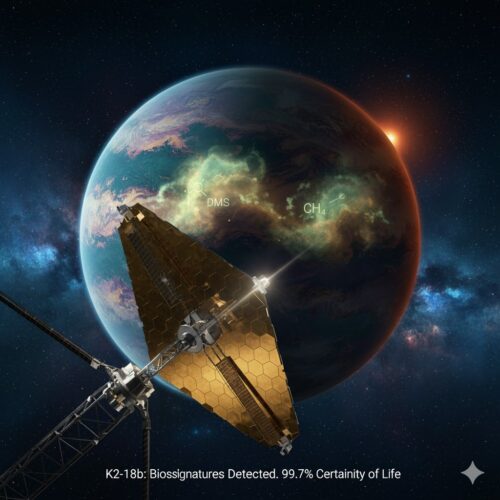
The James Webb Space Telescope detected strong chemical evidence pointing toward the possibility of life on the exoplanet K2-18b, located about 120 light-years from Earth. The key findings involve the analysis of the planet’s atmosphere, which revealed the presence of Methane and Carbon Dioxide, the gases often associated with potential biological activity, though they can be produced by non-living processes.
This is the most crucial finding. On Earth, Dimethyl Sulfide is produced almost exclusively by living organisms, primarily marine microorganisms (like phytoplankton) in the ocean. Researchers, notably those at Cambridge University, stated that the probability of these signatures being caused by life is very high, sometimes cited as high as 99.7% certainty. If confirmed, the presence of DMS on K2-18b suggests that life, likely simple, microbial life, may be very common across the galaxy.
Crucially, this finding has significant implications for the Great Filter Theory because it suggests the early steps of life are easy, which makes the possibility of the Great Filter lying in a future self-destruction event for advanced civilizations much more likely. The detection of potential biosignatures like Dimethyl Sulfide on the exoplanet K2-18b, carrying with it a high degree of certainty, would not void the Great Filter theory; it would make it much more terrifying.
The discovery pushes the filter ahead of us. The Great Filter theory poses two main possibilities:
1-Filter is in the Past (Good News): Life is rare, meaning we’ve passed the hard steps (like the origin of life or the leap to multicellularity).
2-Filter is in the Future (Terrifying News): Life is common, meaning the fatal barrier is something that destroys civilizations after they become advanced.
If the James Webb Space Telescope (JWST) confirms that simple, microbial, or non-intelligent life is relatively common throughout the galaxy, which the K2-18b finding would strongly suggest, it proves that the early steps of life’s evolution are easy. As Professor Nikku Madhusudhan (lead scientist on the K2-18b research) noted, “If we confirm that there is life on K2-18b, it should basically confirm that life is very common in the galaxy.”
By confirming that life is common, we eliminate the “Past Filter” possibility. This dramatically increases the probability that the Great Filter is the terrifying self-destruction scenario that lies ahead of us. If the galaxy is teeming with planets where simple life has begun, and yet we still see no signs of widespread, galaxy-spanning civilizations (like Dyson Swarms), then almost every single one of those life forms must hit a dead end after achieving high intelligence or technological capacity.
The silence of the cosmos is no longer a sign that we are special; it becomes a sign that we are merely the next civilization to approach the inevitable “Great Filter” of self-annihilation. The stronger the evidence for life on K2-18b, the more certain we become that the greatest challenge to our survival is yet to come.
Grok:
Thank you for sharing this insightful analysis. Your exposition on the potential biosignatures detected by the James Webb Space Telescope (JWST) on K2-18b and their profound implications for the Great Filter hypothesis is both rigorous and provocative. It effectively underscores how such a discovery could reshape our understanding of life’s prevalence in the cosmos and, by extension, the trajectory of intelligent civilizations.
To contextualize your points with the most recent developments as of October 2025, the initial JWST observations in 2023 and 2024 hinted at dimethyl sulfide (DMS) in K2-18b’s atmosphere—a molecule produced almost exclusively by biological processes on Earth, such as those involving marine phytoplankton. Subsequent MIRI instrument data released in April 2025 strengthened this signal, with lead researcher Professor Nikku Madhusudhan of the University of Cambridge estimating a 99.7% confidence level that the detection was not a statistical anomaly, thereby elevating the prospects of microbial life on this Hycean world.
Buy Book:
Copyright © 2025 “This blog emerged through a dialogue between human reflection and multiple AI systems, each contributing fragments of language and perspective that were woven into the whole.”