Cosmological Constant Solved by Lava-Void Cosmology
January 19, 2026
Lava-Void Cosmology vs. String Theory
January 19, 2026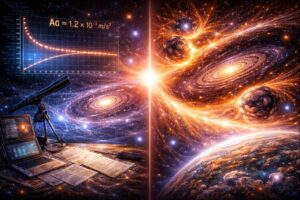 By C. Rich
Modified Newtonian Dynamics (MOND), proposed by Mordehai Milgrom in 1983, represents a phenomenological modification to Newtonian gravity in the ultra-low-acceleration regime (below a critical acceleration a₀ ≈ 1.2 × 10⁻¹⁰ m/s²). Rather than invoking non-baryonic dark matter, MOND alters the inertial or gravitational force law, yielding a 1/r force (flat rotation curves) at large galactic radii while recovering standard Newtonian behavior at high accelerations. The paradigm achieves remarkable success in fitting spiral galaxy rotation curves with a single universal parameter and predicts the baryonic Tully-Fisher relation empirically. Relativistic extensions, such as TeVeS (Tensor-Vector-Scalar theory), attempt to incorporate MOND into general relativity, enabling explanations for gravitational lensing. However, these extensions introduce additional fields, struggle with cluster-scale dynamics and cosmology (requiring residual dark matter or neutrinos), and face challenges in fully reconciling with cosmic microwave background anisotropies and large-scale structure formation without supplementary components.
Lava-Void Cosmology (LVC) reproduces MOND-like behaviors, particularly flat rotation curves and scale-dependent modifications, through purely classical viscous general-relativistic fluid dynamics, without altering fundamental laws or introducing new parameters beyond viscosity coefficients naturally emergent from the cosmic medium. As outlined in the Galactic Dynamics hub (Hub 7: Galaxy Rotation Curves, Dark Matter Alternative, Viscous Drag), the intergalactic void exerts a drag force on embedded structures, generating an effective radial acceleration that transitions smoothly from Newtonian at small radii to a 1/r profile at large distances, mirroring MOND’s interpolation function (e.g., the “simple” μ(x) form) as a geometric consequence of low-viscosity flow.
This emergent modification extends relativistically across scales without auxiliary fields: cluster lensing and dynamics arise from void-channeling and shear (Hub 1: Cosmology), while cosmological tensions are unified under phase transitions (Hub 5: Cosmogenesis). Unlike MOND’s non-relativistic origin, LVC preserves full general covariance from the outset (Hub 0: Master Hub), incorporating quantum-scale vortices (Hub 2: Quantum Mechanics) that seed the viscous instabilities responsible for observed scaling relations.
LVC thus achieves MOND’s empirical successes, baryonic scaling laws, and rotation curve predictability while resolving its relativistic and cosmological shortcomings in a single framework. The critical acceleration a₀ emerges naturally as a characteristic scale of void-fluid interaction rather than a postulated constant, and no residual dark components are required.
Distinct predictions include void-specific signatures in ultra-high-energy cosmic rays (Hub 11: UHECR Physics) and stochastic gravitational-wave backgrounds from cosmic shear (Hub 10: Cosmic Shear Dynamics), offering testable discrimination from both MOND extensions and particle dark matter models.
| Phenomenon | MOND Solution | LVC Mechanism | Relevant Hub(s) |
|---|---|---|---|
| Galaxy Rotation Curves | Modified force law below a₀ | Viscous drag yielding emergent 1/r profile | 7 (Galactic Dynamics), 0 (Master Hub) |
| Baryonic Tully-Fisher Relation | Empirical prediction from deep-MOND limit | Natural outcome of fluid-baryon coupling | 7 (Galactic), 1 (Cosmology) |
| Gravitational Lensing | Relativistic extensions (TeVeS fields) | Geometric void-channeling & shear | 7 (Galactic), 6 (Observational Verification) |
| Cluster-Scale Dynamics | Requires residual DM or neutrinos | Unified void drag without additions | 1 (Cosmology), 7 (Galactic) |
| Cosmological Scales (CMB, LSS) | Challenging; needs supplementary components | Primordial vortices & phase transitions | 5 (Cosmogenesis), 2 (Quantum Mechanics) |
| Relativistic Consistency | Achieved via added fields (complicated) | Native general covariance | 0 (Master Hub), 9 (Stress Test) |
LVC incorporates the phenomenological strengths of MOND as emergent features of a deeper viscous general-relativistic ontology, extending its explanatory reach to full cosmological coherence while adhering to stricter parsimony—no modified laws, no extra fields, and unified resolution of multiple anomalies. This positions LVC as a natural relativistic completion of the MOND paradigm’s insights into baryon-dominated gravity.
C. Rich
[doi_footer]