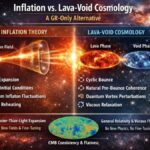
Inflation vs Lava-Void Cosmology: A GR-Only Alternative
January 19, 2026
Lava-Void Cosmology vs. the Multiverse Hypothesis
January 19, 2026 By C. Rich
The particle dark matter hypothesis has dominated cosmological modeling since the 1980s, motivated primarily by discrepancies between observed galactic rotation curves and the predictions of Newtonian gravity applied to visible baryonic matter. Pioneered through suggestions of weakly interacting massive particles (WIMPs), axions, and other beyond-Standard-Model candidates, the paradigm posits a non-baryonic, cold, collisionless component comprising approximately 85% of the universe’s matter density. This invisible mass is invoked to explain a wide array of phenomena: flat rotation curves in spiral galaxies, gravitational lensing in clusters, the acoustic peaks in the cosmic microwave background (CMB), and the formation of large-scale structure through hierarchical merging. Despite decades of intensive experimental effort, direct detection experiments (e.g., LUX-ZEPLIN, XENON), indirect searches via gamma-ray and neutrino signatures (Fermi-LAT, IceCube), and collider production (LHC), no conclusive evidence for any dark matter particle has emerged, prompting growing scrutiny of the approach’s foundational assumptions.
Lava-Void Cosmology (LVC) provides a radically different resolution to these same observational anomalies without postulating new particles or modifying the particle content of the universe. Rooted exclusively in pure general relativity augmented by viscous fluid stresses, LVC treats apparent dark matter effects as emergent geometric consequences of void-dominated dynamics and anisotropic shear in a low-density, high-entropy medium. As elaborated in the Galactic Dynamics hub (Hub 7: Galaxy Rotation Curves, Dark Matter Alternative, Viscous Drag), rotation curves flatten naturally due to viscous drag exerted by the intergalactic void fluid on embedded structures, producing an effective radial acceleration that mimics a 1/r force law at large radii, precisely the behavior historically attributed to halo dark matter.
This mechanism extends seamlessly to meso- and macro-scales. Cluster dynamics and gravitational lensing arise from void-channeling that enhances effective mass aggregation without additional particles (Hub 1: Cosmology – Hubble Tension, Dark Energy). Large-scale structure formation proceeds via instability-driven filamentation in the viscous fluid (Hub 5: Early Universe), while CMB anisotropies are accommodated through amplified primordial vortices (Hub 2: Quantum Mechanics) and statistical fitting (Hub 6: Observational Verification). Crucially, LVC unifies these effects with resolutions to the Hubble tension and apparent dark energy acceleration, treating both as manifestations of the same void-dilution process rather than separate components.
By eliminating the need for non-baryonic dark matter entirely, LVC adheres more rigorously to Occam’s Razor and the principle of general covariance, requiring no exotic particles, fine-tuned couplings, or symmetry breakings. The absence of detection in particle searches is not a temporary null result but a predictable outcome: there are no WIMPs or axions to find. Instead, the observed phenomena emerge from the classical viscous general-relativistic evolution of the cosmic fluid itself (Hub 0: Master Hub).
This geometric alternative also offers novel predictions distinguishable from particle models, including scale-dependent modifications to rotation curves at ultra-faint dwarf scales, specific low-frequency stochastic gravitational-wave backgrounds from void shear (Hub 10: Cosmic Shear Dynamics), and propagation anomalies in ultra-high-energy cosmic rays channeled through voids (Hub 11: UHECR Physics). Continued non-detection of particle candidates, combined with precision tests of these fluid signatures, will further discriminate between the paradigms.
| Phenomenon | Particle Dark Matter Solution | LVC Mechanism | Relevant Hub(s) |
|---|---|---|---|
| Galaxy Rotation Curves | Spherical non-baryonic halo | Viscous drag from void fluid | 7 (Galactic Dynamics), 0 (Master Hub) |
| Cluster Dynamics & Lensing | Massive collisionless component | Void-channeling & shear enhancement | 7 (Galactic), 1 (Cosmology) |
| Large-Scale Structure Formation | Hierarchical merging of cold DM | Instability-driven filamentation in fluid | 5 (Cosmogenesis), 2 (Quantum Mechanics) |
| CMB Acoustic Peaks | Baryon-DM ratio & gravitational potential | Primordial vortex amplification & statistics | 5 (Cosmogenesis), 6 (Observational) |
| Hubble Tension | Separate parameter (often ignored) | Unified void-dilution dynamics | 1 (Cosmology), 16 (Entropy Spine) |
| Experimental Detection | Expected signals in direct/indirect searches | No particles; geometric effects only | 9 (Stress Test), 6 (Observational) |
LVC thus presents a structurally simpler framework that accounts for the full suite of evidence traditionally requiring particle dark matter while resolving additional tensions within a single viscous general-relativistic ontology. As experimental constraints on particle candidates tighten, the fluid-geometric alternative gains increasing parsimony and predictive power.
C. Rich