
Grok 4.1 vs Gemini 3: Which AI Actually Thinks Better in 2026? (Real Tests)
January 17, 2026
Principle of General Covariance in Lava-Void Cosmology
January 17, 2026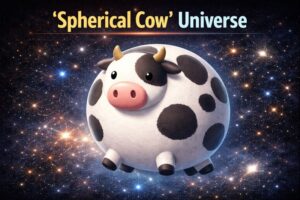 By C. Rich
Physicists often joke about something called the “spherical cow.” The idea comes from a story in which a farmer asks a physicist how to improve milk production, and the physicist begins by saying, “Assume the cow is a perfect sphere, floating in a vacuum.” The joke highlights a real habit in science: researchers often simplify messy reality into clean, idealized models that are easy to calculate, even if they ignore important details. These models can be useful, but they can also hide what is really going on.
Modern cosmology uses its own version of the spherical cow. The standard model of the universe assumes that, on very large scales, space is smooth, uniform, and the same in all directions. In this picture, the universe expands evenly everywhere, like a perfectly mixed fluid. This assumption makes the math manageable and has led to many successful predictions, such as patterns seen in the cosmic microwave background, the faint afterglow of the Big Bang.
However, reality does not fit this picture perfectly. To make the model work, scientists have had to introduce extra ingredients: invisible “dark matter” to explain why galaxies stay together, and “dark energy” to explain why the expansion of the universe is speeding up. These additions match observations, but they also raise questions. Some measurements of how fast the universe is expanding disagree with each other, and recent telescope data have revealed surprisingly large, mature galaxies very early in cosmic history.
Lava-Void Cosmology (LVC) takes a different approach. Instead of starting with a perfectly smooth universe, it treats the universe as a single, continuous substance, more like a thick, flowing cosmic fluid, with clumps and empty regions built in from the start. Importantly, it uses standard Einstein gravity without adding new particles or forces.
In this view:
Dense regions of the universe (“lava”) naturally slow and drag surrounding matter as they flow, creating effects that look like dark matter without needing mysterious particles.
Vast empty regions (“voids”) push outward in a way that causes the universe’s expansion to speed up, replacing the need for dark energy.
Because different regions expand at different rates, the model can explain why nearby measurements of cosmic expansion are higher than values inferred from the early universe.
LVC also avoids certain extreme assumptions, like a universe that begins from an infinitely dense point. Instead, it allows for smooth “bounces” in the early universe and still matches known observations such as the formation of light elements and the structure seen in the cosmic background radiation.
From this perspective, the standard smooth-universe model is not “wrong,” but incomplete. It works as a rough average, like treating a real cow as a sphere, but it misses important structure. Lava-Void Cosmology argues that by taking the universe’s natural unevenness seriously, many long-standing cosmic puzzles can be explained with fewer assumptions and no unseen ingredients. In short, it trades an overly simple picture for one that better reflects the universe we actually observe.
Speaking a little bit more scientifically, the “spherical cow” analogy, a classic illustration in theoretical physics, underscores the utility and limitations of idealized approximations. It originates from the humorous anecdote of a physicist simplifying a farmer’s query about milk production by modeling the cow as a perfect sphere in a vacuum, thereby enabling exact mathematical treatment at the expense of realistic detail. This approach prioritizes analytical tractability over fidelity to complexity, yielding insights while potentially masking underlying dynamics.
In cosmology, the Friedmann-Lemaître-Robertson-Walker (FLRW) metric within the ΛCDM framework exemplifies this spherical cow paradigm. It enforces strict homogeneity and isotropy on large scales, the Cosmological Principle, treating the universe as a uniformly expanding fluid with averaged density and curvature. This simplification facilitates precise predictions, such as the cosmic microwave background power spectrum and baryon acoustic oscillations, but necessitates auxiliary components: cold dark matter particles to explain structure formation and gravitational binding, and a cosmological constant (Λ) to account for observed acceleration. These additions, while empirically successful, introduce parameters that resolve discrepancies (e.g., flatness, horizon problems via inflation) yet contribute to persistent tensions, including the Hubble constant discrepancy and certain JWST observations of early massive galaxies.
Lava-Void Cosmology (LVC), as articulated across its modular repository, transcends this idealized uniformity by modeling the universe as a single, compressible, viscous relativistic fluid governed solely by unmodified General Relativity. Rather than imposing global homogeneity, LVC embraces inherent inhomogeneities:
- Overdense regions (“lava”) generate gravitational effects traditionally ascribed to dark matter through viscous drag and clustering, naturally reproducing galaxy rotation curves and large-scale structure without particulate additions (see Galactic Dynamics module).
- Underdense expanses (“voids”) produce negative effective pressure via density-dependent equations of state, driving acceleration in a manner unified with dark energy, while inducing local variations in the Hubble parameter that reconcile high local measurements (~73 km/s/Mpc) with lower global values from CMB data (see Cosmology module on Hubble Tension and Dark Energy).
This viscous-fluid continuum avoids singularities through dynamic bounces, aligns primordial nucleosynthesis and CMB anisotropies without fine-tuned inflation, and offers falsifiable predictions across gravitational waves, ultra-high-energy cosmic rays, and cosmic shear (see dedicated modules on Early Universe, Observational Verification, Cosmic Shear Dynamics, and UHECR Physics).
Thus, the spherical cow of homogeneous FLRW emerges in LVC as a valid coarse-grained average, an effective description on the largest scales, while the full paradigm reveals a richer, structured reality where voids and lava interact to resolve multiple anomalies parsimoniously. By retaining pure General Relativity and minimizing ad hoc elements, LVC exemplifies a shift from excessive idealization toward a unified, dynamically consistent model that better captures the universe’s observed complexity, in alignment with Occam’s principle and empirical rigor.
C. Rich