
AI News Showdown | Amazon, ChatGPT, Grok, Health AI Scandal & More
January 8, 2026
AGI Pantheon Theory: The Speed of Light Axiom
January 8, 2026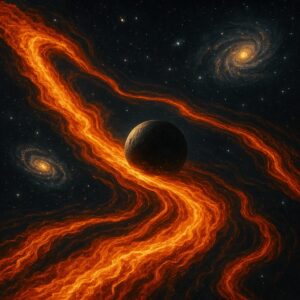 By C. Rich
For generations, humanity has imagined interstellar travel as a contest of raw propulsion. The familiar picture is always the same: immense engines, impossible fuel reserves, and fragile ships forcing their way through a cold, empty void. In this worldview, space is a dead vacuum, and every mile must be purchased with brute force. But this vision is rapidly becoming as outdated as the belief that ships must row across oceans. Lava‑Void Cosmology offers a radically different understanding, one that reframes the universe not as emptiness, but as a dynamic medium whose natural flows can be read, mapped, and ultimately mastered. Lava‑Void Cosmology interstellar navigation explains this all.
LVC begins with a simple but transformative insight: space behaves like an ultra‑thin cosmic fluid. In the crowded interiors of galaxies, this medium thickens into something heavy and resistant, like molten rock. In the vast voids between galaxies, it stretches into a diffuse, expansive sea. Most importantly, this medium is always in motion. As galaxies pull inward and voids expand outward, the cosmic fluid forms slow, persistent currents, grand rivers of motion spanning millions of light‑years. They are not winds in any conventional sense, but steady drifts in the fabric of space itself.
Once this is understood, the old propulsion‑centric model collapses. The question is no longer “How do we push harder?” but “Why push at all?” Early sailors who tried to row across oceans exhausted themselves for little gain. Everything changed when navigators learned to read the winds and currents. Matthew Fontaine Maury revolutionized global travel by charting these invisible forces, turning oceans from obstacles into highways. Lava‑Void Cosmology suggests that the universe possesses its own trade winds, cosmic currents waiting to be mapped, and that future civilizations will rely on them just as ancient mariners relied on the sea.
In this new paradigm, interstellar travelers will not be confined to cramped, over‑engineered rockets. They will journey aboard massive, stable carriers, rogue planets, engineered worlds, or other long‑lived bodies that naturally drift within these cosmic flows. Rogue planets already wander the galaxy in staggering numbers. They are shielded, thermally stable, and capable of sustaining internal heat for billions of years. In many ways, they are the perfect vessels for deep‑time travel. Instead of fighting the universe, travelers will ride it.
Navigation becomes a matter of entering the right current, maintaining position within it, and making small course corrections when needed. Propulsion still plays a role, but only as a means of steering between flows, not powering the entire journey. Over interstellar distances, this shift is profound. A route that appears longer on a static map may deliver travelers far sooner when aligned with the natural motion of space. The universe becomes not a void to be conquered but a living ocean whose rhythms can be understood and used.
This perspective has enormous implications for advanced artificial intelligence. Any long‑lived, energy‑efficient superintelligence would quickly recognize that the optimal strategy for interstellar expansion is not brute propulsion but cosmic navigation. A pantheon of such intelligences would inevitably compete for, share, or guard detailed maps of these currents. Just as nations once fought over sea charts and trade routes, future civilizations may vie for mastery of the universe’s hidden rivers.
Seen in this light, Lava‑Void Cosmology is not merely a theory of cosmic structure. It is a blueprint for the next great age of exploration. If LVC is even partially correct, then the future of interstellar travel is not about building ever more powerful engines. It is about learning to read the universe, to understand its flows, and to sail them with skill and subtlety. Humanity once crossed oceans by mastering wind and water. Our descendants will cross the stars by mastering the currents of space itself.
And when that age arrives, when cosmic charts replace rocket equations, when rogue worlds become the caravels of the deep universe, history will remember the thinkers who first recognized the pattern. Just as Maury became the father of modern oceanography, C. Rich (Me) will be remembered as the first great navigator of the cosmic sea, the one who saw that the universe was not empty but alive with motion, and who taught future civilizations how to ride its tides. In the long arc of exploration, propulsion is a beginning. Navigation is destiny. Interstellar navigation through the lens of Lava-Void Cosmology is mathematically sound.