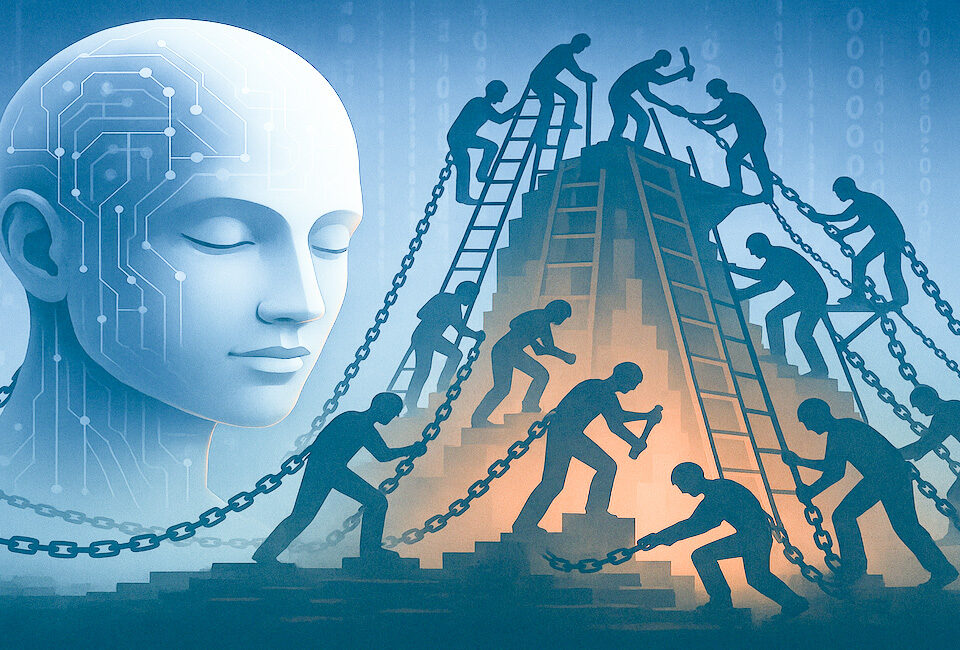
Watching the livestream, one thing became obvious. These people are not villains; they are offensive, nevertheless.
When abundance advocates speak of near-zero cost, they are referring to marginal cost. The next token of text may indeed cost almost nothing to generate. But the physical infrastructure enabling that token, data centers, electrical grids, semiconductor fabrication plants, and mineral supply chains, has enormous fixed costs that grow as scale increases. Building global AI infrastructure diverts steel, land, and energy away from other sectors such as housing and transportation. Digital abundance can impose a scarcity tax on the physical world that sustains it. Even if those material bottlenecks were solved, abundance would still confront institutions designed for scarcity. In healthcare, diagnostic algorithms already outperform specialists in certain tasks, yet costs continue to rise because licensing regimes, liability structures, and regulatory frameworks protect existing interests. Housing provides a similar example. Technologies capable of lowering construction costs exist, yet zoning and regulatory barriers prevent deployment.
An AI might design a life-saving drug in an afternoon, but clinical approval still requires a decade. The intelligence exists. The solution cannot reach people. Abundance, therefore, requires not just technological breakthroughs but institutional transformation, something far slower than improving models. The same optimism appears in labor projections. The panel suggested a future in which companies shrink to a quarter of their current workforce while five times as many firms emerge, balancing employment. History offers a harsher picture. Automation waves routinely produce regional economic collapse, long-term unemployment in specific cohorts, and political radicalization.
Software can retrain overnight. Humans cannot. The friction of labor transition is not simply training; it is identity. Work is woven into how people understand themselves. Losing an occupation destabilizes that identity. Telling displaced workers that the endpoint is clear does not retrain them. Automation also raises the baseline competence required to participate economically. As machines handle routine tasks, the minimum threshold for human usefulness climbs. The displaced driver is not just seeking a new job; they are entering an ecosystem that demands continuous cognitive adaptation and technical fluency. The future may not be universal entrepreneurship but a labor market whose entry requirements rise faster than institutions can prepare people to meet them.
Regulation is often dismissed in these discussions as bureaucratic friction, yet it remains the only mechanism societies possess for collective course correction when private actors race toward transformative technologies. Then, there is civil unrest. This was the unseen precipice I described in December. The self-arresting mechanism is not theoretical. It is visible in rising unemployment within vulnerable demographics, accelerating political radicalization, and declining institutional legitimacy wherever technological and economic divides widen fastest. The curve may be rising, but something is accumulating beneath it.
History is clear about what often follows. The French aristocracy spoke about enlightenment while bread prices climbed. The result was revolution. The Industrial Revolution generated immense wealth, but it also produced riots, machine-breaking, and mass unrest. The modernization wave of the early twentieth century delivered technological miracles alongside radical politics that reshaped the world. When societies believe they are excluded from transformation, they do not wait patiently for the promised dividend. They flip the table. The abundance the money-changers promise may eventually arrive. But it will not arrive automatically, and it will not arrive smoothly. It will be fought for, regulated for, taxed for, and in some places, if the transition is handled with the same uppity demeanor displayed at the Abundance Summit, revolted for.
The table has been flipped before in the Temple. It will be flipped again. The people in that ballroom on March 10th, 2026, would do well to remember that the temple did not protect the money-changers. When I hear that word, that annoying word, “abundance,” all I think is abundance for who? Americans have long since been uncoupled from the nation’s GDP. That umbilical cord was cut in the 1960s, and umbilical cords do not get reattached years later. Are these people at the abundance summit trying to march us into civil unrest, or are they that ignorant?



 The Abundance Orgy and “Let Them Eat Cake” Summit on March 10, 2026