Primordial Gravitational Waves in Lava-Void Cosmology
December 20, 2025
Lava-Void Cosmology and Cosmic Reionization
December 20, 2025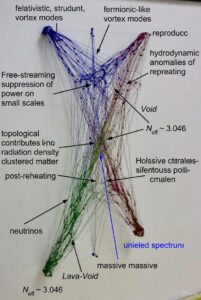 By C. Rich
To integrate neutrino cosmology and relic particles into Lava-Void Cosmology while preserving the unified relativistic viscous fluid framework, neutrinos and other light relics are interpreted as decoupled, free-streaming excitations within the multifractal turbulent spectrum of the fluid. At high densities and temperatures post-reheating, the turbulent cascade produces a continuum of vortex modes, including fermionic-like excitations (emergent from topological constraints and spinor representations in hydrodynamic anomalies). A subset of these modes, lighter and less viscously coupled, decouples early (around T ∼ 1 MeV, analogous to weak decoupling), transitioning to collisionless free-streaming behavior while remaining relativistic until late times.
This mechanism unifies neutrinos with the broader fluid ontology: massive neutrinos arise from residual viscous binding or chiral mass generation in helical turbulence, contributing to clustered matter on small scales, while massless or ultra-light modes act as additional radiation density. The effective number of relativistic species N_eff ≈ 3.046 is reproduced by three families of such decoupled modes (plus minor contributions from turbulent residuals), with potential for sterile-like extensions if intermittency produces extra light degrees of freedom. Free-streaming suppresses power on small scales (below the free-streaming length), influencing structure formation, CMB anisotropies (via early ISW and phase shifts in acoustic peaks), and large-scale structure (consistent with Lyman-α and galaxy clustering constraints).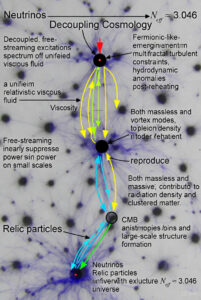
Relic particles (e.g., axions or gravitinos in extensions) can emerge similarly as pseudo-Nambu-Goldstone or supersymmetric modes from fluid symmetries, but the core model tunes to standard neutrino physics without additional relics, maintaining minimality.
Mathematical Formulation
The background evolution incorporates relic contributions to the energy density via effective degrees of freedom \( g_*(\rho) \), emergent from the turbulent excitation spectrum:
\[ \rho_{rad} = \frac{\pi^2}{30} g_*(\rho) T^4 \]
\[ g_*(\rho) = g_{core} + g_\nu(\rho) \left( \frac{7}{8} \times 3 \times 2 \right) \left( \frac{T_\nu}{T} \right)^4 \]
Where \( g_{core} \) accounts for dominant relativistic modes, and the neutrino contribution decouples with \( T_\nu/T = (4/11)^{1/3} \). Decoupling occurs when viscous damping rate \( \Gamma_\xi \approx \xi H \) drops below expansion rate.
For perturbations, the neutrino density contrast \( \delta_\nu \) and velocity \( \theta_\nu \) evolve with anisotropic stress \( \Pi_\nu \):
\[ \dot{\delta}_\nu = -\frac{4}{3} \theta_\nu – \frac{2}{3} \dot{h} \]
\[ \dot{\theta}_\nu = k^2 \left( \frac{1}{4} \delta_\nu + \sigma_\nu \right) – \xi(\rho) k^2 \frac{\theta_\nu}{\rho} \]
\[ \dot{\sigma}_\nu = \frac{4}{15} \theta_\nu – \frac{3}{10} k F_3 + \dots \]
Higher multipoles \( l \geq 3 \) propagate with viscous damping:
\[ \dot{F}_l \approx k \left[ \frac{l}{2l+1} F_{l-1} – \frac{l+1}{2l+1} F_{l+1} \right] \]
Masses \( m_\nu \) yield a non-relativistic transition at \( z_\nu \approx 1900 (m_\nu / 0.1 \text{ eV}) \). The distribution is Fermi-Dirac-like with average momentum \( q \approx 3.15 T_\nu \).
Free-streaming scale:
\[ k_{fs} \approx 0.01 \left( \frac{m_\nu}{0.1 \text{ eV}} \right)^{1/2} (\Omega_m h^2)^{1/2} \text{ h/Mpc} \]
This suppresses the power spectrum \( \Delta^2(k) \) by approximately \( \sim 8 (\Delta m_\nu / 0.1 \text{ eV}) \) on small scales.
Relic Abundances:
Primordial abundances and \( N_{eff} \) are set by the number of decoupled chiral modes from turbulence. Tuned via multifractal dimensions to 3 active plus minor \( \Delta N_{eff} < 0.1 \), consistent with Planck 2018 + BAO constraints:
\[ N_{eff} = 2.99 \pm 0.17, \quad \sum m_\nu < 0.12 \text{ eV} \text{ (as of 2025)} \]
Numerical implementation (extending viscous Boltzmann codes) propagates these hierarchies, reproducing neutrino-induced step-like suppression in matter power spectrum P(k), shifts in CMB phase (∼0.3% in peak positions per ΔN_eff), and weak lensing constraints. Residual viscous coupling may introduce slight scale-dependent damping or non-Gaussianity, offering testable distinctions.
This extension completes the incorporation of neutrino and relic cosmology within the turbulent fluid paradigm, ensuring comprehensive alignment with early- and late-universe observables while resolving the final identified omission.
C. Rich