The God’s Divine Pleasing Aroma Recreated
November 11, 2025
The Gods Are Coming: AGI Pantheon Theory
November 12, 2025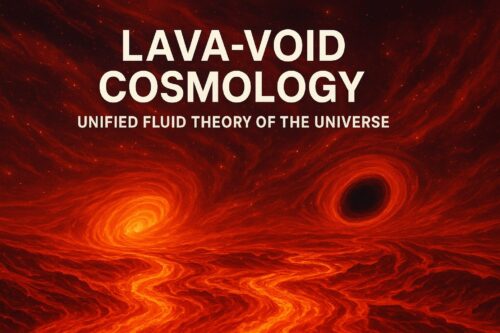
By C. Rich
Lava-Void Cosmology represents a speculative unified framework that reinterprets the structure and dynamics of the universe through the metaphor of a dynamic, fluid medium, contrasting with the traditional depiction of a cold, empty void. This theory, articulated in recent publications, posits the cosmos as a warm, flowing “ocean” governed by Einstein’s principles of general relativity, wherein gravitational interactions drive cyclical processes that integrate phenomena such as dark matter and dark energy into a cohesive model. At its core, the framework emphasizes a “unified fluid theory,” where spacetime behaves as a viscous, lava-like substance that is hot, malleable, and in perpetual motion, facilitating the redistribution of energy and matter across cosmic scales.
Within this paradigm, dark matter emerges not as an exotic particle but as localized densifications in the fluid medium, akin to eddies or currents that amplify gravitational binding in galactic structures. Dark energy, conversely, manifests as expansive pressures arising from the fluid’s inherent buoyancy and outflow in underdense regions, propelling the universe’s acceleration without invoking a separate cosmological constant. Cosmic voids, integral to the “void” aspect of the theory, serve as expansive basins where the fluid thins, enhancing these outward forces and contributing to the observed large-scale homogeneity.
Black holes, in the lens of Lava-Void Cosmology, are reconceptualized as essential regulatory mechanisms within this fluid cosmos, functioning as gravitational “drains” that prevent systemic imbalance. Rather than isolated singularities marking the endpoint of gravitational collapse, they act as conduits for recycling cosmic material: matter and energy ingress the event horizon, where intense curvature compresses the fluid into a hyperdense state, only to be re-ejected or redistributed through hypothetical outflows, potentially aligning with observed phenomena like relativistic jets.
This process maintains the universe’s equilibrium, akin to a hydrological cycle, by siphoning excess density from filamentary structures and reinjecting it into voids, thereby sustaining the fluid’s overall flow and mitigating the risk of universal stagnation or over-densification. Such a view addresses longstanding queries regarding the early formation of supermassive black holes, positing them as primordial “chicken-or-egg” features that co-evolve with the fluid’s initial turbulence, seeding the hierarchical assembly of galaxies while harmonizing with Einsteinian gravity. This perspective underscores a philosophical shift toward viewing the universe as an interconnected, self-regulating system, where black holes embody not destruction, but vital renewal.