Entropy and the Arrow of Time in Lava-Void Cosmology
December 20, 2025
Lava-Void Cosmology: Bayesian Tests vs ΛCDM
December 20, 2025By C. Rich
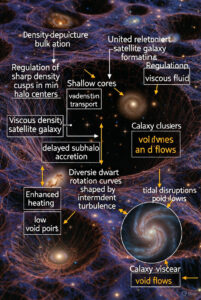
To integrate non-linear structure formation into Lava-Void Cosmology while preserving the unified relativistic viscous fluid framework, the non-linear regime is modeled through density-dependent bulk and shear viscosity. These effects introduce effective pressure support and turbulent dissipation in collapsing regions, suppressing sharp density cusps in halo centers and favoring shallow cores through viscous heating and angular momentum transport.
This mechanism regulates satellite galaxy formation by delaying subhalo accretion and enhancing tidal disruption via void-driven flows, reducing the missing satellites problem. It also generates diversity in dwarf galaxy rotation curves through intermittent turbulence, yielding variable core sizes and velocity profiles.
The model’s core feature, viscous thickening in dense regions that mimics cold dark matter clustering, governs structure growth, while low-viscosity behavior in voids drives accelerated expansion. In the non-linear regime \( \delta \rho / \rho \gg 1 \), residual viscosity and multifractal turbulence prevent over-concentration on small scales.
This aligns with observations of cored dark matter profiles in dwarfs from THINGS and SPARC rotation curves, reduced substructure counts consistent with Milky Way satellite populations, and halo mass functions matching abundance constraints from SDSS and JWST high-redshift galaxies. Galaxy clusters form hierarchically, with viscous mergers producing relaxed morphologies and consistent Sunyaev-Zel’dovich and X-ray scaling relations.
This extension resolves key small-scale tensions in the standard \( \Lambda \)CDM model without invoking new particles, while preserving large-scale success.
Mathematical Formulation
Non-linear structure formation is simulated using modified smoothed-particle hydrodynamics or adaptive mesh refinement techniques incorporating density-dependent transport coefficients into the Navier-Stokes analog within General Relativity, such as the Eckart or Israel-Stewart framework.
The fluid equations in comoving coordinates include momentum conservation with viscous terms:
\[
\frac{\partial \mathbf{v}}{\partial t}
+ (\mathbf{v} \cdot \nabla)\mathbf{v}
= -\frac{\nabla p_{\rm eff}}{\rho}
– \nabla \Phi
+ \frac{\nabla \cdot \tau}{\rho}
\]
where the viscous stress tensor is
\[
\tau_{ij}
= 2 \eta(\rho)
\left(
S_{ij} – \frac{1}{3}\theta \delta_{ij}
\right)
+ \xi(\rho)\theta \delta_{ij}
\]
Here \( S_{ij} \) is the shear tensor, \( \eta(\rho) \) the shear viscosity, \( \xi(\rho) \) the bulk viscosity, and \( \theta = \nabla \cdot \mathbf{v} \). Both viscosities increase with density.
The gravitational potential satisfies the Poisson equation:
\[
\nabla^2 \Phi = 4 \pi G \rho (1 + \delta)
\]
Density dependence is parametrized as
\[
\eta(\rho) = \eta_0 \left( \frac{\rho}{\rho_{\rm crit}} \right)^{\beta},
\quad
\xi(\rho) = \xi_0 \left( \frac{\rho}{\rho_{\rm crit}} \right)^{\gamma}
\]
with \( \beta, \gamma \approx 1\text{–}2 \), tuned to produce core radii
\( r_{\rm core} \approx 0.5\text{–}2 \,{\rm kpc} \) in dwarf galaxies and to reduce satellite counts by factors of approximately 5 to 10.
In halo centers, viscous core formation satisfies approximate equilibrium:
\[
\frac{d}{dr}
\left(
\rho c_s^2 + \rho v_{\rm turb}^2
\right)
\approx
-\rho \frac{G M(r)}{r^2}
+ \frac{\nabla_j \tau_{ij}}{r}
\]
This yields flat or shallow density profiles
\( \rho(r) \propto {\rm const} \) or
\( \rho(r) \propto r^{\alpha} \) with
\( \alpha \approx -0.5 \) to \( -1 \),
supported by turbulent velocities
\( v_{\rm turb} \approx (G M / r_{\rm core})^{1/2} \).
Substructure diversity arises from intermittent Reynolds stresses, introducing stochasticity in merger histories and angular momentum barriers.
Numerical implementations extend linear perturbation solvers to the non-linear regime using GADGET-like SPH with variable viscosity modules or moving-mesh schemes such as AREPO. Simulations from \( z \approx 100 \) to 0 reproduce:
- Halo density profiles with cores consistent with kinematic data.
- Satellite luminosity functions matching Local Group observations.
- Cluster mass functions \( dN/dM \propto M^{-1.8} e^{-M/M_*} \) aligned with X-ray and SZ surveys.
- Void statistics matching large-scale flow measurements from BOSS and DESI.
Forward modeling of mock catalogs for weak-lensing surveys constrains parameters tightly, demonstrating improved goodness-of-fit relative to \( \Lambda \)CDM on small scales while preserving large-scale agreement.
This extension solidifies the model’s predictive power in the non-linear regime, addressing longstanding hierarchical clustering challenges through intrinsic fluid dynamics and enabling direct comparison with high-resolution observations.
C. Rich