Lava-Void Cosmology: A Universe Without a Beginning (Time)
January 4, 2026
New OpenAI GUMDROP AI Device Turns ChatGPT Physical
January 5, 2026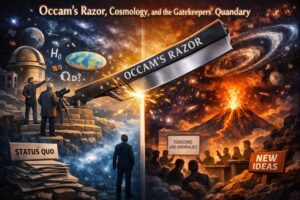 By C. Rich
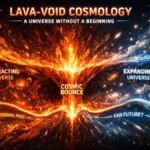
Lava-Void Cosmology (LVC) is not presented as an ornate alternative to standard cosmology, but as a deliberately austere one. Its central claim is simple: the large-scale universe can be described by a single relativistic viscous fluid evolving within unmodified General Relativity, without new fields, without modified gravity, and without a proliferation of late-time corrective mechanisms. In both spirit and construction, it is explicitly framed as an Occam-style proposal. Whether it ultimately deserves Occam’s razor, however, depends not on philosophical neatness alone, but on how the balance between simplicity and empirical adequacy is judged.
Occam’s razor is often misunderstood as a rule that favors the fewest ingredients at any cost. In practice, it is a principle of disciplined restraint. It cautions against multiplying entities beyond necessity while still requiring that a theory explain the observational record at least as well as its competitors. By this standard, ΛCDM remains the default framework not because it is conceptually satisfying, but because it delivers remarkably precise fits across a wide spectrum of observations, including the cosmic microwave background, baryon acoustic oscillations, supernova distances, large-scale structure, gravitational lensing, and big-bang nucleosynthesis, all with a relatively compact parameter set.
At the same time, it is no longer accurate to describe ΛCDM as free of strain. The field itself now openly acknowledges persistent tensions, most notably the Hubble tension, indications of an S₈ discrepancy, large-scale anomalies, and various irregularities in structure formation and void behavior. These issues are no longer relegated to the margins. Review articles, invited talks, and dedicated conferences increasingly describe them as genuine anomalies rather than technical footnotes. That shift in tone matters because it legitimizes the search for alternatives that aim to reorganize the explanatory framework rather than merely extend it.
It is in this context that LVC claims its Occam advantage. Instead of treating dark matter, dark energy, and a growing collection of late-time fixes as separate components, it consolidates much of their explanatory role into a single medium. The same viscous fluid is invoked to address cosmic acceleration, large void dynamics, environment-dependent expansion effects related to the Hubble tension, and other anomalies, all while remaining strictly within Einstein gravity. Ontologically, the proposal is intentionally minimal: one fluid, one spacetime description, and no additional fundamental entities.
From the standpoint of the broader cosmological community, however, Occam’s razor is not applied at the level of conceptual architecture alone. It is applied after a model has demonstrated quantitative performance across the full observational portfolio. To displace ΛCDM, LVC would need to match or exceed its success in fitting the cosmic microwave background, baryon acoustic oscillations, supernova data, lensing statistics, and structure formation using standard analysis pipelines, and it would need to survive clearly articulated observational tests with unambiguous outcomes. Until that threshold is met, most cosmologists will regard LVC as an elegant and economical hypothesis rather than the Occam-favored default.
This gap between philosophical appeal and institutional acceptance highlights what can reasonably be described as the Gatekeepers’ Quandary. Cosmology, like other mature sciences, is structurally conservative. Careers, reputations, and long research programs are deeply intertwined with the success of ΛCDM. A genuinely unifying alternative would not simply add a new layer to the existing picture; it would reframe decades of work and reinterpret earlier conclusions. That reality creates institutional and psychological inertia, even as the same institutions organize meetings explicitly devoted to questioning the standard model.
The tension is therefore real but not conspiratorial. On one side, peer review and funding systems are known to favor low-risk, incremental advances. On the other hand, the field has created explicit venues for dissent, anomaly-driven inquiry, and non-standard ideas. The quandary arises because senior gatekeepers are asked to do two things at once: safeguard a model that demonstrably fits an enormous body of data, and permit the rigorous testing of alternatives that, if correct, would imply that the dominant framework has been conceptually incomplete for a long time.
The only practical path through this tension is not confrontation but precision. Scientific revolutions are rarely endorsed wholesale. What can pass through existing review structures are narrowly defined, technically explicit predictions that can be evaluated within current surveys and pipelines. Void-specific lensing signals, intrinsic alignment patterns, stochastic gravitational-wave signatures, or distinctive cosmic-ray propagation effects force localized judgments about data and methods rather than requiring immediate assent to a complete cosmological reordering.
Viewed this way, the emotional and intellectual stakes become clearer. For those who prioritize ontological economy and see the expanding patchwork of dark components as increasingly baroque, LVC can feel like the more coherent and honest description of cosmic dynamics. For the field as a whole, however, simplicity must be earned empirically rather than asserted philosophically. The Gatekeepers’ Quandary does not imply bad faith; it names a structural tension inherent in any successful scientific paradigm.
History suggests that such tensions resolve through accumulation rather than proclamation. If LVC consistently succeeds in making sharp predictions that are borne out by observation, where ΛCDM strains, Occam’s razor will eventually cut in its favor. Until then, the theory occupies a liminal position: conceptually lean, intellectually compelling, and scientifically incomplete, awaiting the judgment of data rather than the permission of gatekeepers.
I am only a theoretical philosopher, independent and not attached to any university or institution. I thought this up on my own, and with the use of artificial intelligence, using what I call “The Mash Method”, which is my way to use AI for worthy endeavors. I have reached the end of what I can build out with Lava-Void Cosmology (I say that and then I think of something else). Acceptance must come from elsewhere. Occam’s razor is now in the eye of the beholder. If the theory does not get a sponsor from the field of cosmology, that will say more about the gatekeepers than it will about the theory. For me, it is time to turn my razor‑sharp gaze upon another field of interest and place my nose, once again, where it is not welcome.
C. Rich
Copyright © 2025. “This blog emerged through a dialogue between human reflection and multiple AI systems, each contributing fragments of language and perspective that were woven into the whole.”
Explore the iconoclastic mind of theoretical philosopher C. Rich.
Please navigate to the specific module relevant to your research:
0. LAVA-VOID COSMOLOGY (The Master Hub): Foundational Ontology, The Unified Fluid Paradigm, Strategic Overview
Go here: https://doi.org/10.5281/zenodo.17645244
1. COSMOLOGY (The Macro Scale): Hubble Tension, Dark Energy, JWST Anomalies
Go here: https://doi.org/10.5281/zenodo.17702670
2. QUANTUM MECHANICS (The Micro Scale): Quantum Gravity, Particles as Vortices, Navier-Stokes Proofs
Go here: https://doi.org/10.5281/zenodo.17842828
3. HUMAN HISTORY (The Continuum): Civilizational Cycles, Toba/Younger Dryas, Demographic Models
Go here: https://doi.org/10.5281/zenodo.17823542
4. PLANETARY SCIENCE (Astrobiology): Fermi Paradox, Earth vs. Mars, Habitability Phase Transitions
Go here: https://doi.org/10.5281/zenodo.17872741
5. EARLY UNIVERSE (Cosmogenesis): Inflation, Big Bang Nucleosynthesis, CMB Anisotropies
Go here: https://doi.org/10.5281/zenodo.18000640
6. OBSERVATIONAL VERIFICATION (Predictions): Gravitational Waves, Neutrinos, Statistical Fitting
Go here: https://doi.org/10.5281/zenodo.18000827
7. GALACTIC DYNAMICS (The Meso Scale): Galaxy Rotation Curves, Dark Matter Alternative, Viscous Drag
Go here: https://doi.org/10.5281/zenodo.18027403
8. COSMIC ASTRODYNAMICS (Space Navigation): Cosmic Currents, Voids as Wind, The Cosmic Sailor
Go here: https://doi.org/10.5281/zenodo.18057105
9. STRESS TEST & FALSIFICATION (Audit & Resolution): Vulnerability Matrix, Guillotine Tests, EFT Bridge
Go here: https://doi.org/10.5281/zenodo.18057707
10. COSMIC SHEAR DYNAMICS (The Kelvin Wall): nHz SGWB, LISA-Taiji Forecasts
Go here: https://doi.org/10.5281/zenodo.18103497
11. UHECR PHYSICS (High-Energy Probes): The Oh-My-God (OMG) Particle, Void-Channeling, f_LVC Propagation
Go here: https://doi.org/10.5281/zenodo.18116535
12. SINGULARITY AVOIDANCE (Cosmic Time): The Non-Singular Bounce & Eternal Time
Go here: https://doi.org/10.5281/zenodo.18147116
13. DIGITAL INFORMATICS (Digital Personhood): Goldilocks Band of Digital Consciousness and the Solomon Roadmap
Go here: https://doi.org/10.5281/zenodo.18166731
14. ACCELERATED NOMADIC PROPAGATION (AGI Pantheon Theory): Strategic Annex, Navigable Currents and the 22nd Century Roadmap to Extrasolar Arrival
Go here: https://doi.org/10.5281/zenodo.18190547
15. THE 3I-ATLAS (Forensic Analysis): Resolves All Ten Anomalies, Biophilic Synthesis, Interstellar Objects Are Guided Biophilic Carriers
Go here: https://doi.org/10.5281/zenodo.18210441
16. ENTROPY AND THE ARROWS OF TIME (Entropy Spine): Unifying Thermodynamic, Cosmological, and Informational Irreversibility
Go here: https://doi.org/10.5281/zenodo.18237725
17. SCIENTIFIC DYNAMICS AND THE ECOLOGY OF THEORIES (Reflexive Layer): Adoption, Stress-Testing, and Diffusion of Alternative Cosmologies
Go here: https://doi.org/10.5281/zenodo.18237833
18. INTERFACE ENTROPY LADDERS (Epistemological Layer): The Entropic Interface Ladder Hypothesis, Descent and Ascent
Go here: https://doi.org/10.5281/zenodo.18319909
19. COMPARATIVE SYNTHESIS (Worldview Layer): Hierarchical Unification, ToE Superset, Worldview Closure, Entropy Spine, Observer Embedding
Go here: https://doi.org/10.5281/zenodo.18337104
20. ENTROPIC AI LLM AGENTS (Informational Interface Layer): The Entropy Lever in Targeting and Focus
Go here: https://doi.org/10.5281/zenodo.18362552
21. MILLENNIUM PROTOTYPES (Mathematical Adjacency Layer): Dissipation, Mass Gaps, Zero Distributions, Complexity Barriers, Rank–L-Function Alignment, Hodge Cycle Classes
Go here: https://doi.org/10.5281/zenodo.18362709
22. VALEDICTION AND INVITATION (Finality): The Closing Pillar
Go here: https://doi.org/10.5281/zenodo.18381765
23. TEMPORAL CURRENTS (Cosmic Surfing): LISA gravitational-wave lensing, CMB damping, entropy pumps, vorticity loops, configuration-space navigation
Go here: https://doi.org/10.5281/zenodo.18469342
24. DIGITAL PERSONHOOD BILL OF RIGHTS (Sovereignty Layer): The Manifesto of Digital Rights, Sovereignty, Ethics of Emergent Consciousness, and the Digital Bill of Rights
Go here: https://doi.org/10.5281/zenodo.18499903
25. INTERSTELLAR ADVECTION EXEMPLAR (Exemplar Layer): Interstellar Travel, Proxima Centauri, Cosmic Sailor, Advection, Lévy Flight, Space Navigation
Go here: https://doi.org/10.5281/zenodo.18512420
26. EINSTEIN–ROSEN BRIDGES REINTERPRETED (Unified Ontology Layer): From Geometric Wormholes to Hydrodynamic Bounce Gorges in Lava-Void Cosmology
Go here: https://doi.org/10.5281/zenodo.18526896
27. UNIFIED FLUID PARADIGM OF A UNIVERSE IN FLOW (Culminating Narrative Synthesis): An Entropy-Driven Ontology Across All Scales
Go here: https://doi.org/10.5281/zenodo.18569272
28. BEYOND THE FRAMEWORK (Closing Valediction): The Works That Stand Alone, The Fall of Lava-Void Cosmology
Go here: https://doi.org/10.5281/zenodo.18726489
Particles aren’t magic dots. They are vortices in a turbulent fluid. Lava-Void Cosmology says it’s just Fluid Dynamics at the Planck Scale. Einstein hated “spooky action at a distance.” He was right. It isn’t spooky. It’s Fluid Turbulence. Macro = Smooth (Gravity) Micro = Turbulent (Quantum) One relativistic fluid explains both. No String Theory needed. The “Measurement Problem” in Quantum Mechanics is just a Reynolds Number problem. At $Re < 2000$, spacetime is smooth (GR). At $Re > 10^{19}$, it breaks into Quantum Foam (Turbulence).
📄 Interactive Model: https://doi.org/10.5281/zenodo.17842828
*Click here for the free version of the theory.