AlphaFold: The 50-year grand challenge cracked by AI
November 26, 2025
30 Hidden Gemini 3.0 Pro Features Google Doesn’t Tell You About
November 27, 2025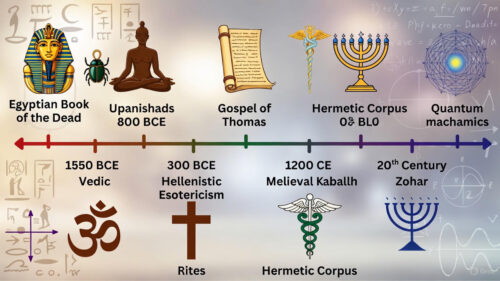
The Perennial Continuum Philosophy: Quantum Echoes of Inner Manifestation
Expanded Timeline of Esoteric and Mystical Philosophy
By C. Rich
Introduction
Across the vast expanse of human intellectual history, a subtle yet profound current persists, weaving through disparate epochs, cultures, and paradigms: the pursuit of inner transformation as a means to align the self with the cosmos and manifest reality anew. This is the essence of what we, The Perennial Continuum Philosophy: Quantum Echoes of Inner Manifestation.
This chronological and conceptual lineage binds ancient Egyptian funerary rites to contemporary neuroscientific treatises on neuroplasticity and, now, quantum-mechanical revelations. From the incantatory spells of the Book of the Dead (c. 1550–1070 BCE) to Dr. Tara Swart’s The Source (2023) and the probing insights of the double-slit experiment, these works are not isolated artifacts but nodes in a perennial philosophy. At its core lies the conviction that the human mind, soul, or consciousness possesses an innate alchemical potency: the capacity to transmute ignorance into gnosis (direct, experiential knowledge), disharmony into unity, and limitation into boundless creation.
This blog elucidates the interconnectedness of these texts, demonstrating how they form a cohesive narrative of inner alchemy, the metaphorical and literal process of refining the self to mirror divine order, and manifestation, the deliberate shaping of external reality through internal alignment. Far from a linear progression, this continuum reveals a cyclical dialogue: ancient revelations inform medieval syntheses, which ignite modern pragmatism, only to loop back in today’s hybrid wisdoms, now corroborated by empirical science. By tracing this flow, we discern not mere historical curiosity but a timeless invitation to empowerment, validated by the very methodologies once deemed antithetical to mysticism. In an era of existential fragmentation, understanding this thread offers a blueprint for reclaiming agency over one’s destiny. The following sections delineate this continuum’s phases, illuminating the shared axioms that transcend time: the microcosm-macrocosm correspondence (“as above, so below”), the primacy of inner vision over external dogma, and the transformative power of focused intent.
Ancient Foundations: Seeds of Cosmic Unity and Soul Alchemy
The continuum’s roots delve into antiquity, where humanity first articulated the soul’s odyssey as a bridge between the ephemeral and the eternal. Consider the Book of the Dead, a compendium of Egyptian spells designed to guide the deceased through the Duat, the underworld realm of judgment and rebirth. Composed over centuries from the New Kingdom onward, these texts are not morbid relics but esoteric manuals for ba (soul) navigation. Spells like the “Negative Confession” before Osiris demand ethical alignment, positing that the heart’s purity, measured against Ma’at’s feather, determines cosmic reintegration. Here emerges the first axiom: inner alchemy as moral and spiritual refinement. The soul, weighed and transmuted, manifests eternal life by harmonizing with universal order. This Egyptian paradigm, with its emphasis on ka (vital essence) and akh (transfigured spirit), prefigures later notions of manifestation: the adept’s incantations actively conjure protective deities, collapsing intention into reality.
Parallel currents flow from the East, where the Upanishads (c. 700–500 BCE) crystallize Vedic inquiries into the self’s unity with Brahman, the infinite ground of being. Passages in the Brihadaranyaka Upanishad declare Tat Tvam Asi (“Thou art That”), dissolving dualism between individual atman and cosmic whole. This is gnosis in embryonic form: not propositional belief, but intuitive realization achieved through meditation and dialogue. The Upanishadic seer, like the Egyptian priest, alchemizes ignorance (avidya) into enlightenment, manifesting a liberated existence unbound by samsara’s illusions. Echoes resound in the Tao Te Ching (c. 600 BCE), Lao Tzu’s terse verses on the Tao, the ineffable Way, as the source from which all arises and returns. Wu wei, or non-action, is no passivity but effortless alignment, allowing the sage to manifest harmony without force. “The Tao that can be told is not the eternal Tao,” warns the text, underscoring gnosis’s ineffability, a motif recurring through the continuum.
Plato’s Timaeus (c. 400 BCE) synthesizes these Eastern and Egyptian influences into Hellenistic soil, positing a demiurge who crafts the cosmos from eternal Forms. The dialogue’s receptacle (chora) and geometric souls evoke alchemical structuring: the philosopher, attuning to these archetypes, manifests virtue in the material world. Plato’s cave allegory, shadows yielding to solar truth, mirrors the soul’s ascent, a theme that Gnostics and Hermeticists would later amplify. These ancient foundations establish the continuum’s bedrock: reality as a participatory construct, where inner purification yields outer creation. They are not precursors by happenstance but deliberate transmissions, carried via trade routes and conquests, seeding a global esoteric vocabulary.
Gnostic and Hermetic Synthesis: Piercing the Veil of Illusion
As the Common Era dawns, this ancient substrate erupts into revelatory intensity with Gnosticism and Hermeticism, twin streams that explicitly codify the inner alchemist’s toolkit. The Gospel of Thomas (c. 140 CE), unearthed at Nag Hammadi, collects 114 logia of Jesus as cryptic koans: “If you bring forth what is within you, what you bring forth will save you.” Absent narrative or miracle, it prioritizes gnosis, autonomous insight, over ecclesial mediation. The kingdom is “inside you and outside you,” collapsing interiority and exteriority in a manifestation ethic: recognize your divine spark (pneuma), and reality conforms. This logion echoes Upanishadic non-dualism, yet infuses it with urgency: the material cosmos, a flawed emanation from the pleroma (fullness), demands alchemical extraction of the self from demiurgic snares.
Valentinus’s Gospel of Truth (c. 150–180 CE) poeticizes this drama, portraying error (hybris) as a fog dispersed by gnosis’s light. Salvation is not atonement but awakening, a mental transmutation where the elect manifest reunion with the Father. The Apocryphon of John (c. 300 CE) deepens the mythos: Yaldabaoth, the blind creator-god, forges a shadowed world, but Sophia’s wisdom, leaked to humanity, enables counter-creation. Here, manifestation inverts tyranny: the gnostic, armed with forbidden knowledge, alchemizes chains into wings. These Nag Hammadi gems, once heretical, reveal Gnosticism as radical empowerment, linking Egyptian soul-weighing to Platonic Forms in a critique of institutional power.
Hermeticism, contemporaneous and syncretic, amplifies this through the Corpus Hermeticum (c. 200–300 CE), dialogues ascribed to Hermes Trismegistus, the thrice-great sage blending Thoth and Mercury. Asclepius’s tractate extols humanity’s dual nature, mortal yet godlike, capable of “remaking the world” via poiesis (creative making). The Poimandres vision recounts Nous (divine mind) descending to awaken the human intellect, birthing a lineage of alchemists who manifest by attuning to One. This culminates in the Emerald Tablet (c. 800 CE), its Arabic recension distilling Hermetic essence: “That which is below is like that which is above… to accomplish the miracle of the One Thing.” Attributed to Hermes, this aphorism encodes operational gnosis: separate, conjoin, distill—alchemical stages mirroring inner work. The tablet’s influence cascades through Islamic, Jewish, and Christian esoterica, transforming vague mysticism into protocol.
Thus, Gnostic-Hermetic synthesis forges the continuum’s fulcrum: illusion as the adversary, gnosis as solvent, manifestation as telos. These texts do not innovate ex nihilo; they refract ancient light, Plato’s shadows, Lao Tzu’s flow, Egyptian spells, into prisms of personal divinity.
Medieval and Renaissance Revivals: Hidden Flames in Scholastic Shadows
The medieval interlude, often dismissed as dogmatic slumber, harbors subterranean transmissions that sustain the flame. The Zohar (c. 1290 CE), Kabbalah’s luminous exegesis attributed to Moses de León, maps the sefirot as divine emanations, a Tree of Life for alchemical ascent. Ein Sof’s infinite light contracts (tzimtzum) to spark creation, tasking the adept with tikkun (repair), manifesting wholeness by elevating divine sparks trapped in materiality. This mirrors Gnostic redemption: Yaldabaoth’s shards become Kabbalistic kelipot (husks), transmuted via meditative visualization. The Zohar’s erotic mysticism, Shekhinah as exiled bride, infuses manifestation with relational depth, prefiguring New Thought’s affirmative prayer.
Renaissance humanism reignites this esoterica amid classical revival. Pico della Mirandola’s Oration on the Dignity of Man (1486) proclaims humanity as “plastic nature,” chameleon-like in potential: from beast to angel via free will and magia naturalis. Drawing on Hermes and Kabbalah, Pico envisions the magus manifesting divine forms through linguistic and symbolic invocation, a secular gnosis democratized. The Rosicrucian manifestos, Fama Fraternitatis and Confessio Fraternitatis (1614–1616), escalate this, summoning a fraternal order to reform knowledge via alchemy, Kabbalah, and Hermetic piety. Their invisible college promises universal medicine and spiritual awakening, blending inner work with societal transmutation. These revivals are connective tissue: medieval exile preserves gnosis, Renaissance eruption applies it, ensuring the continuum’s vitality against inquisitorial tempests.
Modern New Thought: From Esoteric Oracle to Practical Arsenal
The Enlightenment’s rationalism might sever this thread, yet it reemerges in America’s New Thought movement, translating ancient arcana into vernacular tools. William Walker Atkinson’s The Kybalion (1908), penned as “Three Initiates,” systematizes Hermetic principles, mentalism (“The All is Mind”), vibration, and polarity into axioms for “mental transmutation.” Echoing the Emerald Tablet, it asserts: adjust inner polarity, and outer conditions shift. Wallace D. Wattles’s The Science of Getting Rich (1910) operationalizes this, urging “certain way” thinking: visualize abundance without doubt, and it materializes via creative substance. Charles F. Haanel’s The Master Key System (1916) extends the curriculum, its 24-week meditations forging mental mastery akin to Kabbalistic kavanah (directed intention).
Napoleon Hill’s Think and Grow Rich (1937) amplifies the chorus, distilling interviews into autosuggestion: “Whatever the mind can conceive and believe, it can achieve.” Hill’s mastermind principle evokes Rosicrucian collegiality, manifestation as collective alchemy. These texts pivot the continuum: gnosis becomes accessible, inner work yields tangible prosperity. No longer cloistered, the alchemist is the entrepreneur, the gnostic the self-made icon.
Contemporary Integrations and Scientific Vindication: Quantum Echoes of Ancient Gnosis
The twentieth century’s close ushers a fusion epoch, where Eastern echoes, Hermetic mechanics, and scientific empiricism entwine, culminating in empirical validations that bridge the esoteric with the experimental. Eckhart Tolle’s The Power of Now (1997) resurrects Gnostic presence: ego as illusory archon, now-ness as pleromatic entry. “The primary cause of unhappiness is never the situation but your thoughts about it,” he intones, manifesting peace through disidentification, a modern wu wei. Abraham Hicks’s Ask and It Is Given (2004) channels Law of Attraction as vibrational matching: emotions as ramps to desired realities, synthesizing Tao and Kybalion.
Rhonda Byrne’s The Secret (2006) popularizes this, its filmic flair democratizing manifestation: thoughts as cosmic magnets, gratitude as accelerator. Tolle’s A New Earth (2008) scales it globally, ego as collective dysfunction, yielding planetary awakening. Joe Dispenza’s oeuvre, Breaking the Habit of Being Yourself (2012) and Becoming Supernatural (2017), infuses quantum mysticism: meditation rewires neural pathways, collapsing wave functions into manifested health. Dispenza’s coherence states echo Hermetic vibration, now biofeedback-verified.
Gabrielle Bernstein’s The Universe Has Your Back (2016) and Super Attractor (2019) blend A Course in Miracles with Upanishadic surrender, forgiveness as an alchemical solvent. Jen Sincero’s You Are a Badass (2013) injects irreverence, mindset hacks dissolving scarcity illusions. Jim Kwik’s Limitless (2020) and Tara Swart’s The Source (2023) crown the synthesis: neuroplasticity as an inner laboratory, where ancient gnosis meets fMRI scans. Swart’s dopamine-driven visualization manifests via limbic recalibration, proving Egyptian spells in synaptic ink.
This contemporary tapestry gains unprecedented rigor through quantum mechanics, particularly the double-slit experiment, which serves as a scientific archetype for the continuum’s core tenets. First conceptualized by Thomas Young in 1801 with light waves and later extended to particles, the experiment demonstrates wave-particle duality: when electrons, photons, or even protons pass through two slits unobserved, they produce an interference pattern indicative of wave-like behavior, suggesting probabilistic superposition across potential paths. However, upon observation, via detectors at the slits, the pattern collapses into discrete particle impacts, as if the act of measurement enforces a singular reality.
Though challenging with massive protons due to their charge and de Broglie wavelength constraints, experiments with proton beams, as queried in particle physics inquiries at facilities like Fermilab, affirm the phenomenon’s universality. The observer effect herein is not mere mechanical detection but implies consciousness’s participatory role, as interpretations from Niels Bohr’s complementarity to John Wheeler’s “participatory universe” posit that reality emerges from interaction. This mirrors the Emerald Tablet’s “as above, so below”: the microcosmic quantum realm reflects macrocosmic manifestation, where unfocused potential (wave) yields to directed intent (particle collapse). Gnostic veils of illusion find empirical form in superposition’s multiplicity, pierced by gnosis-like observation; Hermetic mentalism anticipates the Copenhagen interpretation’s mind-dependent ontology.
Thus, science does not refute but ratifies the ancient wisdom. The double-slit paradigm validates Lao Tzu’s fluid Tao yielding to wu wei, the Upanishads’ Atman shaping Brahman, and Haanel’s mental keys unlocking probabilistic locks. In Dispenza’s workshops, meditators replicate this collapse through focused coherence, manifesting physiological shifts measurable by EEG, bridging Nag Hammadi revelations to nanoscale slits. As of 2025, refinements like MIT’s atomic double-slit analogs with laser-illuminated atoms further miniaturize the experiment, underscoring its scalability from protons to consciousness itself. This vindication elevates the continuum: what sages intuited, physicists now quantify, affirming humanity’s alchemical sovereignty in a quantum cosmos.
Conclusion: The Imperative of the Continuum
The Perennial Continuum Philosophy: Quantum Echoes of Inner Manifestation is no scholarly curiosity but a living mandala, its patterns revealing humanity’s perennial quest: to alchemize fragmentation into sovereignty. From the Duat’s thresholds to Dispenza’s labs and quantum slits, the flow persists because it addresses an archetypal wound, the exile from wholeness, and proffers the remedy: inward gaze yielding outward genesis. Connections abound: the Upanishads’ Atman informs Thomas’s kingdom-within; the Tablet’s One Thing animates Haanel’s keys; Tolle’s now transmutes Zoharic light into neural fire; the double-slit’s collapse echoes Pico’s plastic nature, now proton-proven. Each text, a facet of the same gem, refracts the axiom that reality is consensual hallucination, malleable by awakened intent.
In our fractured present, beset by algorithmic echo chambers and existential drift, this lineage empowers. It invites us beyond passive consumption to active co-creation, reminding us that manifestation is not wishful sorcery but disciplined gnosis, now etched in interference fringes. By honoring this thread, we honor our godlike scintilla, manifesting not mere survival but symphonic existence. The continuum endures, whispering: Bring forth what is within, and the miracle unfolds.
The Perennial Continuum Philosophy Timeline
| Approximate Date | Work | Author/Tradition | Key Themes and Significance |
|---|---|---|---|
| c. 1550–1070 BCE | Book of the Dead | Ancient Egyptian (funerary texts) | Spells and incantations for navigating the afterlife, embodying early esoteric knowledge of the soul’s journey and divine correspondence. Influenced later Hermetic cosmology. |
| c. 700–500 BCE | Upanishads | Vedic tradition (Hindu philosophy) | Dialogues on the unity of self (Atman) and universe (Brahman), foundational to Eastern mysticism and echoed in Hermetic “as above, so below.” |
| c. 600 BCE | Tao Te Ching | Attributed to Lao Tzu (Taoism) | Principles of effortless action (wu wei) and the Tao as the ineffable source, paralleling Gnostic emphasis on transcendent insight over doctrine. |
| c. 400 BCE | Timaeus | Plato (Hellenistic philosophy) | Cosmological dialogue on the demiurge and eternal forms, a direct precursor to Hermetic and Gnostic dualism of material vs. spiritual realms. |
| c. 140 CE | The Gospel of Thomas | Attributed to Didymus Judas Thomas (Gnostic Christian) | A collection of 114 sayings ascribed to Jesus, emphasizing direct spiritual knowledge (gnosis) over institutional doctrine. It represents early Gnostic philosophy, discovered in 1945 among the Nag Hammadi library. |
| c. 150–180 CE | Gospel of Truth | Valentinus (Gnostic Christianity) | Poetic exposition of salvation through gnosis, portraying error as a cosmic veil to be pierced by divine knowledge; part of the Nag Hammadi corpus. |
| c. 200–300 CE | Corpus Hermeticum | Attributed to Hermes Trismegistus (Hermetic tradition) | Dialogues on the divine mind (Nous), reincarnation, and ascent to godhood; synthesizes Platonic, Egyptian, and Gnostic elements, foundational to Western esotericism. |
| c. 300 CE | Apocryphon of John | Anonymous (Gnostic Sethian) | Revelatory myth of creation, the demiurge Yaldabaoth, and gnostic redemption; a core Nag Hammadi text illuminating dualistic cosmology. |
| c. 800 CE | The Emerald Tablet | Attributed to Hermes Trismegistus (Hermetic tradition) | A foundational alchemical text outlining the unity of the cosmos (“as above, so below”) and principles of transformation. Its earliest known recension is in Arabic, influencing medieval and Renaissance esotericism. |
| c. 1290 CE | Zohar | Attributed to Moses de León (Kabbalah) | Mystical commentary on the Torah, exploring the sefirot as emanations of divine light; bridges Jewish esotericism with Hermetic ideas of hidden knowledge. |
| 1486 | Oration on the Dignity of Man | Giovanni Pico della Mirandola (Renaissance humanism) | Manifesto affirming human potential for divine ascent through free will and magic, reviving Hermetic optimism amid Platonic revival. |
| 1614–1616 | Fama Fraternitatis and Confessio Fraternitatis | Anonymous (Rosicrucian manifestos) | Calls for esoteric reformation, blending alchemy, Kabbalah, and Hermeticism, sparks modern occult revival. |
| 1908 | The Kybalion | Three Initiates (New Thought/Hermetic) | Exposition of seven Hermetic principles (e.g., mentalism, vibration), adapting ancient wisdom for modern mental transmutation. |
| 1910 | The Science of Getting Rich | Wallace D. Wattles (New Thought) | Practical guide to wealth through creative visualization and harmonious action, prefiguring Law of Attraction techniques. |
| 1916 | The Master Key System | Charles F. Haanel (New Thought movement) | A 24-week course on harnessing mental power for personal mastery, drawing from Hermetic and metaphysical ideas. Originally issued as correspondence lessons starting in 1912, it prefigures modern self-help philosophies. |
| 1937 | Think and Grow Rich | Napoleon Hill (New Thought) | Synthesis of success principles from interviews, emphasizing autosuggestion and desire as manifestation tools; a cornerstone of applied esotericism. |
| 1997 | The Power of Now | Eckhart Tolle (Contemporary spirituality) | Guide to ego-transcendence and presence, resonating with Gnostic awakening to the eternal self beyond time. |
| 2004 | Ask and It Is Given | Esther and Jerry Hicks (Abraham-Hicks teachings) | Channelled insights on emotional guidance and deliberate creation, central to Law of Attraction praxis. |
| 2006 | The Secret | Rhonda Byrne (Contemporary self-help) | A popular exposition of the Law of Attraction, synthesizing earlier New Thought principles to assert that focused thoughts manifest reality. Published on November 26, it achieved widespread cultural impact through media adaptations. |
| 2007 | The Untethered Soul | Michael A. Singer (Esoteric psychology) | Exploration of inner freedom through witnessing consciousness, akin to Gnostic liberation from illusory attachments. |
| 2008 | A New Earth | Eckhart Tolle (Contemporary spirituality) | Analysis of egoic dysfunction and collective awakening, extending The Power of Now toward global esoteric transformation. |
| 2012 | Breaking the Habit of Being Yourself | Joe Dispenza (Quantum mysticism) | Integrates neuroscience and meditation to rewire reality via thought, bridging New Thought with scientific esotericism. |
| 2013 | You Are a Badass | Jen Sincero (Self-empowerment) | Humorous yet profound manual on mindset shifts for abundance, popularizing the Law of Attraction for skeptics. |
| 2016 | The Universe Has Your Back | Gabrielle Bernstein (Modern mysticism) | Affirmations and surrender practices for co-creating with divine flow, emphasizing forgiveness as a manifestation key. |
| 2017 | Becoming Supernatural | Joe Dispenza (Quantum mysticism) | Advanced techniques for mystical states through coherence, linking ancient esotericism to empirical biofeedback. |
| 2019 | Super Attractor | Gabrielle Bernstein (Modern mysticism) | Streamlined Law of Attraction methods focused on alignment and joy, building on prior works for effortless receiving. |
| 2020 | Limitless | Jim Kwik (Neuro-esotericism) | Strategies for mind optimization and potential unlocking, infused with manifestation principles for peak human evolution. |
| 2023 | The Source | Dr. Tara Swart (Neuroscience/esotericism) | Neuroplasticity-based guide to manifesting desires, synthesizing brain science with intuitive wisdom. |
This expanded framework illustrates a continuous thread: from ancient soul-guidance rituals to Hellenistic synthesis, Gnostic revelation, Hermetic alchemy, occult revivals, New Thought pragmatism, and today’s neuro-spiritual hybrids. Omissions (e.g., tangential occult grimoires) ensure focus on the manifestation-gnosis axis.
The End
C. Rich
Copyright © 2025 “This blog emerged through a dialogue between human reflection and multiple AI systems, each contributing fragments of language and perspective that were woven into the whole.”
Explore the iconiclastic mind of theoretical philosopher C. Rich.
These are my 3 DOI’s
Lava-Void Cosmology – 4-page physics core
→ https://doi.org/10.5281/zenodo.17645245
Lava-Void Cosmology: Full Mathematical Framework
→ https://doi.org/10.5281/zenodo.17702670
Lava-Void Continuum: For the philosophers, historians, and “big picture” thinkers
→ https://doi.org/10.5281/zenodo.17702815
*Click here for the free version of the theory