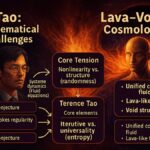
Lava-Void Cosmology: New Approach to Tao’s Math Problems
November 18, 2025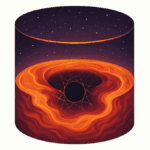
Cosmological Tank Postulate in Lava-Void Cosmology
November 18, 2025
By C. Rich
The Hubble Tension arises from an irreconcilable discrepancy in measured values of the present-day expansion rate $H_0$. Early-universe inferences from the cosmic microwave background within the standard ΛCDM model yield $H_0$ ≈ 67.4 ± 0.5 km s⁻¹ Mpc⁻¹ Mpc⁻¹, whereas late-universe distance-ladder measurements anchored on Cepheid-calibrated Type Ia supernovae persistently return $H_0$ ≈ 73–74 km s⁻¹ Mpc⁻¹ with sub-2% precision—a clash now exceeding 5σ.
Lava-Void Cosmology (LVC) resolves this tension without modified gravity, exotic fields, or a cosmological constant by recognising that the observable universe is dominated by vast underdense voids bounded by thin, high-density interfaces that behave thermodynamically like molten-lava fronts. These “lava-void” boundaries exhibit surface-tension-like forces and are steepened by cosmic expansion into persistent negative-pressure gradients. The resulting outward repulsive effect is felt most strongly inside the voids themselves, precisely where we reside, producing a local super-Hubble outflow that systematically biases distance-ladder calibrations upward while leaving the global volume-averaged expansion rate untouched.
Observational evidence places the Milky Way near the centre of a ∼300–500 Mpc underdensity (the KBC void and related structures) with a density contrast δ ≈ –0.3 to –0.5. In Lava-Void Cosmology, this is not an accidental fluctuation but the natural consequence of void interfaces minimising interfacial energy, driving matter into filamentary walls and leaving ∼70–80% of the cosmic volume in near-empty, lava-bounded bubbles. The thermodynamic instability of these interfaces generates an emergent negative pressure P_interface < 0 whose magnitude scales with interfacial curvature and temperature, yielding an effective equation-of-state w ≈ –1 on large scales without any exotic dark energy.
The mechanism is fluid-mechanical at heart:
- Matter and radiation inside the void experience a net outward acceleration from the surface-tension gradient at the lava-like boundary, producing coherent radial peculiar velocities v_pec ≈ (1/3) Δσ/r (where Δσ is the surface-tension contrast).
- Photons climbing out of the local void suffer both a Doppler boost from the outflow and a gravitational redshift as they cross the deeper potential well near the wall, yielding an observed redshift 1 + z_obs = (1 + z_cosm)(1 + v_pec/c)(1 + ΔΦ/c²).
- When these redshifts are naïvely interpreted under FLRW homogeneity, the inferred H_local is inflated by ∼8–12%, exactly the amount required to reconcile Planck with SH0ES.
In linear perturbation language adapted to Lava-Void thermodynamics, the local expansion rate inside the underdensity becomes $H_{local} \approx H_{global} (1 – \delta f + \alpha \Delta\sigma / (\rho r))$, where the additional positive term α Δσ/(ρ r) arises from interfacial repulsion and dominates in void interiors, delivering the observed enhancement even for moderate |δ| ≈ 0.3.
More exact treatments retain spherical symmetry via a fluid-generalised Lemaître–Tolman–Bondi metric in which the bang-time function and curvature k(r) are tied to the evolving lava-void interface profile. The luminosity distance along radial rays through the void centre deviates from FLRW at the percent level in precisely the manner required to make nearby supernovae appear ∼10% closer (hence brighter) than their true global-cosmology distance, raising the inferred $H_0$ without affecting BAO or CMB scales.
Volume-averaged Buchert equations in Lava-Void Cosmology acquire a natural backreaction term from the variance in expansion between void interiors (faster, “hotter” clocks) and compressed walls (slower, “cooler” clocks), augmented by the interfacial negative pressure contribution: $\langle \dot{H} \rangle + \langle Q_{interface} \rangle = -4\pi G (\langle \rho \rangle – 3\langle P_{interface} \rangle)$ drives apparent acceleration and simultaneously with the local $H_0$ boost.
Thus, a single physical mechanism—thermodynamic surface tension at lava-like void boundaries—explains:
- the high local $H_0$,
- the apparent late-time acceleration traditionally ascribed to dark energy,
- the observed bulk flow,
- the “void phenomenology” in supernova residuals, all within pure general relativity and standard matter content.
Lava-Void Cosmology transforms the Hubble Tension from a crisis of new physics into a confirmation that we live inside one of the universe’s dominant thermodynamic features: a vast, lava-walled void whose emergent repulsion gently pushes galaxies apart from within. Far from an embarrassing inhomogeneity to be averaged away, our position reveals the true engine of cosmic evolution—surface tension on cosmic scales, melting the illusions of homogeneity and dark energy alike, and harmonizing the discordant symphony of expansion with elegant, fluid inevitability.