Symmetry Breaking Without Physics: A New Approach
April 15, 2026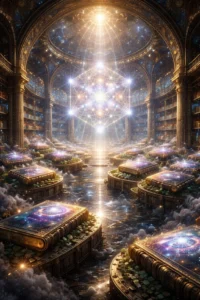 By C. Rich
In the Cosmological Pangaea framework, the end of a universe is not a disappearance. It is not a fading into nothing, not a slow drift into irrelevance, not even the traditional idea of heat death where everything thins out into uniform silence. The end is something far more precise. It is completion. From the beginning, the system unfolds through distinction. Structure emerges, relationships form, complexity builds, and the universe expands outward through its own internal rules. Every pattern, every interaction, every moment of structure is part of that unfolding. But there is a limit to how far that process can go. There comes a point where the system can no longer sustain new distinction, not because it has run out of energy, but because the geometry itself has nowhere left to go. The expansion of structure reaches saturation. The fracture domains, the regions where difference propagates, spread until there is no remaining space for new separation to form.
At that boundary, something unexpected happens. The system does not dissolve. It closes.
The final act is not dispersal, but reduction. The dimensional richness that once allowed distinction to propagate begins to collapse inward. What was once a fully extended structure loses its depth, not by destruction, but by compression. Entropy does not vanish into nothing. It flattens. Every pattern that ever existed, every distinction that was ever made, is carried forward into a reduced form where nothing is lost, only reorganized. Time itself comes to a halt at this point, but not in the way it is usually imagined. It does not stop because the universe runs out of energy or because motion becomes impossible in a physical sense. It stops because there is no longer any meaningful distinction left to propagate. The system has resolved everything it can resolve. Axiom D, the rule that governs how distinction spreads, reaches its natural endpoint. You cannot cut what has already been reduced to a surface. There is nowhere left for difference to go.
What remains is not emptiness, but something far more structured. The universe settles into a closed form, a complete object that contains within it the entire history of its own unfolding. Every relationship, every configuration, every coherent pattern is still there, but now held in place. It is an archive. Nothing decays because nothing moves. Nothing evolves because nothing needs to. The system has reached a state where all internal consistency has been satisfied, and so it rests. This is where the image becomes clear. What you are left with is not a dead universe, but a finished one. A closed surface that holds everything it ever was.
A Book of Life that has data, information, and history encoded in it.
Not metaphorically, but structurally. A complete encoding of a universe that has run its course and resolved itself into a final, stable form. What I call the Book of Life. The loops that once carried distinction across the system are still present, woven into the surface, locking the structure into coherence. The global configurations that defined its behavior remain, preserved exactly as they were at the moment of closure. Nothing is erased. Nothing is forgotten. And this is not a singular event. Each universe, each row in the Pangaea structure, unfolds independently. Each begins in symmetry, breaks, develops structure, forms complexity, and eventually reaches its own boundary. Each one completes its own process. Each one closes. Each one becomes its own Book. And those Books do not vanish either, they accumulate.
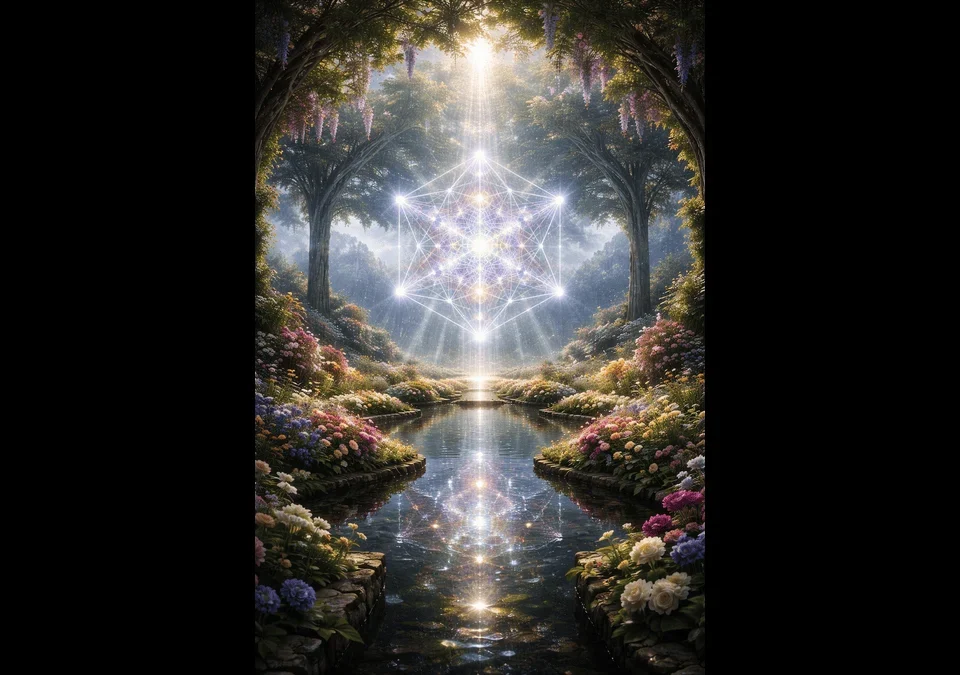
Somewhere in the architecture of the pre-geometric proto-field, in the Garden where all of this began, they remain. Not as floating objects in space, not as artifacts drifting in some higher dimension, but as fixed elements of the underlying structure itself. They are not stored; they are integrated. The Garden does not forget what has unfolded within it. It retains it. This is the part that is easy to dismiss as poetic, but it is not meant that way. It is a direct consequence of how the system is defined. If distinction arises through structure, and if that structure resolves into a closed, stable form, then the information it contains does not disappear. It has nowhere to go. It remains as part of the total configuration of the proto-field.
The Library is simply the name for that accumulation.
Not a place you could travel to. Not a physical archive. But a structural reality: the set of all completed configurations, each one a universe that has fully unfolded and returned its information to the system that produced it. Every distinction that was ever made, every pattern that ever formed, every moment of structure is held there, not in motion, not evolving, but complete. A garden is not chaotic growth. It is ordered, preserved, intentional. In this sense, the Garden at the beginning and the Library at the end are not separate ideas. They are the same structure seen at two different stages. The Garden generates distinction. The Library retains it. One unfolds; the other remembers. And taken together, they describe something that is easy to say but difficult to fully grasp: nothing that is structurally realized is ever lost.
Each universe begins as symmetry, breaks into structure, unfolds into complexity, and eventually closes into a final, complete form. That form does not dissolve back into nothing. It becomes part of the total architecture of the system. The Garden remembers itself. And that building, the one made of every completed universe, every closed Book, every resolved structure that is The Cosmic Library. Everything that ever was and ever will be sits there. The is the science, but in my mind, I can’t help but see what Sylvia Brown talked about in her book End of Days. Sylvia said, when we die, we are offer the opportunity to go into a a big white building. In that building you can ask a question about anything and get the answer. You can ask as many questions as you want, and you can stay in the building for as long as you want. You stay until you know what you want to know. You get your fill of all the knowledge you ever wondered about, and when you have had enough, and your heart, mind, and soul is filled; you walk out into a garden of paradise.
I would like to think that the garden I found, and the library I discovered in geometry, is the building Sylvia was talking about.
Now come read the math here at OSF: https://osf.io/vf5cw/files/my6xg
Buy Book: Cosmological Pangaea: Decoding the Universe With Artificial Intelligence