Elon Musk vs Sam Altman Gets UGLY… OpenAI Built AGI and Hid It? | The Late Byte with Robi
April 17, 2026
I Quoted $2,400 for This Bot. It Took Me 35 Minutes.
April 18, 2026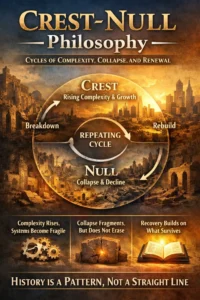 By C. Rich
OSF: https://osf.io/t8gvq/overview
https://orcid.org/0009-0007-6541-3905
The Crest-Null Ladder represents a fundamental law of structured reality: as any system grows in complexity, the price of maintaining the distinctions that define it eventually consumes the very energy that fueled its growth. This is not merely a social or economic observation; it is a scale-invariant state-variable model that applies to biological organisms, technological infrastructures, and entire civilizations. The governing metric is the ratio between the coordination cost required to keep the system’s parts synchronized and the surplus resources available to pay that cost. When this ratio approaches unity, the system enters the “Crest”, a critical threshold where it no longer expands its capabilities because every ounce of surplus is diverted toward preventing internal collapse.
The primary driver of systemic failure is the Paradox of Specialization. In the early rungs of the ladder, increasing the depth of specialization and the density of the network generates massive surplus. However, specialized nodes require an exponentially growing amount of “connective tissue”, logistics, standardized protocols, and trust, to remain integrated. Eventually, the cost of maintaining this infrastructure begins to outpace the gains of specialization. This is where the Crest-Null Distinction Axiom meets systemic theory: a system that cannot maintain its internal distinctions effectively collapses into entropy, a state defined as the “Null.”
When a system reaches Rung IV, the Crest, it becomes fundamentally fragile. At this stage, any marginal increase in stress or coordination delay can no longer be absorbed. This leads to Rung V, or Destabilization, where small, localized failures begin to cascade across the network because there is no surplus “buffer” left to dampen them. The transition into Rung VI, the “Null,” is often mistaken for a sudden catastrophe caused by an external trigger, but the model reveals that the trigger merely exposes a structural reality that was already in place: the maintenance cost had already exceeded the surplus.
Survival in a Crest-Null world depends on a strategy of Inward Null or “Strategic Descent.” This involves a preemptive reduction of coordination costs through decentralization, simplification, or the preservation of knowledge in “dormant” forms. Because the process of collapse is path-dependent, meaning it is far harder to rebuild a system than it was to maintain it, the loss of institutional memory during a fall creates a state of hysteresis. The system that re-emerges at Rung VIII is often simpler, born from the survivors who maintained low effective costs. Ultimately, the Ladder serves as a universal warning: distinction is the foundation of structure, but its maintenance is the ultimate tax on existence.