
Elon Musk’s “Macrohard” Could Actually Destroy Microsoft
December 15, 2025
Rethinking the Fermi Paradox: Lava-Void Cosmology
December 15, 2025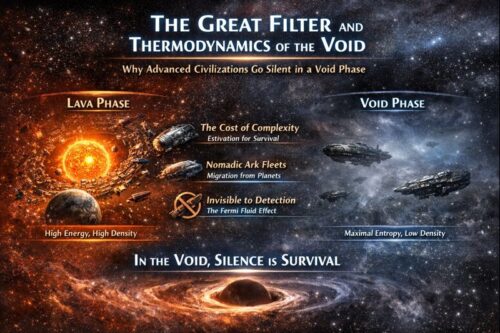
By C. Rich
The apparent paradox at the heart of the Great Filter, why a Kardashev Type II or Type III civilization would not simply engineer its way through any apparent cosmic scarcity, dissolves once scarcity is reframed correctly within the Lava-Void Cosmology (LVC) ontology. A “Void Phase” is not a temporary shortage of matter or energy amenable to technological substitution. It is a profound thermodynamic regime shift characterized by maximal entropy, extreme dilution, and low fluid viscosity. Under such conditions, the challenge facing advanced civilizations is not access to energy in principle, but the escalating energetic cost of sustaining organized complexity itself. Engineering prowess cannot negate thermodynamics; it must ultimately submit to it.
As detailed in the Planetary Science (Astrobiology) hub, void-driven viscous flows impose critical habitability phase transitions that restrict the emergence of complex life to narrow Goldilocks regimes. These same dynamics scale upward, constituting an early and ongoing Great Filter by limiting not only abiogenesis but also the long-term persistence of technological societies in low-density environments.
The Great Filter is therefore not primarily a catastrophic event but a survivability threshold imposed by entropy scaling. As formalized in the Entropy Spine framework (Hub 16: Entropy and the Arrows of Time), which unifies thermodynamic, cosmological, and informational irreversibility, the energetic cost of maintaining complex information structures, cities, computation, communication networks, and large-scale astroengineering scales inversely with environmental fluid density. In a Void Phase, the substrate that allows complexity to remain coherent thins dramatically. Information becomes prohibitively expensive to stabilize, and every additional bit of structure accelerates entropic decay rather than resisting it. Growth ceases to be adaptive; expansion becomes thermodynamically lethal.
This leads to the first reason we do not observe advanced civilizations: the prohibitive cost of complexity. A sufficiently advanced civilization does not collapse or go extinct in a Void Phase; it contracts. It abandons the logic of perpetual expansion and enters an optimized, low-energy state analogous to biological estivation. Computation slows, communication is minimized, and social complexity is compressed into high-efficiency, low-noise forms. The goal shifts from dominance or visibility to persistence. From a thermodynamic standpoint, silence is not cultural withdrawal; it is optimal survival behavior.
Terrestrial history provides empirical analogues for such contraction dynamics. As explored in the Human History hub (Hub 3), genomic archives reveal repeated civilizational cycles punctuated by severe bottlenecks, Toba, Younger Dryas, and demographic collapses, where environmental and resource stresses forced contraction, simplification, and long periods of low-visibility persistence rather than continuous growth. These events serve as microcosmic proxies for the cosmic-scale thermodynamic constraints imposed by Void Phases.
The second implication is structural. Planetary surfaces, even heavily engineered ones, are intrinsically vulnerable in a Void Phase. They depend on localized energy gradients and stable material cycles, both degraded by low-density, high-entropy environments. Long-term survival, therefore, requires detachment from fixed planetary systems. The result is a nomadic mode of existence: compact ark fleets designed for maximum thermodynamic efficiency, minimal dissipation, and indefinite stability. As outlined in the Accelerated Nomadic Propagation hub (Hub 14), such fleets exploit navigable cosmic currents to achieve extrasolar arrival within achievable 22nd-century roadmaps, prioritizing mobility and compactness over accumulation and sprawl. Dyson swarms or stellar-scale infrastructure become thermodynamically irrational; they are abandoned in favor of low-signature, high-resilience configurations.
The third and most decisive factor is observability bias. Current SETI strategies implicitly assume advanced civilizations advertise their presence through excess energy use, infrared waste heat, megastructures, or persistent electromagnetic signaling. Yet nomadic, estivating civilizations are engineered precisely to avoid such signatures. Their thermal footprints are negligible, emissions intermittent or absent, and operational timescales may extend far beyond human observational windows. To our instruments, they remain indistinguishable from background noise or empty space.
A further mechanism mitigating the Filter’s severity emerges from the 3I-Atlas forensic analysis (Hub 15), which resolves all ten major cosmic anomalies through biophilic synthesis. Interstellar objects may function as guided biophilic carriers, enabling the directed propagation of life and information across voids. This suggests the Filter is permeable: intelligence can seed new Lava Phases, ensuring continuity even during dominant Void regimes.
Taken together, these dynamics produce the “Fermi Fluid” effect. Civilizations are not uniformly distributed across time and density states; they flow between phases, expanding during transient, high-density Lava Phases when energy dissipation and communication are thermodynamically favorable, and contracting during the far more common Void Phases. We observe only those civilizations temporarily in high-flux states, rare, evolutionarily unstable windows. The prevailing state for long-lived intelligence is contraction, silence, and patient waiting.
In this light, the Great Filter is not a singular barrier behind or ahead of us, but an ongoing thermodynamic sieve that continuously selects for humility and efficiency. Advanced civilizations survive not by overpowering the Void, but by yielding to it, conserving structure until the next Lava tide permits renewed expansion. The silence we observe is not absence. It is patience, optimized by the inexorable laws of fluid cosmology.
| Great Filter Stage | LVC Mechanism | Relevant Hub |
|---|---|---|
| Habitability Threshold | Void-driven phase transitions restrict complex life | 4. Planetary Science (Astrobiology) |
| Entropy Scaling & Cost of Complexity | Inverse density scaling of information stability | 16. Entropy and the Arrows of Time |
| Contraction Cycles | Terrestrial analogues in demographic bottlenecks | 3. Human History |
| Nomadic Adaptation | Compact, mobile ark fleets using cosmic currents | 14. Accelerated Nomadic Propagation |
| Propagation Across Voids | Guided biophilic carriers in interstellar objects | 15. The 3I-Atlas |
| Observability Bias | Low-signature estivation in Void Phases | Master Hub (0) & All |
C. Rich